Brick Builders Language Camp
Three days of writing and comprehension, built as a Minecraft-styled camp
- Structure
- 3 days, about 90 minutes each
- Routines
- 5, named and reused throughout
- Drill gym
- Job, punctuation, run-ons, transitions
- Print pack
- 6 passages, mock paper, marking sheet
- Views
- Learner, progress, parent, print
- Built for
- Browser and paper, offline
What this case study claims
Design decisions, intended behaviour and the reasoning behind them, plus counts verified against the built product. It does not claim learner outcomes, adoption or improvement: those have not been measured, and describing an intention as a result would be the easiest thing on this page to get wrong.
Overview
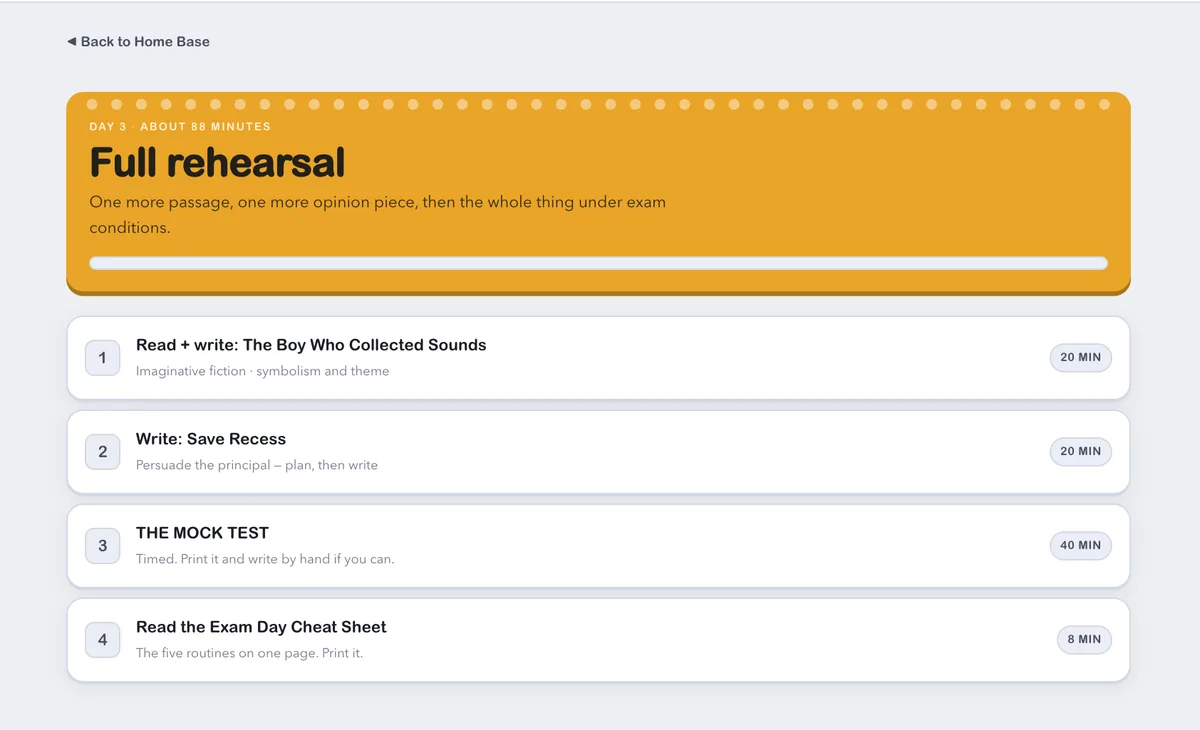
A three-day language camp for children sitting a written entrance test, built in a Minecraft visual register — blocks, levels, experience points, a day streak. Each day runs about ninety minutes and moves from learning a shape, to using it under prompt conditions, to a full timed rehearsal. Underneath the styling sit five named routines that recur on every task, a drill gym for the four things that cost the most marks, original reading passages with typed comprehension questions, a print pack because the real exam is handwritten, and two reporting views — one for the child and one for the adult beside them.
Problem
Entrance-test preparation is usually a stack of past papers. A child does one, gets a score, and learns almost nothing from it: the score says how they did but not which skill failed, and the next paper repeats the same gap. The second problem is medium. The test is handwritten and timed, and a child who has only ever typed answers into a screen is rehearsing the wrong act.
Audience
A child of about eleven preparing for a written entrance exam, and the parent sitting next to them who needs to know what to work on tonight without marking anything themselves.
My role
- Instructional design — the three-day arc and the five routines that hold it together
- Content authoring — the passages, the comprehension questions by type, and the writing prompts
- Assessment design — accuracy by question type, and the rule that decides what to fix first
- Interaction design — the camp structure, the drill gym, the two reporting views
- Front-end build — a browser app with a paper counterpart generated alongside it
Goals
What the design set out to achieve. These are objectives, not results.
- Report by skill rather than by score, so a low mark points somewhere
- Name the routines, so a child has something to do when a blank page arrives
- Rehearse on paper, because the real test is handwritten
- Give the parent a view without asking them to mark anything
- Keep it playable enough that a child returns on day two
How it works
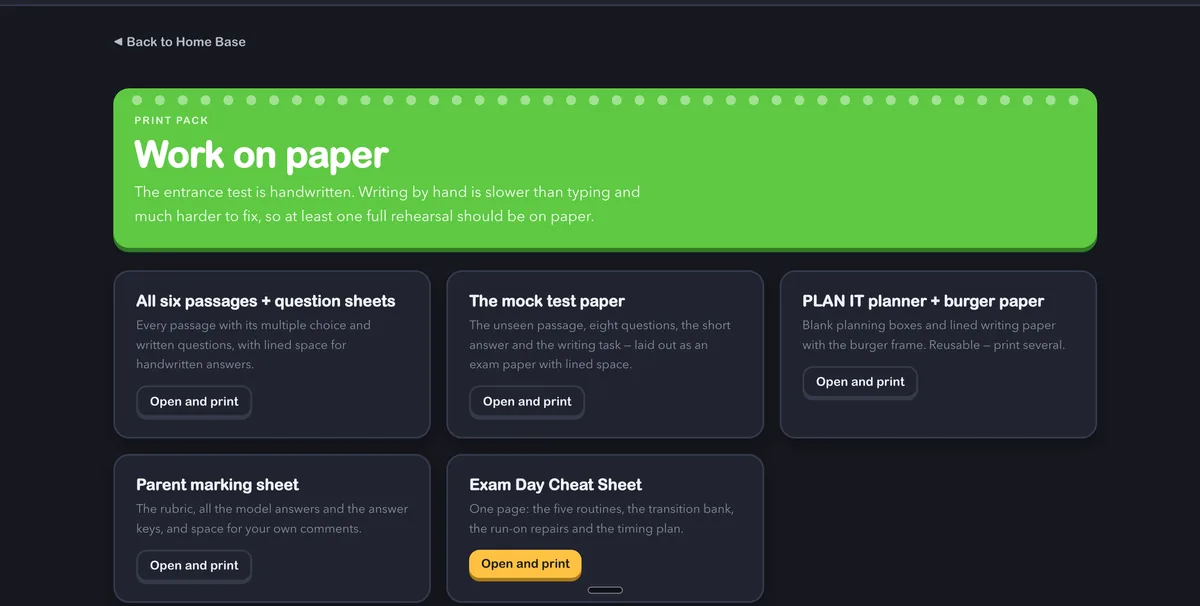
A single browser app with routed views — the three days, the drill gym, progress, the parent dashboard and the print pack. Each task records the question type it tested, not just right or wrong, so the progress view can rank weaknesses instead of averaging them. The print pack renders the same passages and prompts as paper: lined answer sheets, planning boxes, a mock paper laid out like the real one, and a marking sheet with the rubric and model answers for the adult.
Design decisions
Five routines, named and reused
What’s it asking · Plan it · Burger paragraph · One idea, one sentence · CUPS check. The same five appear on every task and on the one-page cheat sheet, because a child under exam pressure needs a procedure to fall back on, not a principle.
Accuracy by question type, not a total
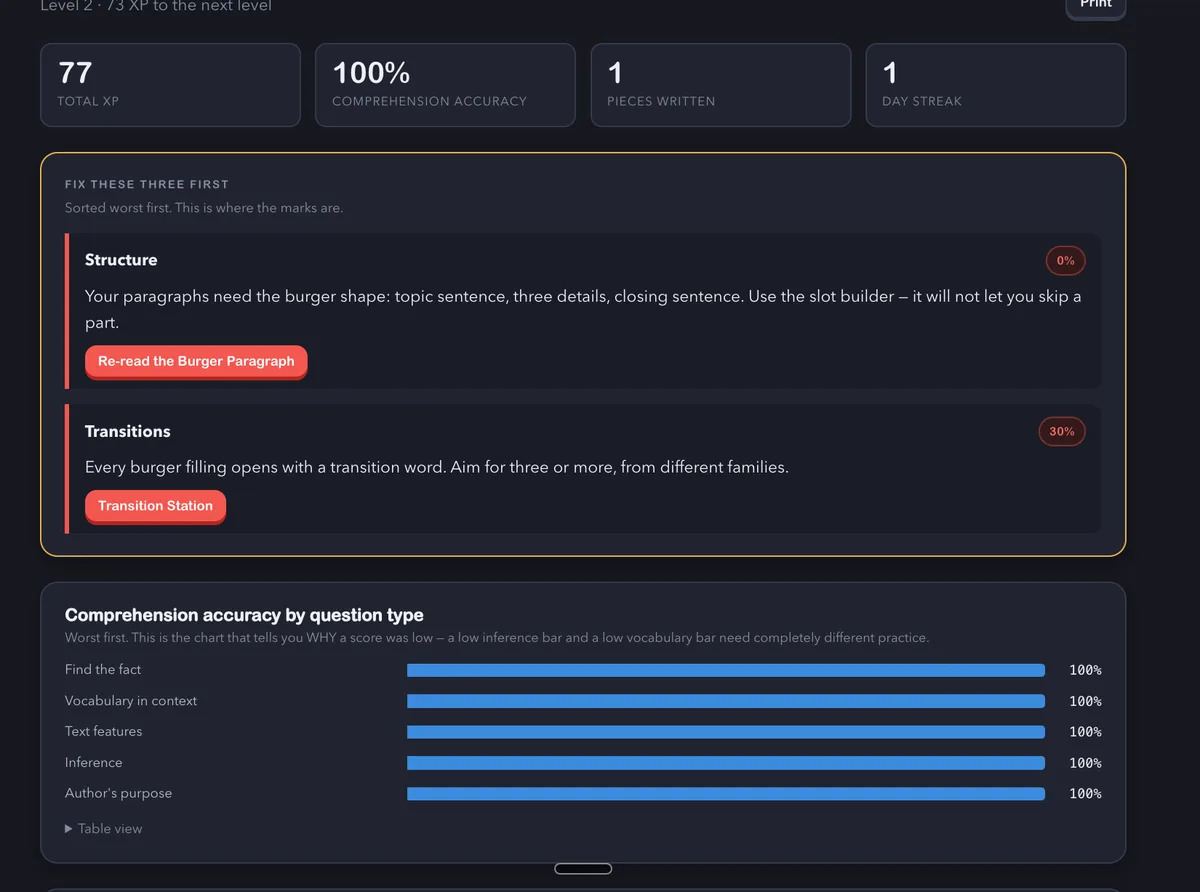
The progress view breaks comprehension into find the fact, vocabulary in context, text features, inference and author’s purpose. As the page itself says, a low inference bar and a low vocabulary bar need completely different practice — an average hides exactly the thing worth knowing.
Fix these first, sorted worst
The report does not list everything. It names the two or three weakest skills, in order, and puts a button beside each that opens the drill for it. The diagnosis is only useful if the next step is one tap away.
The rehearsal is on paper
The exam is handwritten, so the print pack is not a bonus. Writing by hand is slower and much harder to revise, and a child who has only typed has not practised the actual task.
A parent view that asks nothing of the parent
Both learners side by side, every answer they have written, and a marking sheet with the rubric and model answers. The parent can see what happened without becoming the teacher.
AI’s role
Drafting passages and question sets against a specification — question type, difficulty, and the skill each one is meant to test — and generating the paper counterpart of every screen so the print pack and the app cannot drift apart.
Human judgment
Which five routines are worth naming, out of the twenty a writing course could teach. Whether a passage is genuinely funny to an eleven-year-old, because a bored reader answers comprehension questions badly for reasons that have nothing to do with comprehension. Which distractors represent real misreadings. And the decision to report by skill and rank the weaknesses — the thing that turns a score into an instruction.
Experience
Shown from the outside only
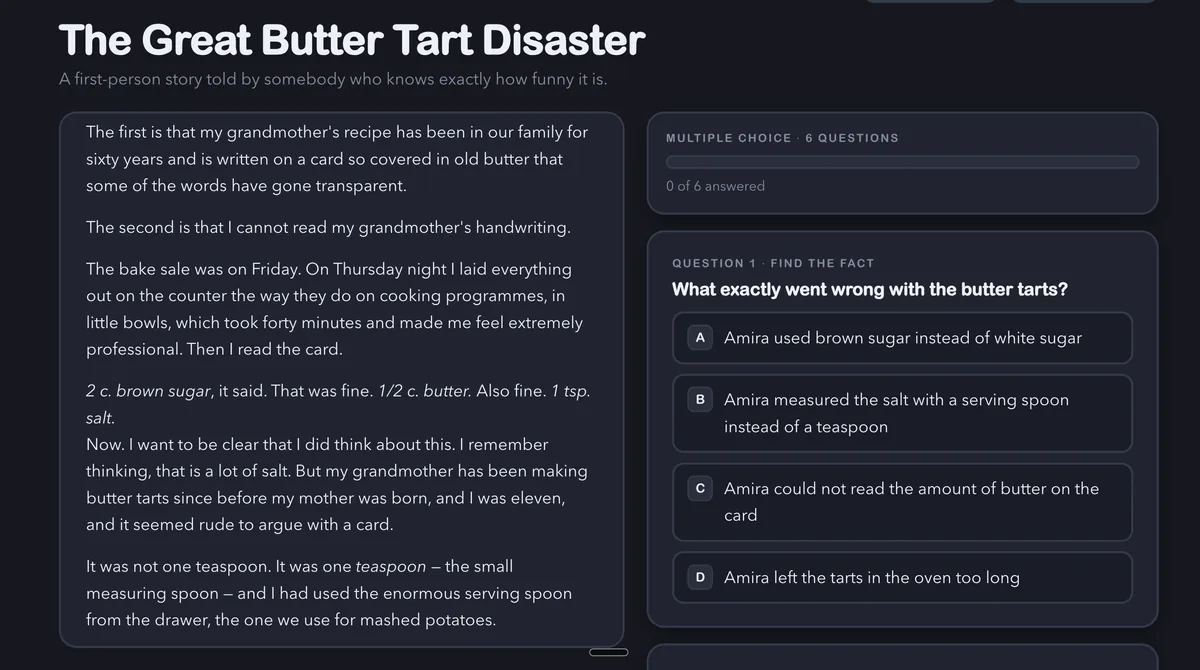
This unit is a paid product, and the teaching material is the product. What follows shows its front door and describes its architecture in words. No lesson pages, printables, assessments or games are reproduced, and no screenshot here contains text a reader could re-type and use.
Challenges
Keeping the game layer honest. Experience points and streaks make a child come back on day two, but the moment the reward becomes the point, they optimise for the reward. The progression is tied to work completed rather than to marks scored, so a bad day still counts as a day done.
Iteration
The progress view came last and changed the shape of everything before it. Once the tasks recorded question type rather than score, the report could say which two skills to fix, and the drill gym existed to answer it — the drills were built because the diagnosis needed somewhere to point.
Reflection
Built for two children preparing for a specific test, which is why it is shown rather than sold. It is the clearest example here of a whole tutoring product: teaching, practice, diagnosis, remediation and a parent view, with a paper edition of all of it. Names and the school have been changed or cropped out of every image on this page.
Skills demonstrated
- Instructional design for test preparation
- Comprehension assessment by question type
- Diagnostic reporting and remediation routing
- Original passage and question authoring
- Parallel screen and print publishing
- Interaction design for children