Mamta Motwani

Education

Four learning environments, not a folder of files.

The classroom work in this portfolio is organised as products, because that is what it is. Each one carries the full stack — the expectations it is mapped to, the planning, the instruction, the practice, the games, the visuals, the assessment and the resources for the adult — and each is built by the same production system, which checks it before it ships.


The honest numbers

I have produced 93 learning resources. Only 24 of them are the interactive web products described on this page; the rest are print and slide material — real resources, and widely used, but not builds. Everything counted below is from the 24, verified against the files on disk.

That back catalogue is where the range sits rather than the architecture: a 50-test assessment matrix covering all ten Ontario mathematics strands across Grades 1 to 5, daily writing and mathematics routines built undated so the same file is reusable every year, and a Grade 10 exam review for MPM2D. They are named here because the range is real and worth stating — Grade 1 through Grade 10, and every elementary mathematics strand. They do not get pages of their own because a flat PDF has no design decisions to show, and a portfolio should be judged on the work that does.

Interactive web products
24Interactive web products
Distinct pages
1,197Distinct pages
Games
120Games
Print sheets
686Print sheets
Slide decks
90Slide decks

The learning environments

Professional ProjectOntario Grade 3 · nine units · 629 pages

Grade 3 Mathematics Digital Learning Environment

Nine units of mathematics built as a single environment rather than as a worksheet pack, and aimed at the adult sitting with the child rather than at a teacher with a class. Unit 1 is free and complete.

What it contains
Curriculum expectations
Mapped to Ontario Grade 3 across nine units: place value, addition and subtraction, multiplication and division, fractions, patterning, algebra and coding, measurement, area and perimeter, and data.
Planning
A scripted first ten minutes at the front of every unit — one game, one question, one sheet, timed — so a family can start without deciding anything.
Instruction
Six interactive Learn pages per unit, each carrying one idea and stopping there.
Interactive practice
Questions made fresh each round rather than drawn from a fixed bank: seven of ten activities produce genuinely new questions each time, so replay is practice rather than recall.
Games
85 across the series, eight to ten per unit, each built to about three minutes.
Multimedia
Interactive manipulatives and demonstrations, including a base-ten tool that shows two quantities changing at once.
Assessment
A Check per unit with no score and one attempt, every item tagged to a skill, and a report written for the adult that names what to do next.
Teacher and family resources
43 to 45 printables per unit with answer keys, talk cards, a twelve-item challenge set, a device-local progress store, and a grown-ups page that explains why rather than what.
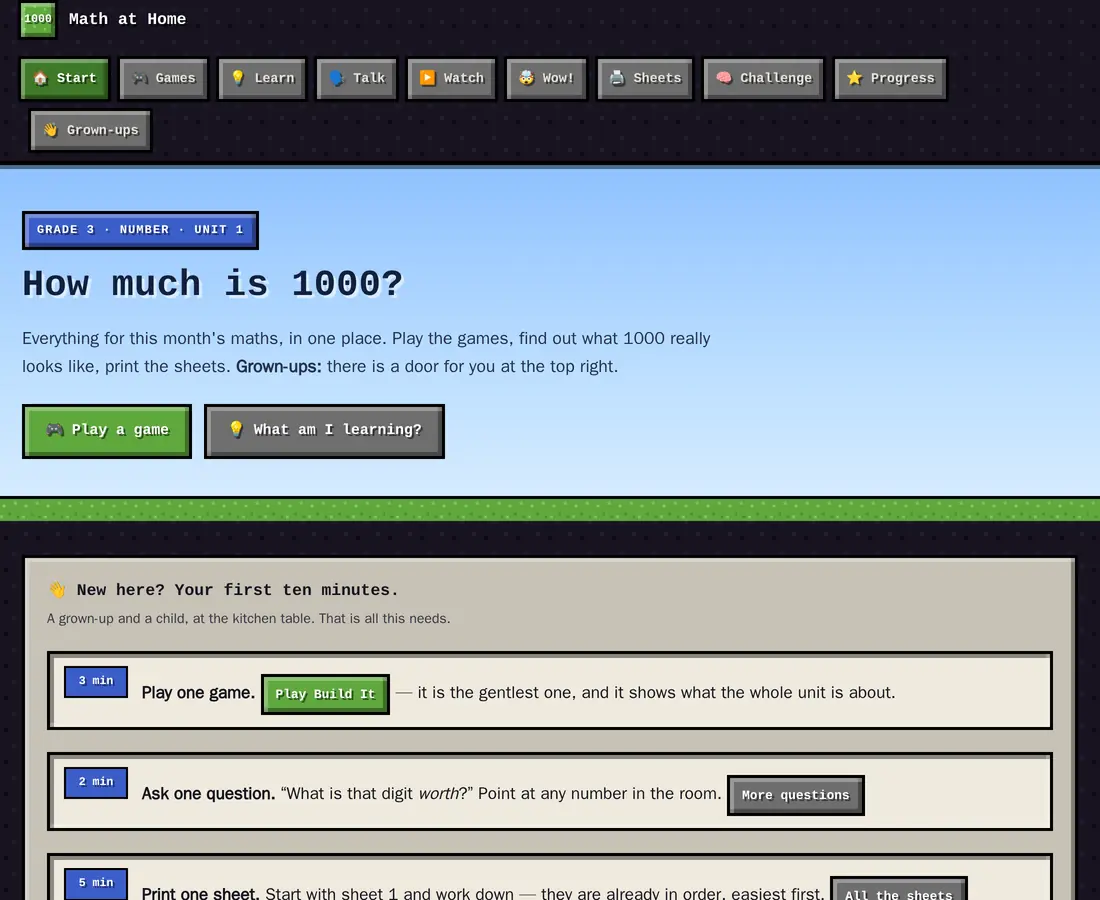
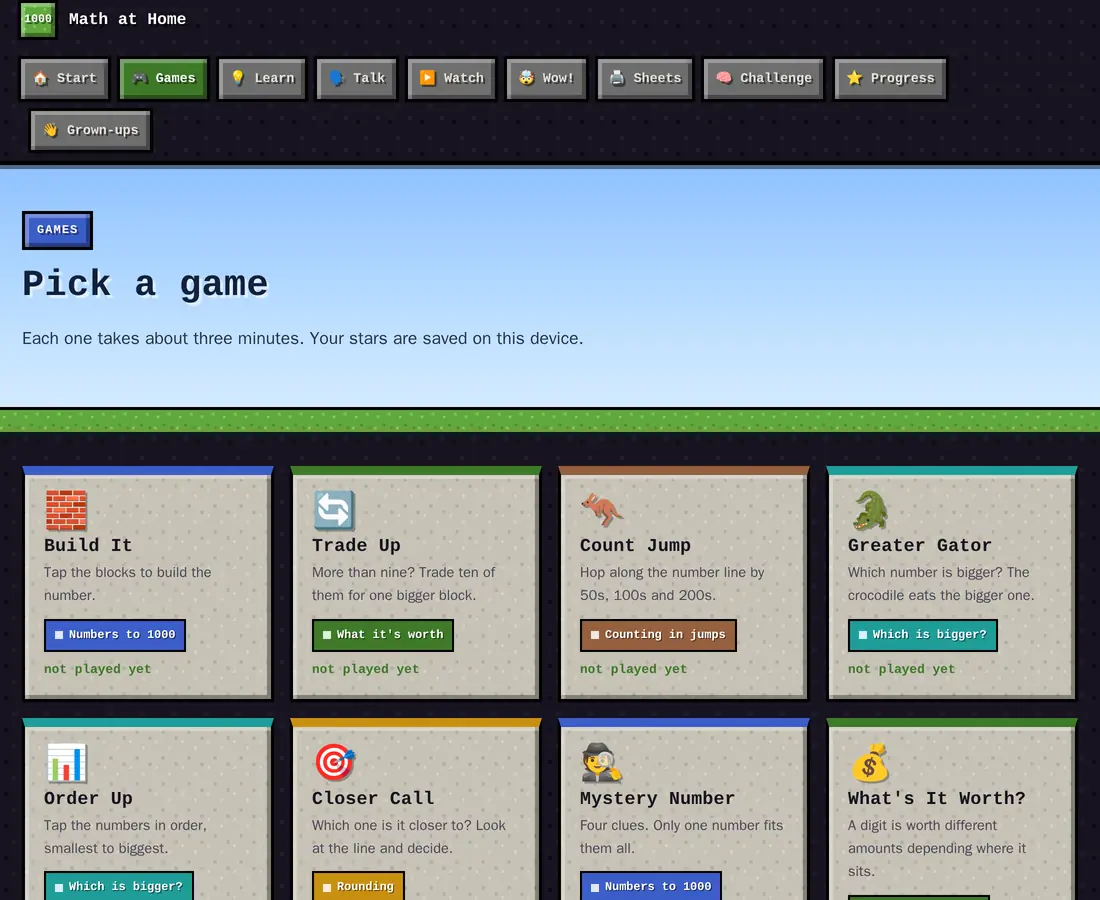
Math at Home unit home page
The front page is written for the adult, not the child
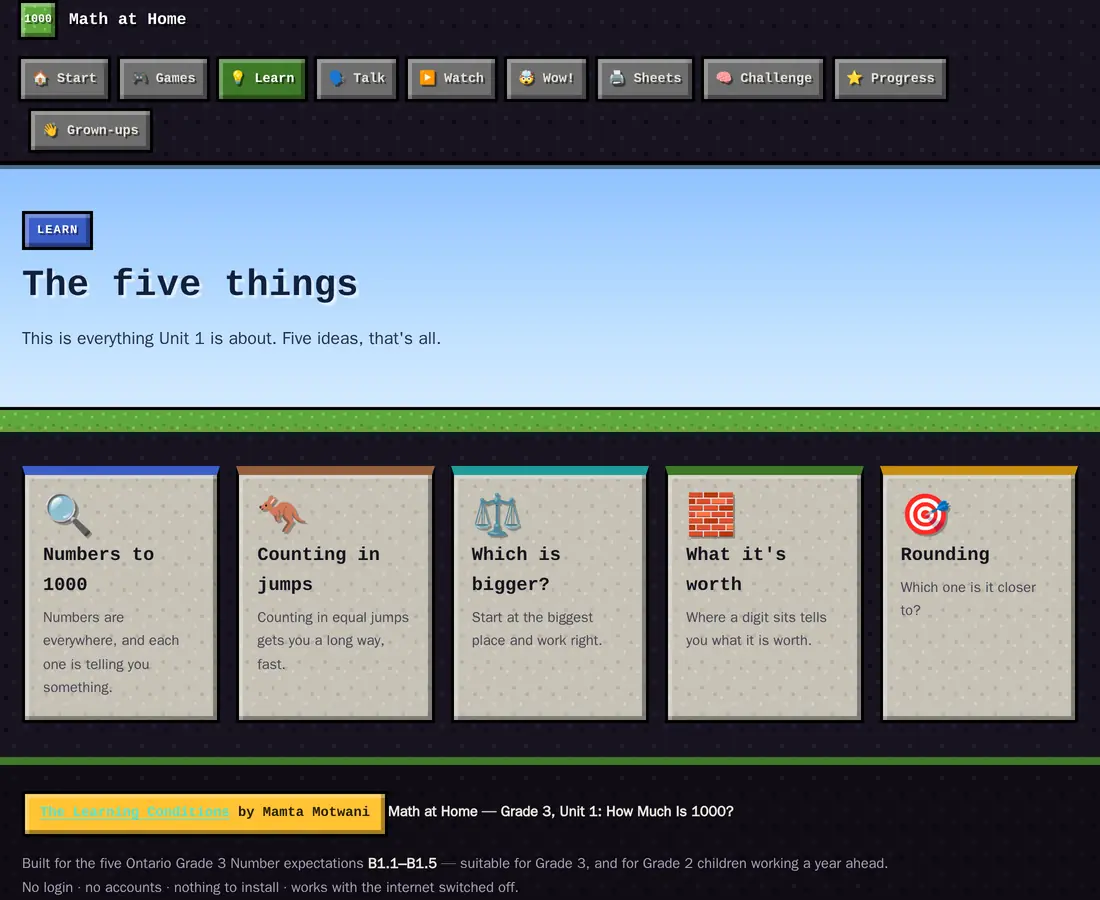
The games index for a Math at Home unit
Eight three-minute games per unit
The Learn section explaining one idea
Professional ProjectOntario Grade 3 · four units · 366 pages

Grade 3 Science Programme

All four Grade 3 science strands, built around an assessment system rather than around a set of activities. Unit 1, Growth and Changes in Plants, is free and complete at 107 pages.

What it contains
Curriculum expectations
All four Ontario strands, quoted rather than paraphrased — and a page that names the two expectations the programme does not carry, with a note on where they would fit.
Planning
50 lessons sequenced across four units, each timed, with the assessment trigger stated on the plan.
Instruction
50 scripted lessons carrying learning goal, success criteria, differentiation and teacher moves.
Interactive practice
32 games, built to consolidate vocabulary and process rather than to score.
Multimedia
50 visual decks rendered as real web pages rather than embedded slide files, with every diagram drawn in code so it is consistent, correctable and licence-clean.
Assessment
16 instruments — one product, one observation, one conversation and one quiz per unit — released by finishing a lesson rather than by a date, each with exemplars at three levels.
Teacher resources
190 printables, an assessment trigger card, weighting guidance, and a collected-not-graded table that says what to look at and deliberately not mark.
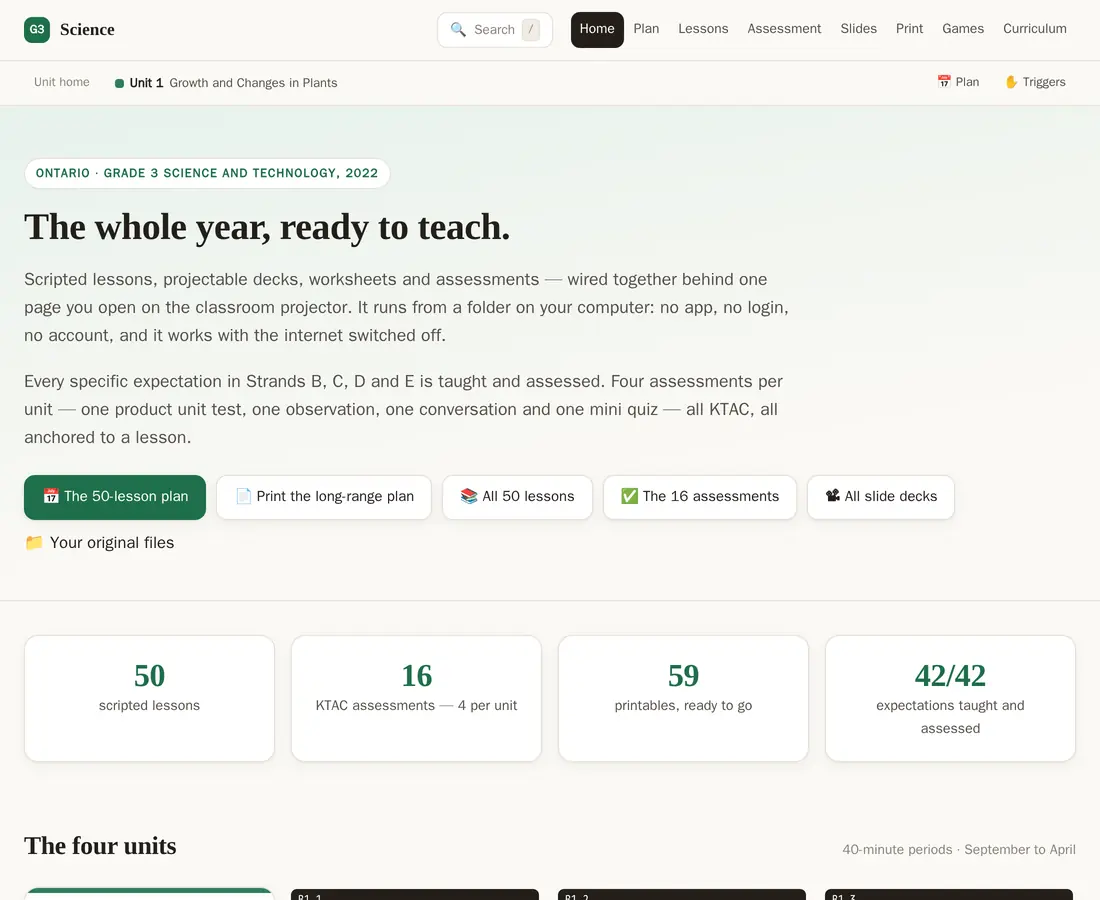
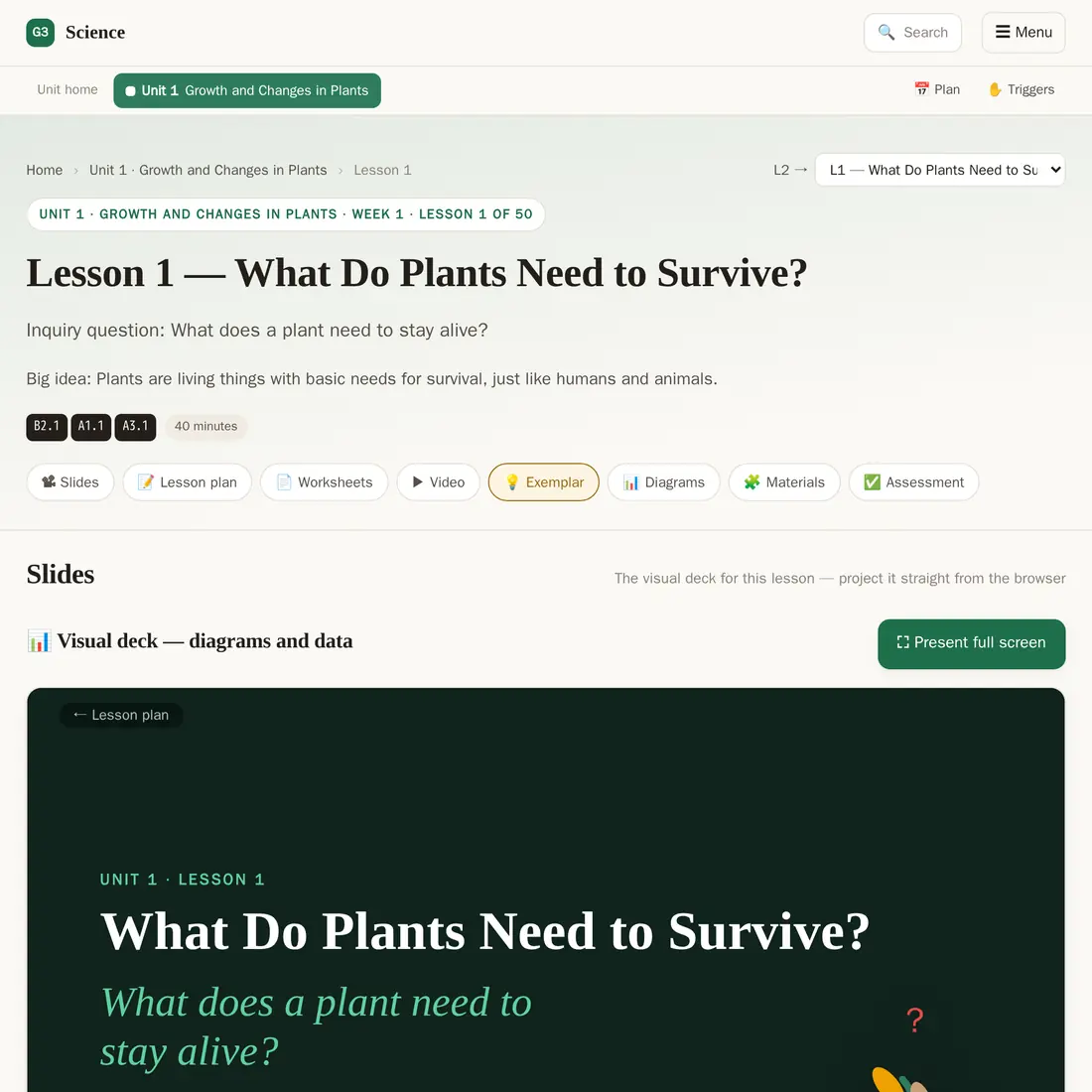
Science unit home page
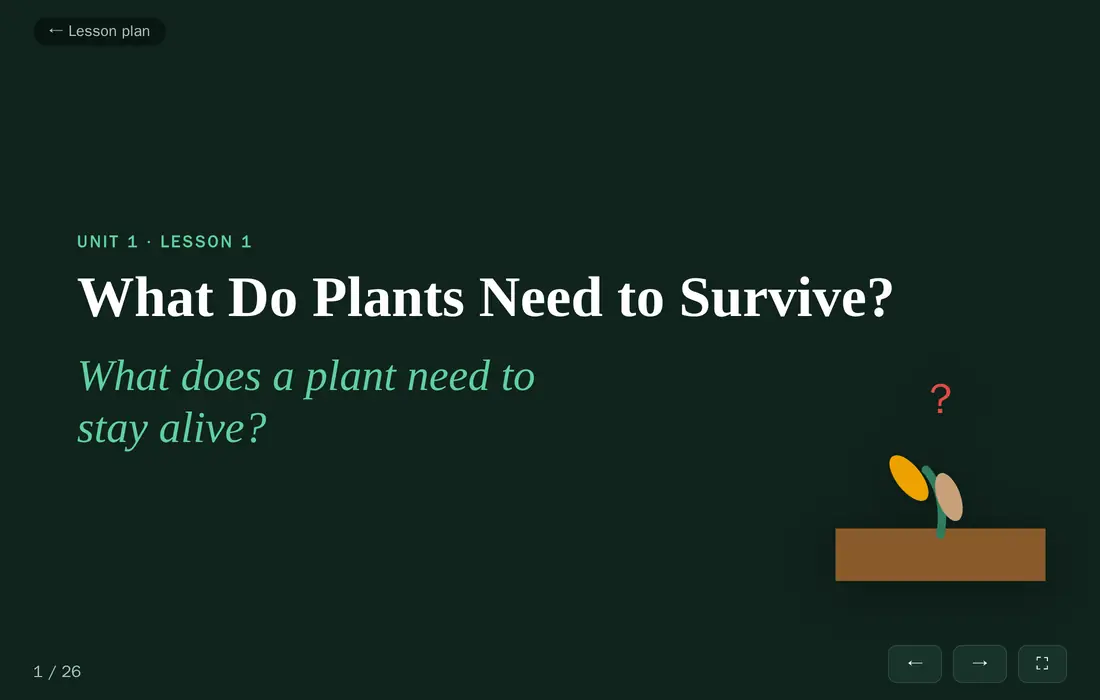
A Grade 3 science lesson slide
Slides drawn in code rather than sourced as photography
A timed and sequenced science lesson plan
Every lesson is timed and sequenced
Professional ProjectOntario Grade 2 · Strand A · 191 pages

Grade 2 Social Studies — Heritage and Identity

A complete Strand A unit designed backward from a nine-lesson Identity and Heritage Museum, whose exhibits are curated from artefacts the children made in earlier lessons.

What it contains
Curriculum expectations
All 17 Strand A expectations reproduced in the Ministry’s wording and tied to the lessons that meet them.
Planning
The culminating performance is fixed first and the 40-lesson sequence is built to supply it, so each lesson has a reason to exist that can be pointed at.
Instruction
40 lessons scripted to the minute, with goals, criteria, differentiation and the verbatim expectation on the page.
Interactive practice
8 games, working offline with nothing to install.
Multimedia
40 projectable decks, generated from the same lesson definition as the plan so the two cannot drift.
Assessment
10 assessments on one shared frame, plus the nine-lesson museum as the culminating performance.
Teacher resources
91 printables, and a localisation pass that turns every place-specific reference into a slot for the teacher’s own community.

This unit is a paid product, and the teaching material is the product. It is described here and shown only from the outside — no lessons, printables, assessments or games are reproduced.

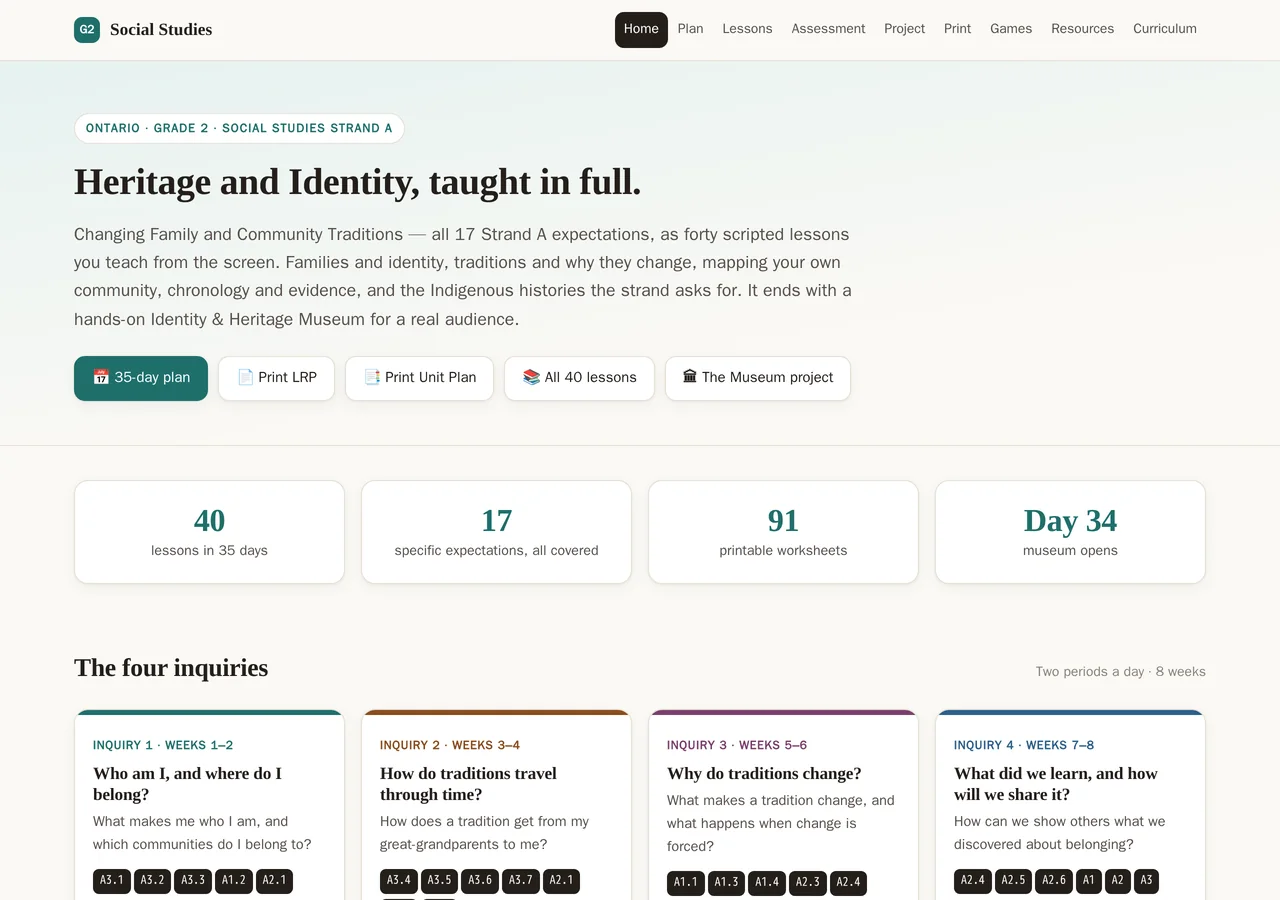
Heritage and Identity unit home page
The front door: buyers open the unit in a browser with a code from their download. Nothing inside is reproduced here.
Professional ProjectGrades 2 to 4 · nine single-page tools · free

Classroom Tools

Nine tools that each do one thing and explain themselves on the same page. Every one is free, openly linkable, and usable within ten minutes of finding it.

What it contains
Curriculum expectations
Each tool sits on a single Ontario expectation and does not stray from it.
Instruction
A short note to the adult on every page: what the idea is, and what children typically get wrong about it.
Interactive practice
Sorting and matching sheets that put the tool to work rather than describing it.
Multimedia
Built to be projected on a board and printed on the same page, without a separate version for each.
Teacher resources
Answer keys where they are needed, and a parent guide on the talk-card sets.
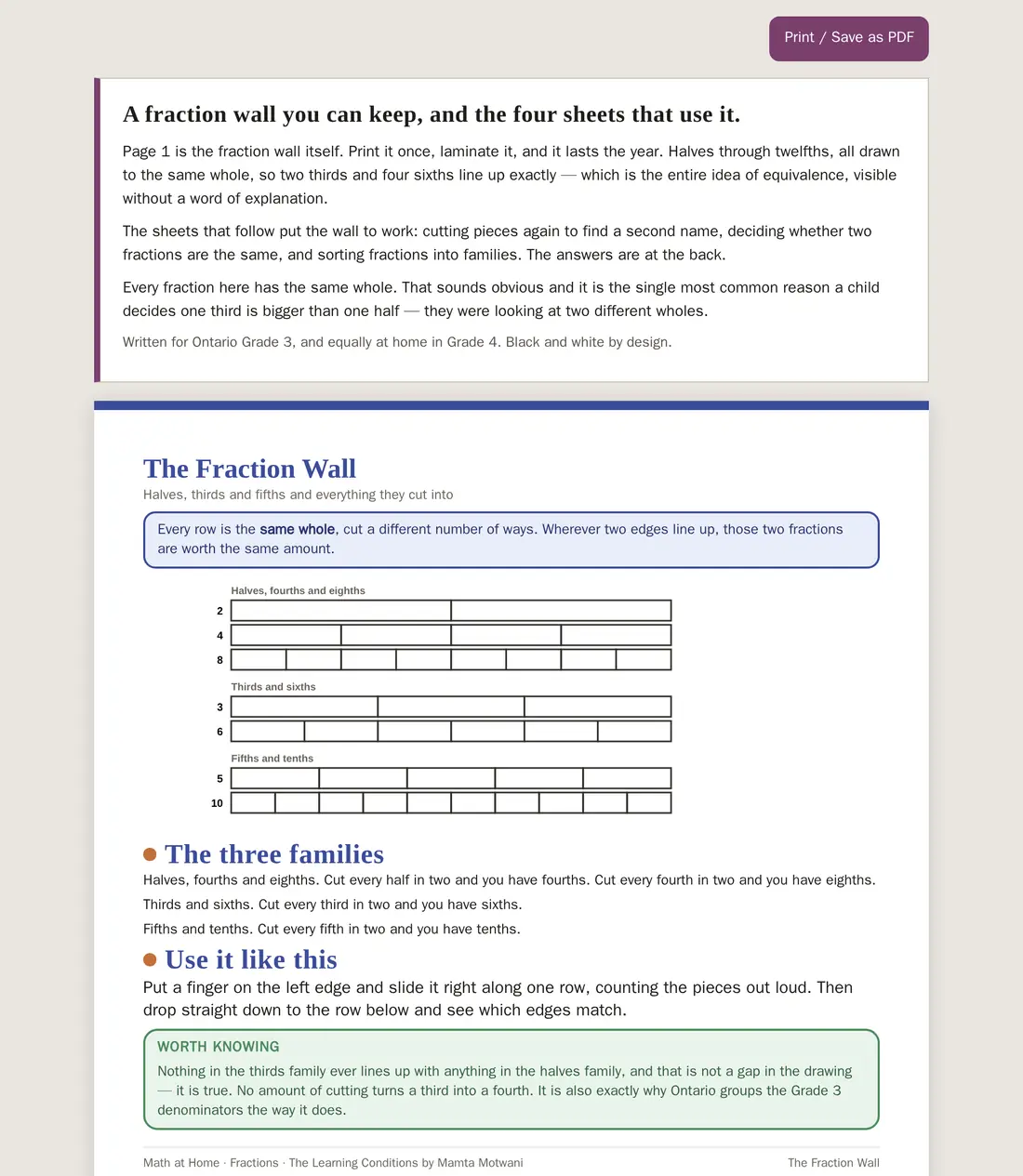
Fraction wall and equivalent fractions
Every fraction family drawn against the same whole
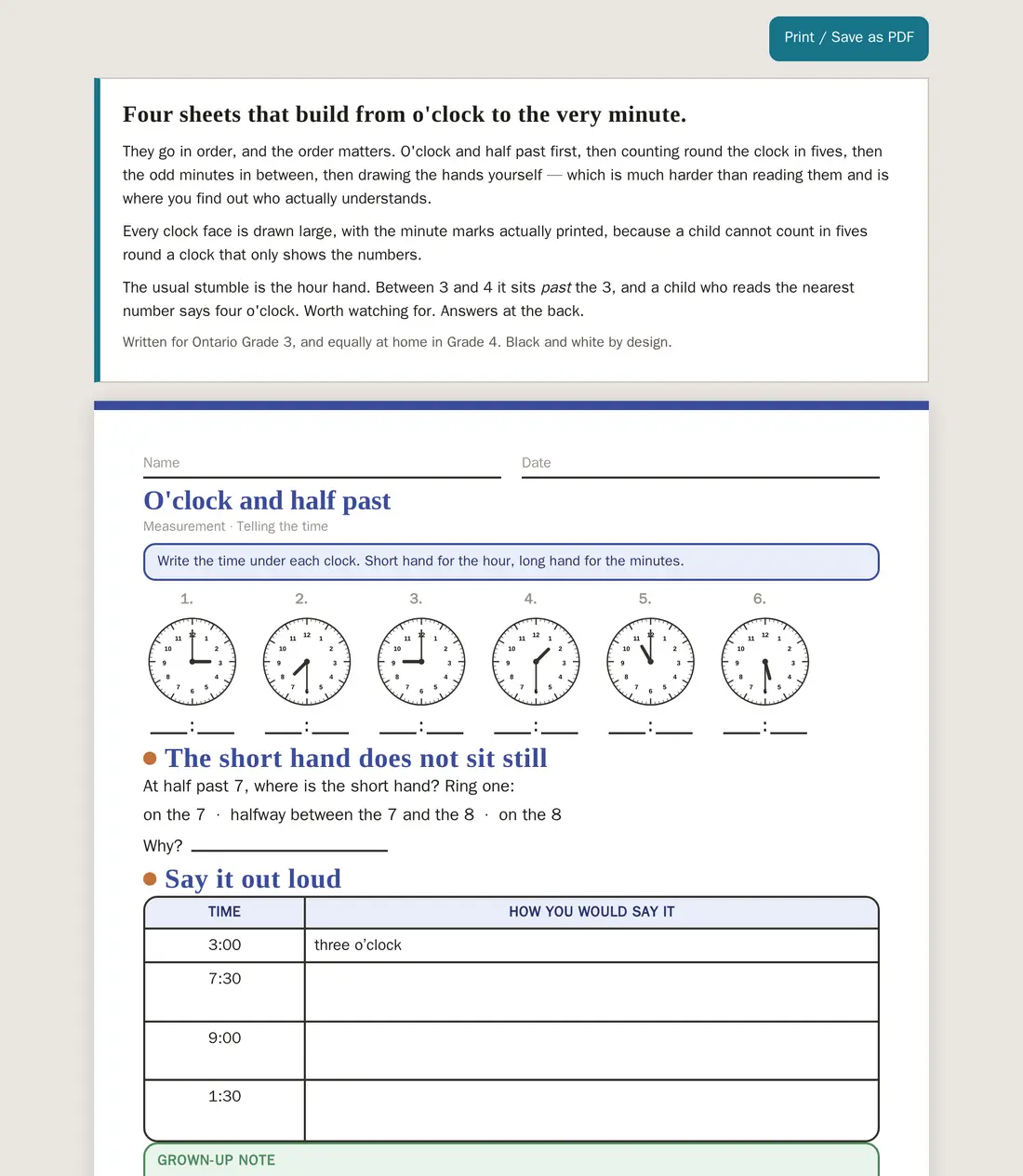
Telling time to the minute
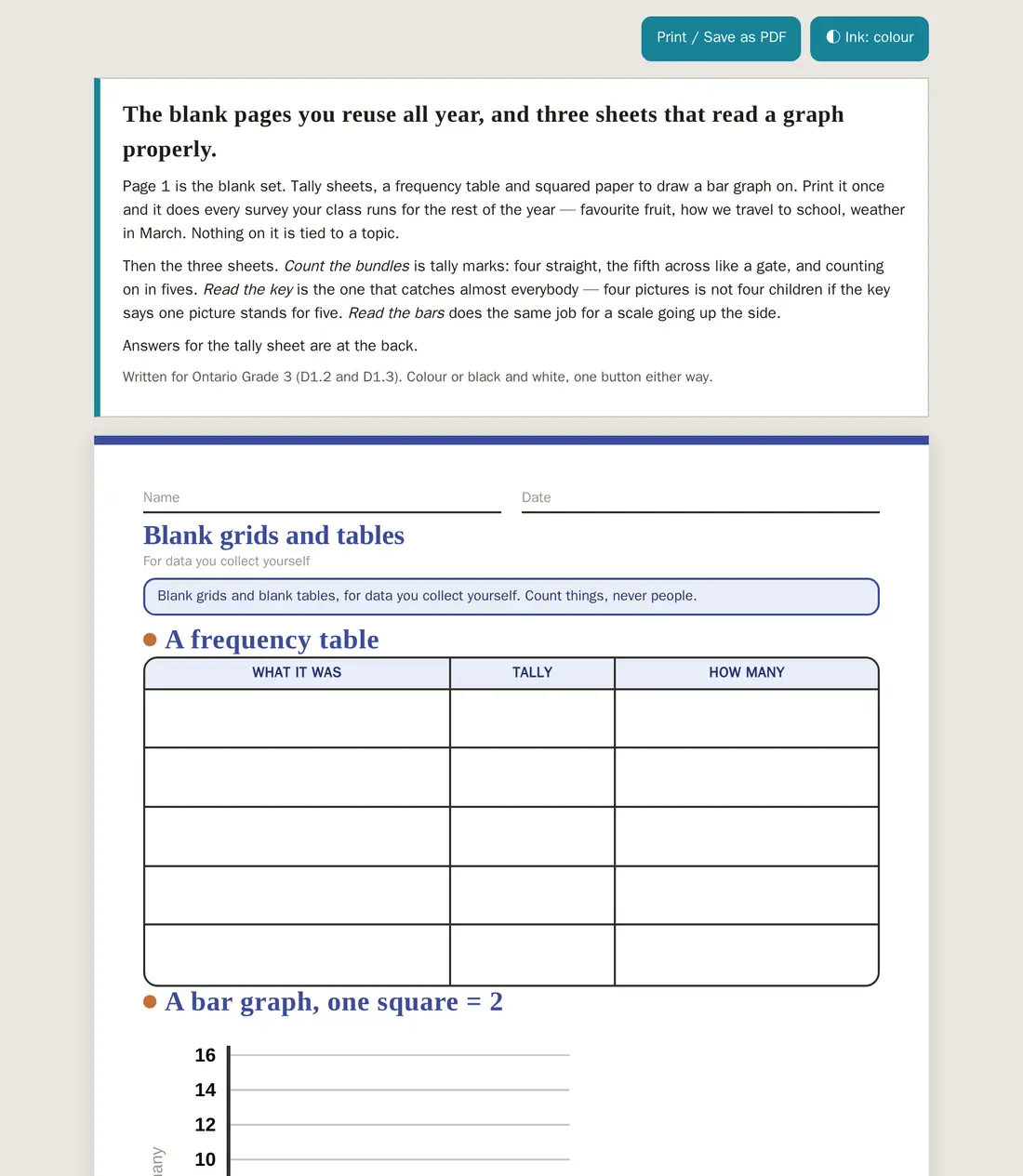
Tally, pictograph and bar graph starter set

What builds and checks all four

None of these are assembled by hand. Each is generated from a content model, checked against curriculum rules written as executable tests, and then served without asking anybody for an account.

Systems

Curriculum QA Suite

61 checks that run against the shipped HTML, including a grade-level ceiling enforced on the actual output. A failure stops the release.

Systems

Hosted Delivery Platform

24 products opened as a website with no accounts, no passwords and no personal data held anywhere — and 83 sold releases locked read-only so nothing can change under a buyer.


Why they are built this way

The games run to about three minutes, the sheets print in black and white, the guidance for adults explains why rather than what, and the Check has no score. Those are not four separate preferences. They follow from a published framework: The Learning Conditions — a child must be able to start alone, be wrong at no cost, and have an adult nearby who knows what to say next.