Heritage and Identity
A Grade 2 social studies unit built backward from its culminating task
- Pages
- 191
- Lessons
- 40, minute-scripted
- Culminating task
- 9-lesson Museum project
- Curriculum
- Ontario Grade 2
- Status
- Complete, live
What this case study claims
Design decisions, intended behaviour and the reasoning behind them, plus counts verified against the built product. It does not claim learner outcomes, adoption or improvement: those have not been measured, and describing an intention as a result would be the easiest thing on this page to get wrong.
Overview
Forty scripted lessons for Ontario Grade 2 Social Studies, Strand A — Changing Family and Community Traditions — published as a 191-page offline website. Alongside the lessons sit 40 projectable decks, 91 printables, 8 games, 10 assessments on a single knowledge / thinking / application / communication frame, and a curriculum map that quotes all 17 Strand A expectations word for word. The unit ends in a nine-lesson Identity and Heritage Museum whose exhibits are curated from artefacts the children already made, in Lessons 2, 3 and 4, 16, 17, 23 and 30.
Problem
Heritage units reach teachers as a set of activities with no stated sequence and no defined endpoint. Because the culminating task is not fixed at the start, it gets planned late and runs as a standalone craft week with no connection to the ten weeks before it. Work the children produced in October contributes nothing to it. The cost is a unit that fills classroom time without accumulating into anything a teacher can assess. The requirement was a unit where the final task is specified first and every lesson before it produces material that task consumes.
Audience
Grade 2 classroom teachers working to the Ontario curriculum — including teachers meeting Strand A for the first time, and anyone who has to pick a lesson up cold and run it that morning.
My role
- Curriculum architecture — the unit structure, the culminating performance and the sequence that feeds it
- Lesson writing — all 40 lessons, scripted with timings, teacher moves and differentiation
- Assessment design — 10 assessments on one shared frame, with the criteria written for children
- Interaction and visual design — the site, the decks, the printables and the eight games
- Production design — one definition per lesson, so the lesson page, the deck and the printables cannot drift apart
Goals
What the design set out to achieve. These are objectives, not results.
- Design backward from a culminating performance so that every earlier lesson has a reason to exist
- Script each lesson closely enough that a teacher can run it without preparation the night before
- Put the verbatim expectation beside the lesson rather than in an appendix nobody opens
- Make the unit localisable, so the community studied is the buying teacher’s own
- Ship as offline HTML that opens on a locked-down school device with no network and no install
How it works
Each lesson is defined once rather than written three times. Its learning goal, success criteria, minute-by-minute timings, differentiation notes, verbatim expectation and assessment note live in one place, and the lesson page, the projectable deck and the printables all come from that one definition. Three artefacts, one source, so they cannot say different things after a revision. The unit is delivered as a folder of ordinary web pages that opens from a file, a memory stick or the hosted copy — no install, no accounts, nothing that breaks when a school network blocks a domain.
Decided first
Identity and Heritage Museum
A nine-lesson culminating project, curated rather than started
Assembled from work already made in
- Lesson 2
- Lessons 3 and 4
- Lesson 16
- Lesson 17
- Lesson 23
- Lesson 30
Design decisions
The Museum is the plan, not the finale
The culminating project runs for nine lessons and is assembled rather than started. Its exhibits are curated from artefacts made in Lessons 2, 3 and 4, 16, 17, 23 and 30, so by the time the museum is built its contents already exist. Backward design is usually described; here it is load-bearing, because changing an exhibit means changing the lesson that produces it.
Scripted to the minute, not suggested
Each lesson carries timings, the teacher’s actual moves, the learning goal, the success criteria, differentiation and the assessment note. The design objective is that preparation is reading, not planning — and that a teacher covering the class at short notice can still teach the lesson rather than fill the time.
The expectation is quoted, not paraphrased
The curriculum map reproduces all 17 Strand A expectations in the Ministry’s wording and ties each to the lessons that meet it. Paraphrase is where coverage claims quietly become generous; quoting removes the room to be generous.
The generic version is the faithful one
An ordered replacement pass turns every place-specific reference into a slot the buying teacher fills with their own community. This is not a commercial compromise: the expectation asks students to investigate their own community, so a unit fixed to somebody else’s town is the less faithful reading of it. The original community survives as one worked example.
Offline first, because school networks are the constraint
The whole unit is a folder of HTML that opens from a file, a memory stick or the hosted mirror. No accounts, no plugins, nothing to install, nothing that breaks when the board blocks a domain.
AI’s role
AI sits in the making of this unit, not inside it. Nothing here calls a model at runtime, no child’s work is sent anywhere, and the site would behave identically with the network unplugged. During the build, AI was used the way a fast, tireless drafting assistant is used: expanding a fixed lesson structure into narration, turning a scripted lesson into a first-pass slide sequence, and reading across all 191 pages for inconsistency at a scale that hand-checking does not reach. It was never asked what the unit should be about, where it should end, or which expectation a lesson meets.
Human judgment
The decisions a model cannot be handed are the ones that decide whether the unit works: which culminating performance is worth building 40 lessons toward, which artefacts genuinely feed it, where a seven-year-old’s attention actually runs out, and the difference between an expectation a lesson meets and one it merely touches. Every expectation-to-lesson mapping was checked against the Ministry wording by hand. So was the decision that the localised, community-agnostic version is the pedagogically correct one — a judgement about the curriculum, not about the market.
Experience
Shown from the outside only
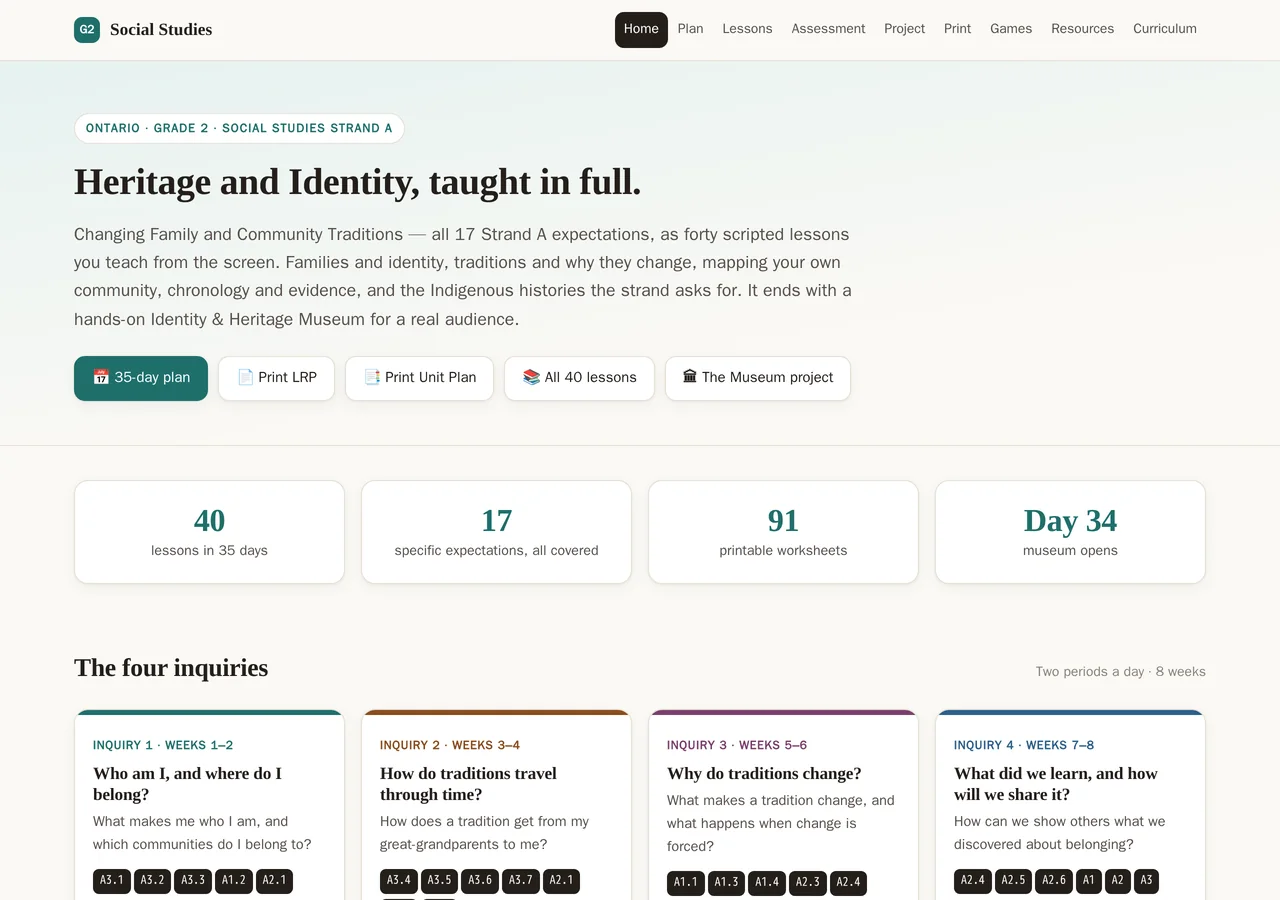
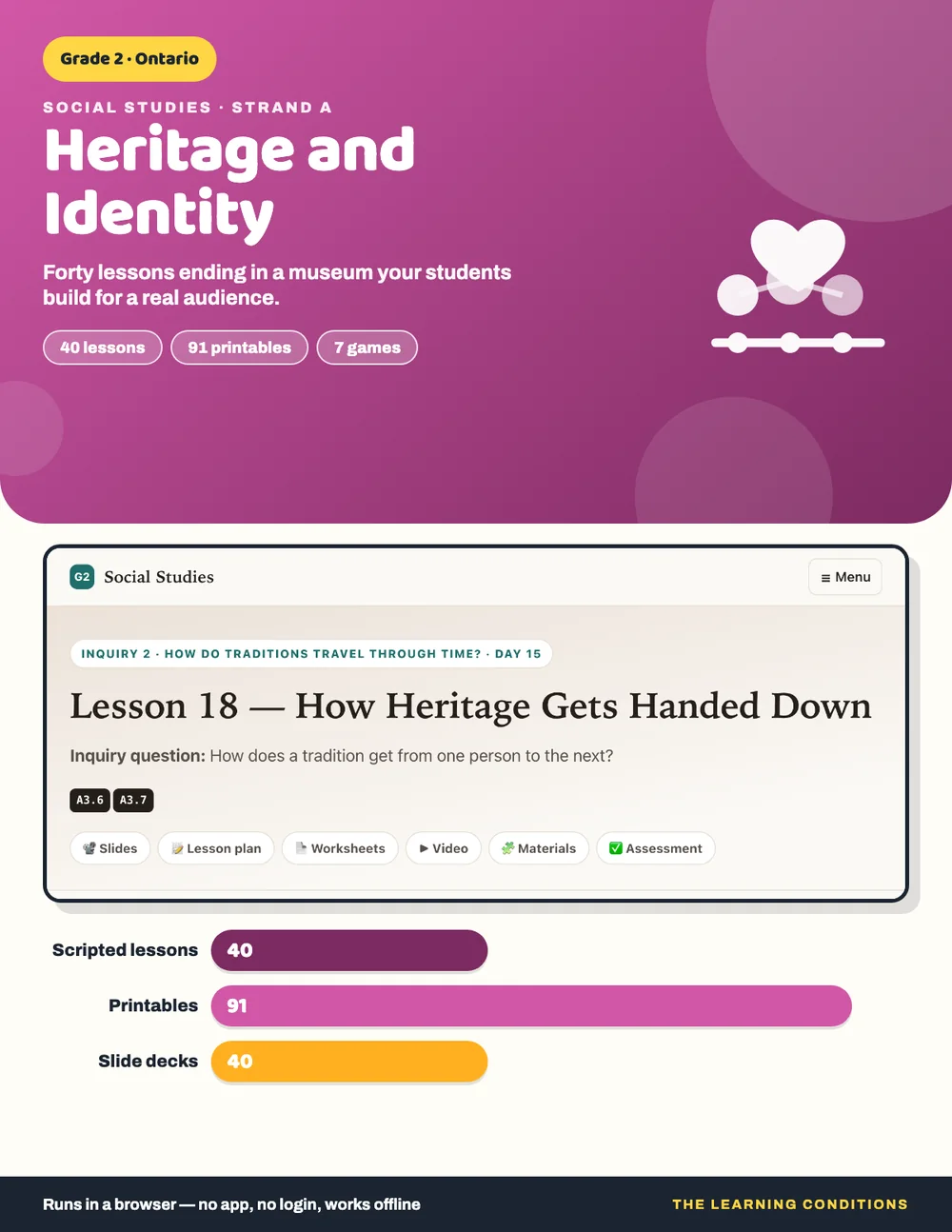
This unit is a paid product, and the teaching material is the product. What follows shows its front door and describes its architecture in words. No lesson pages, printables, assessments or games are reproduced, and no screenshot here contains text a reader could re-type and use.
Challenges
Backward design is easy to state and structurally awkward to build. It means committing to a final performance before you know whether the lessons in between can supply it, then going back and rewriting lessons whose artefacts turn out not to fit the exhibit they were supposed to fill. The second difficulty was drift: a lesson plan, a slide deck and a printable that say slightly different things are worse than any one of them alone, because the teacher discovers the mismatch mid-lesson. Defining each lesson once rather than writing it three times is the answer to that, and it constrains the writing as much as it protects it.
Iteration
The record of the iteration is in the artefact rather than in a changelog: the mapping between each museum exhibit and the lesson that produces it is exactly what the revision passes produced. Committing to the museum first forced a sweep back through the sequence to confirm that every exhibit had a lesson that actually made the thing, and the lessons that could not supply their exhibit were the ones that changed.
Reflection
The strongest thing about this unit is structural, which means it is invisible in any single screenshot — you cannot see backward design in a picture of a lesson. That is a genuine presentation problem and it is why this case study leans on the sequence rather than the pages. What I cannot tell you is what it did in a classroom. No learning measurement was designed into it and none has been collected, so there is nothing here about outcomes, only about intent. If I built it again I would add one thing: a short teacher-facing instrument that captures what the museum revealed, so the unit produces evidence about itself.
Skills demonstrated
- Backward design
- Ontario curriculum mapping
- Lesson scripting
- Assessment design
- Content-model design
- Product localisation
- Offline-first delivery
Read next
Curriculum
Grade 3 Science Programme
Four units with assessment triggered by progress, not by the calendar
Systems
Curriculum QA Suite
Pedagogical rules turned into pass-or-fail release checks
Adult Learning
The Learning Conditions
A practitioner framework, published as a live site