Open to everyone
Open it now. No code, no account.
17 complete resources you can open in a browser this minute. Each one runs offline afterwards, works the same on a locked-down school device as on a laptop at home, and asks nothing of you — no sign-up, no email address, no download.
Everything here is complete rather than a sample — the units are whole units, and the exam review is the whole review. Nothing on this page is a preview of something better. The catalogue is still being built, so this page grows.
Complete units
Whole units, not samples. Each one opens in a browser and runs offline afterwards — no login, no install, nothing to download.
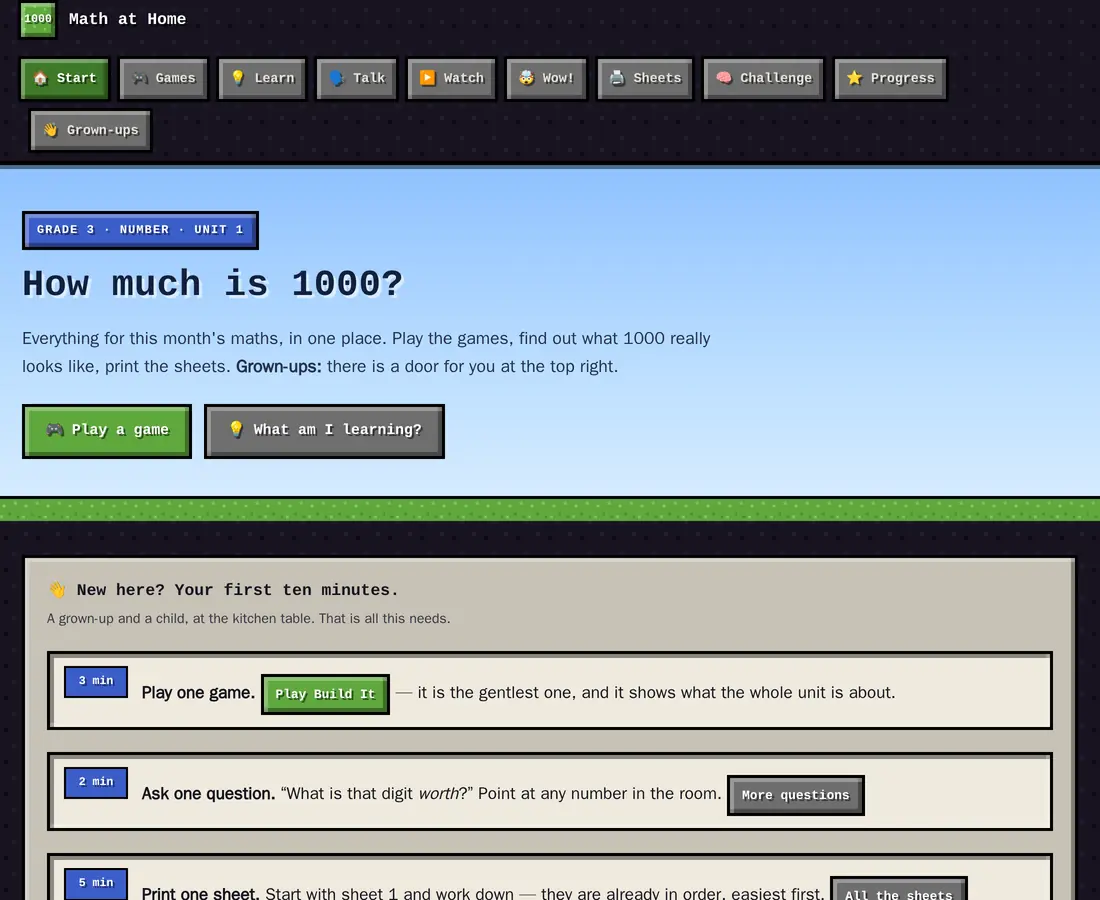
Math at Home — Grade 3, Unit 1: Place Value to 1000
For Parents and carers, and the children sitting beside them
The full first unit of the nine-unit series. Games that take about three minutes, interactive Learn pages, printables with answer keys, talk cards, a page written for the adult, a scripted first ten minutes, and the Check — an instrument with no score and one attempt that reports to the adult rather than ranking the child.
- 67–72 pages
- 8–10 games
- 43–45 printables
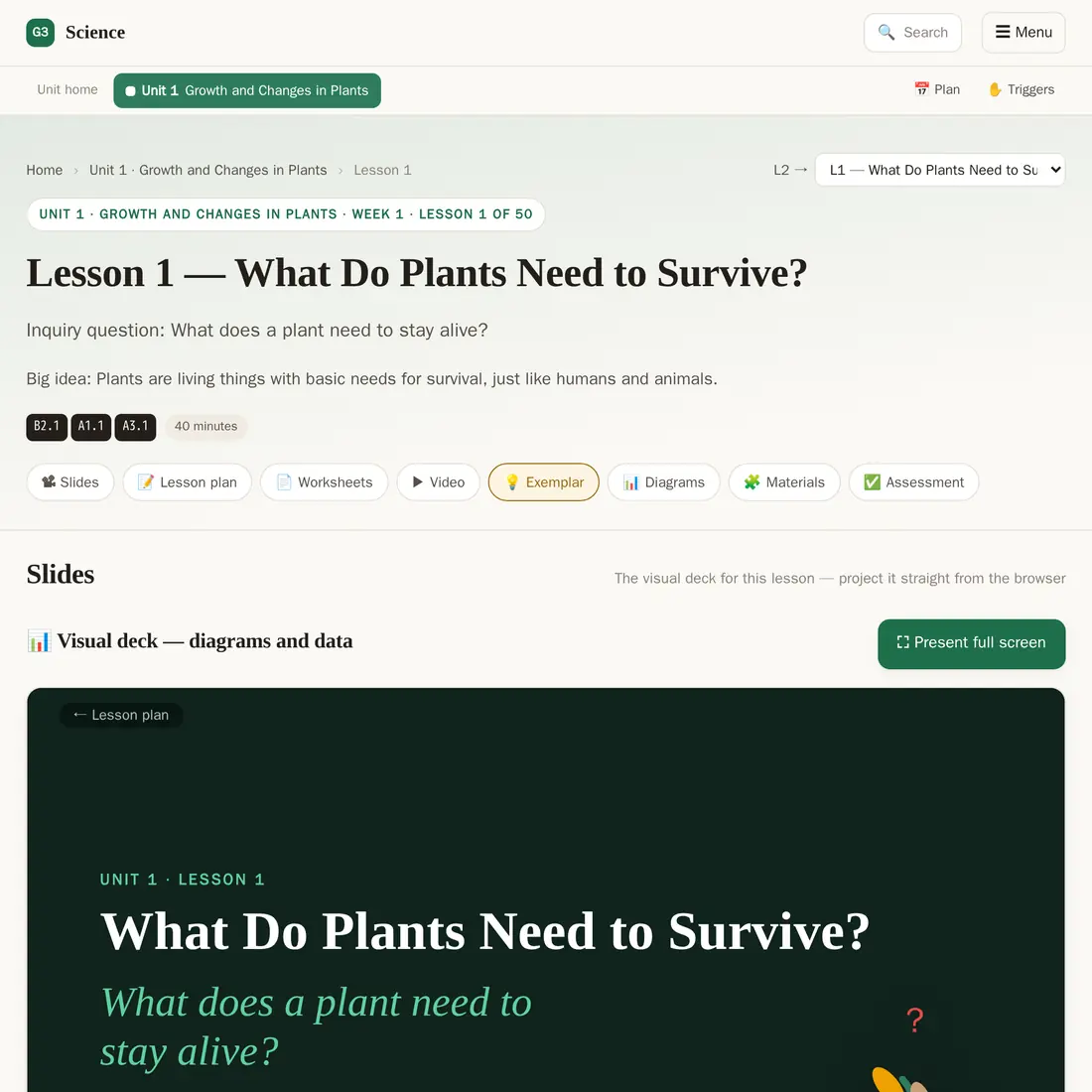
Grade 3 Science — Unit 1: Growth and Changes in Plants
For Grade 3 teachers
The full first unit of the four-unit Ontario programme. Scripted lessons, projectable decks, printables, games, and four assessments — one product, one observation, one conversation, one quiz — each released by finishing a lesson rather than by a date, with exemplars at three levels.
- 107 pages
- 4 assessments
- Exemplars at 3 levels
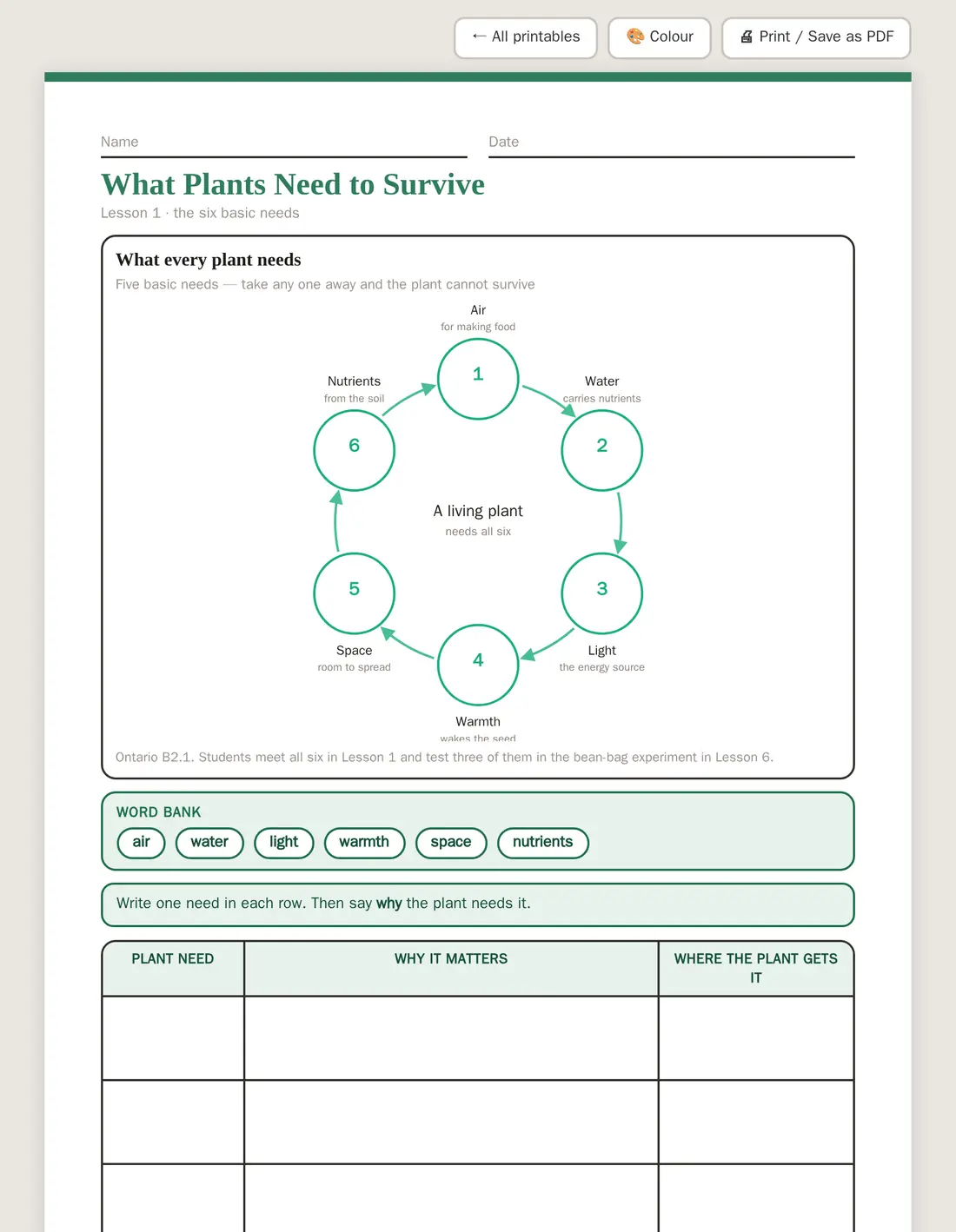
The Plant Lab — the plants unit, for home
For Parents and families, alongside the Grade 3 unit
The parent-facing companion to the plants unit, built phone-first because that is what a family actually opens. Eight big ideas in plain language, each with its words, one question to ask out loud and one thing to go and spot outside. Eight games, five diagrams to label, thirty words with the same definitions the class uses, three experiments to run on a windowsill, and three charts to fill in. Nothing refers to a lesson number or a week, so a family can open any part of it at any point in the unit.
- 8 big ideas
- 8 games
- 3 experiments
- One file, works offline
Secondary
Exam-facing, and the only Grade 10 material here.
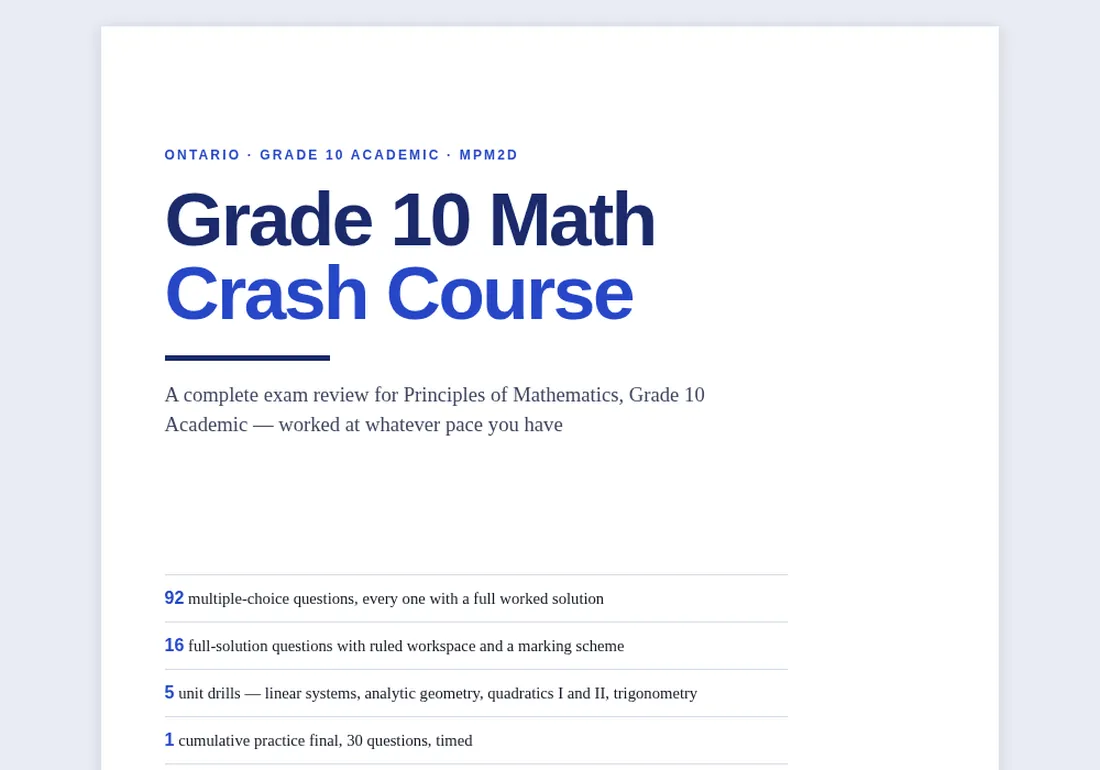
Grade 10 Math Crash Course — MPM2D Ontario Exam Review
For Grade 10 Academic students, and the teachers handing it to them
A complete exam review for Principles of Mathematics, as a self-paced interactive site. Five taught method pages, ten worked model examples, 90 practice questions and a timed 40-question mock exam, with a formula sheet and an error tracker that shows which topic to go back to. Every one of the 130 questions is worked in full. Opens in the browser, works offline, keeps your progress on the device.
- 42-page student workbook
- 37-page answer key
- 130 questions, all worked
- 40-question timed mock exam
Printable worksheets
Newer work, and the design is deliberately warmer — a first-day-of-school page a six-year-old wants to pick up is a different object from a drill sheet. Both print cleanly and both are editable.
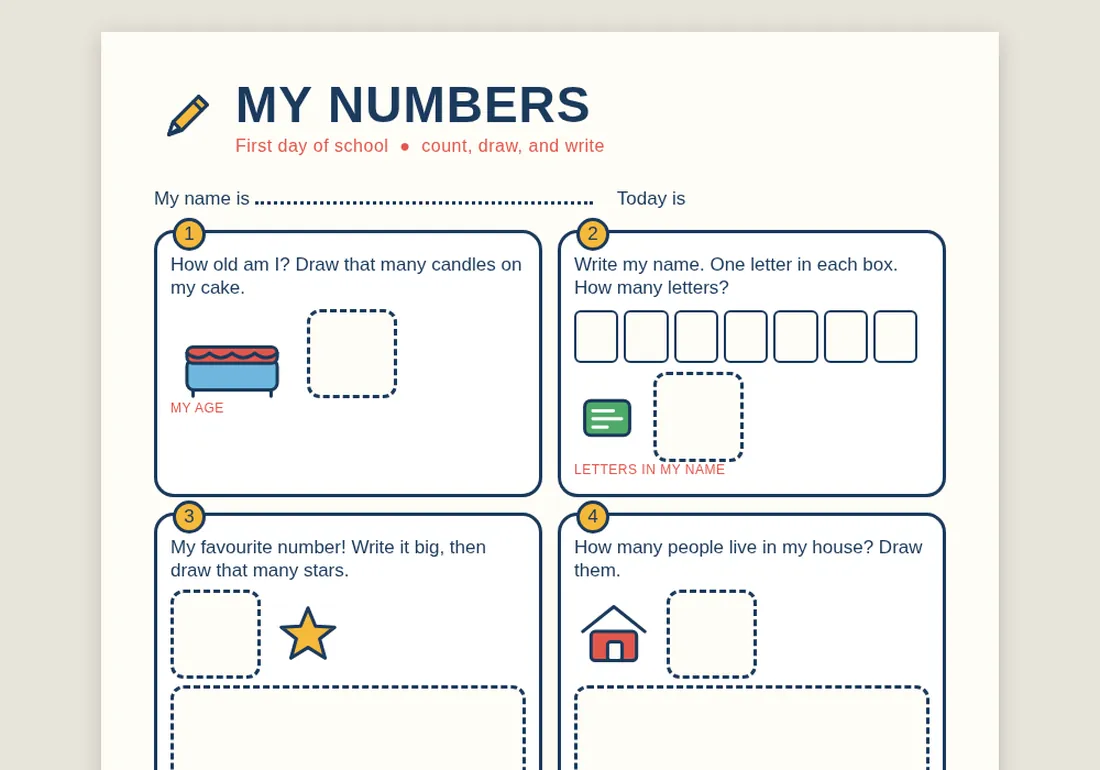
My Numbers, and Number Buddies
For Grade 1 and 2 teachers, for the first day
Two pages for the first day of school. The first has a child count what is theirs — their age, the letters in their name, the people at home, their favourite number — with a helper number line along the bottom. The second sends them around the room to find a friend with more letters in their name, or the same number of pets, adding as they go.
- 2 pages
- First day of school
- Number line included
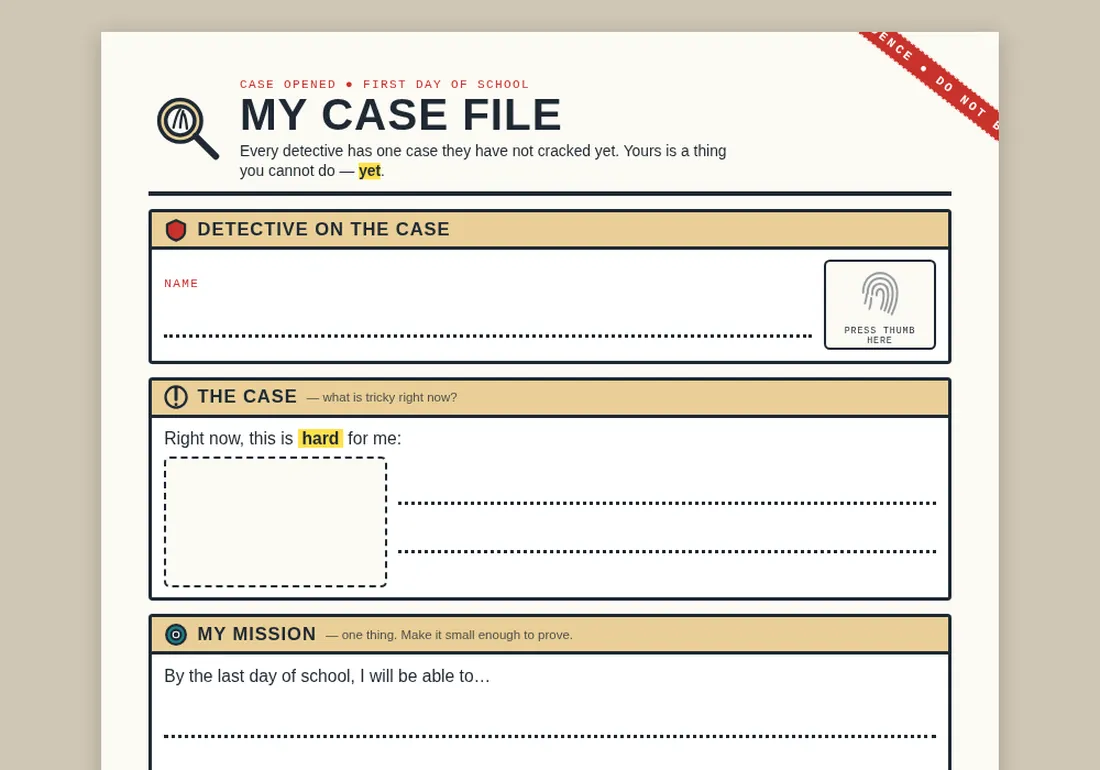
My Case File — goal setting
For Grade 1 to 3 teachers, the first week
Goal setting as a detective case. A child opens a file on the one thing that is hard for them right now, writes what they will be able to do by the last day of school, and states the evidence that will prove it. The frame does real work: it turns "what I am bad at" into a case that has not been cracked yet.
- Goal setting
- First week
- Grades 1–3
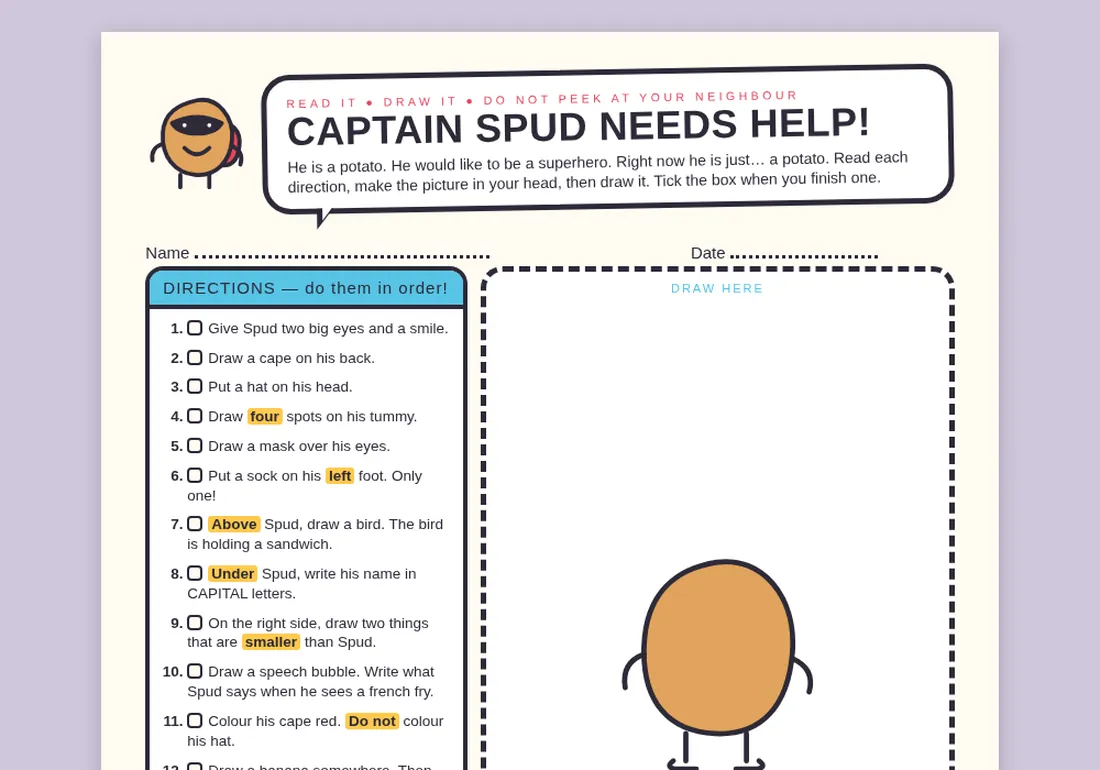
Captain Spud — follow-the-directions screener
For Primary teachers, for the first days
A reading screener disguised as a drawing task. Twelve numbered directions build a potato superhero, and each one quietly tests something different — ordinal position, above and below, left and right, colour words, capital letters, comparatives. What the teacher gets back is a picture that shows exactly which directions a child could follow.
- 12 directions
- Reading screener
- No marking scheme needed
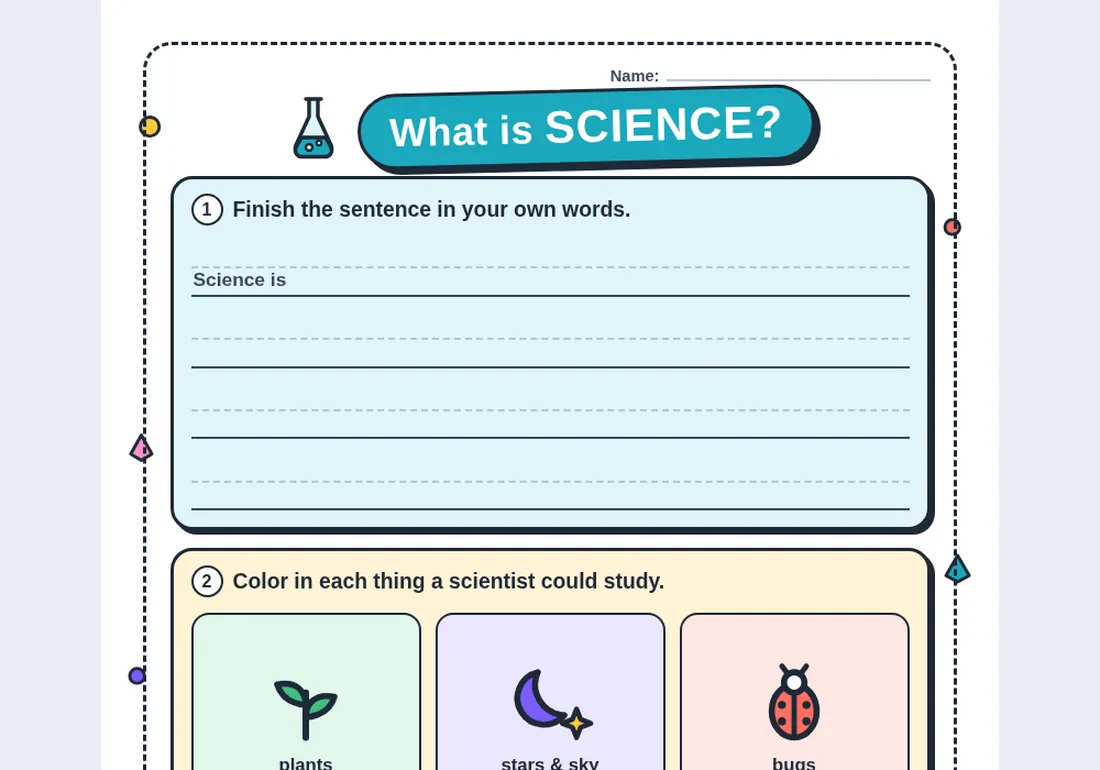
What is Science? — four starter pages
For Primary teachers, first week of a science unit
What is science, what is a scientist, draw a scientist, and a word splash. Open questions with room to answer them rather than blanks with one right word, so the same four pages work at the start of a unit and again at the end to see what changed.
- 4 pages
- Colour and black-and-white
- Editable
Single-page classroom tools
One page, one idea, no assembly. Each prints in black and white without losing anything, and each explains the idea to the adult on the same page as the tool.
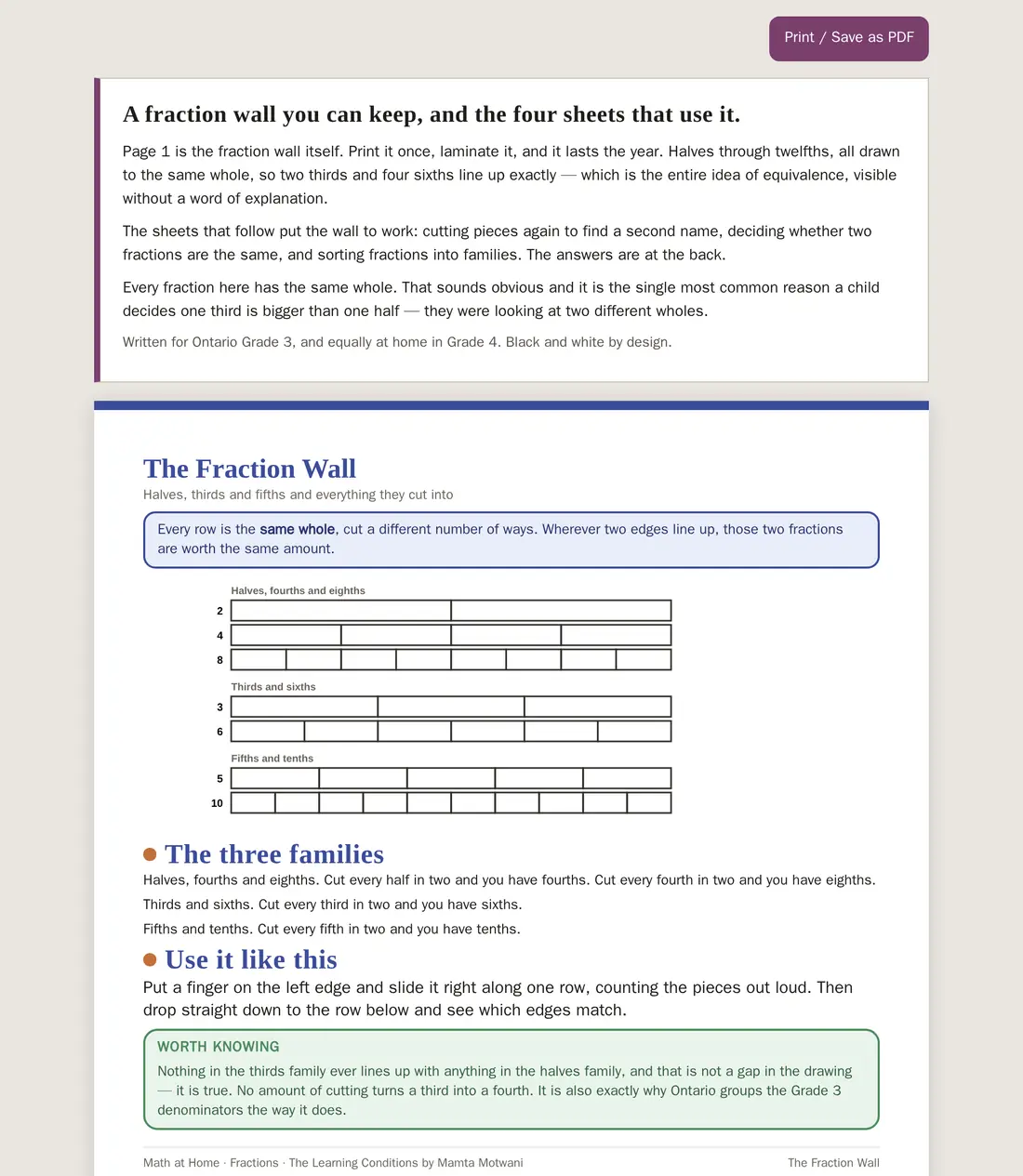
Fraction Wall and Equivalent Fractions
For Teachers and parents
Halves through twelfths drawn against the same whole, so two thirds and four sixths line up on the page. That single constraint is the whole idea of equivalence, made visible without a sentence of explanation.
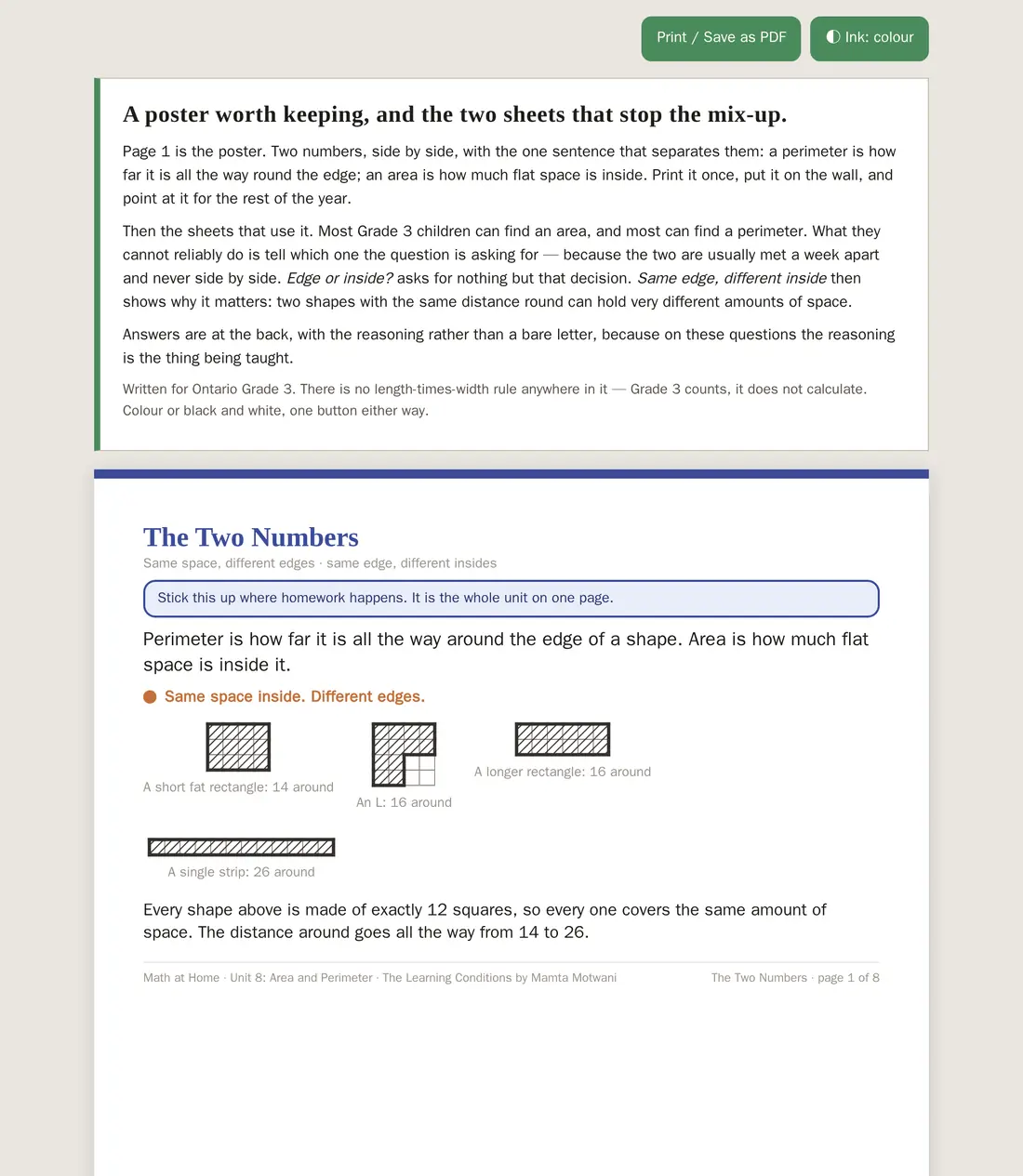
Area and Perimeter Poster and Sorting Sheets
For Teachers and parents
The distinction children most often collapse, on one page, with sorting tasks that make them commit to which is which.
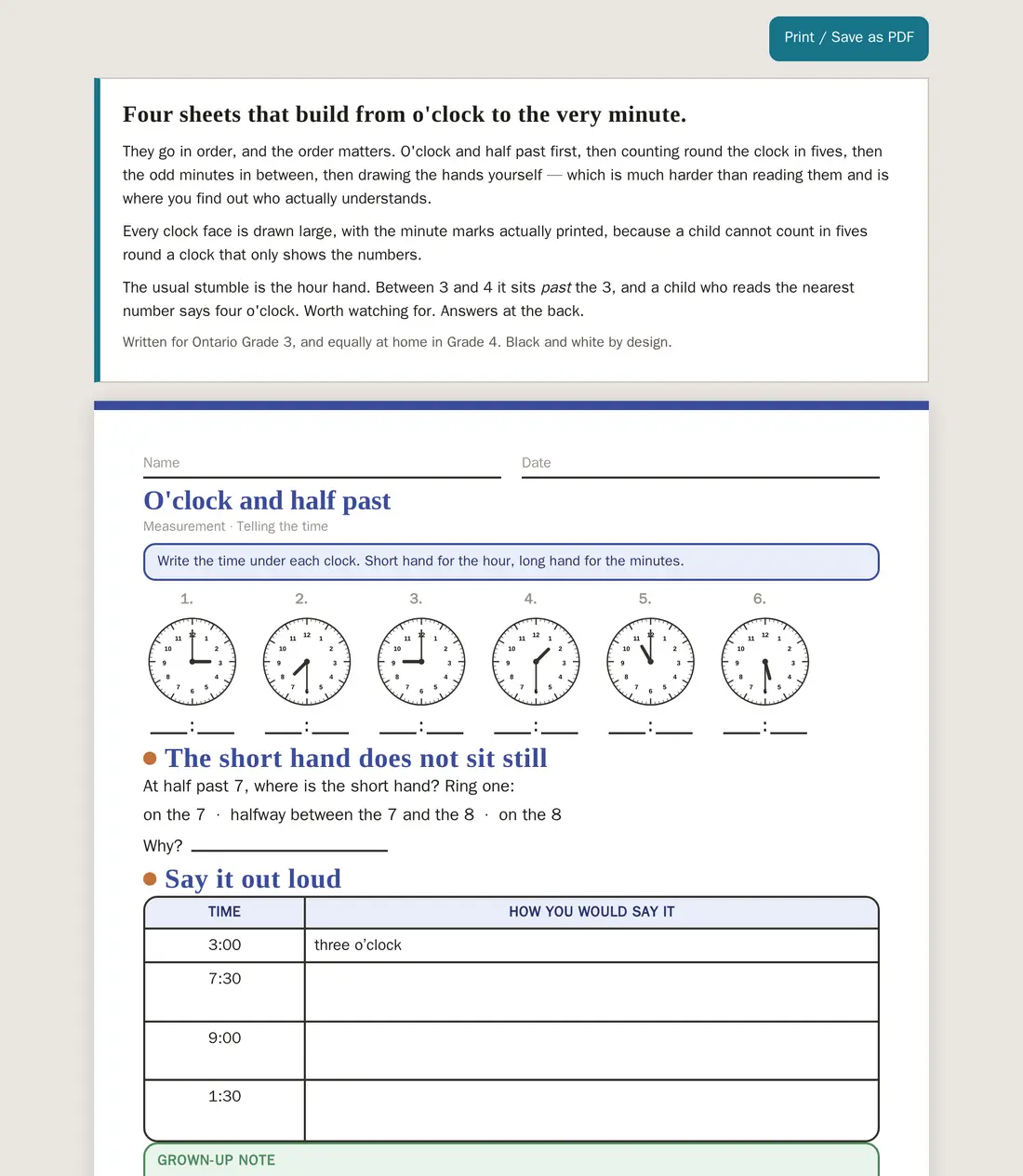
Telling Time to the Minute
For Teachers and parents
Analogue time to the minute, built for the step where five-minute intervals stop being enough.
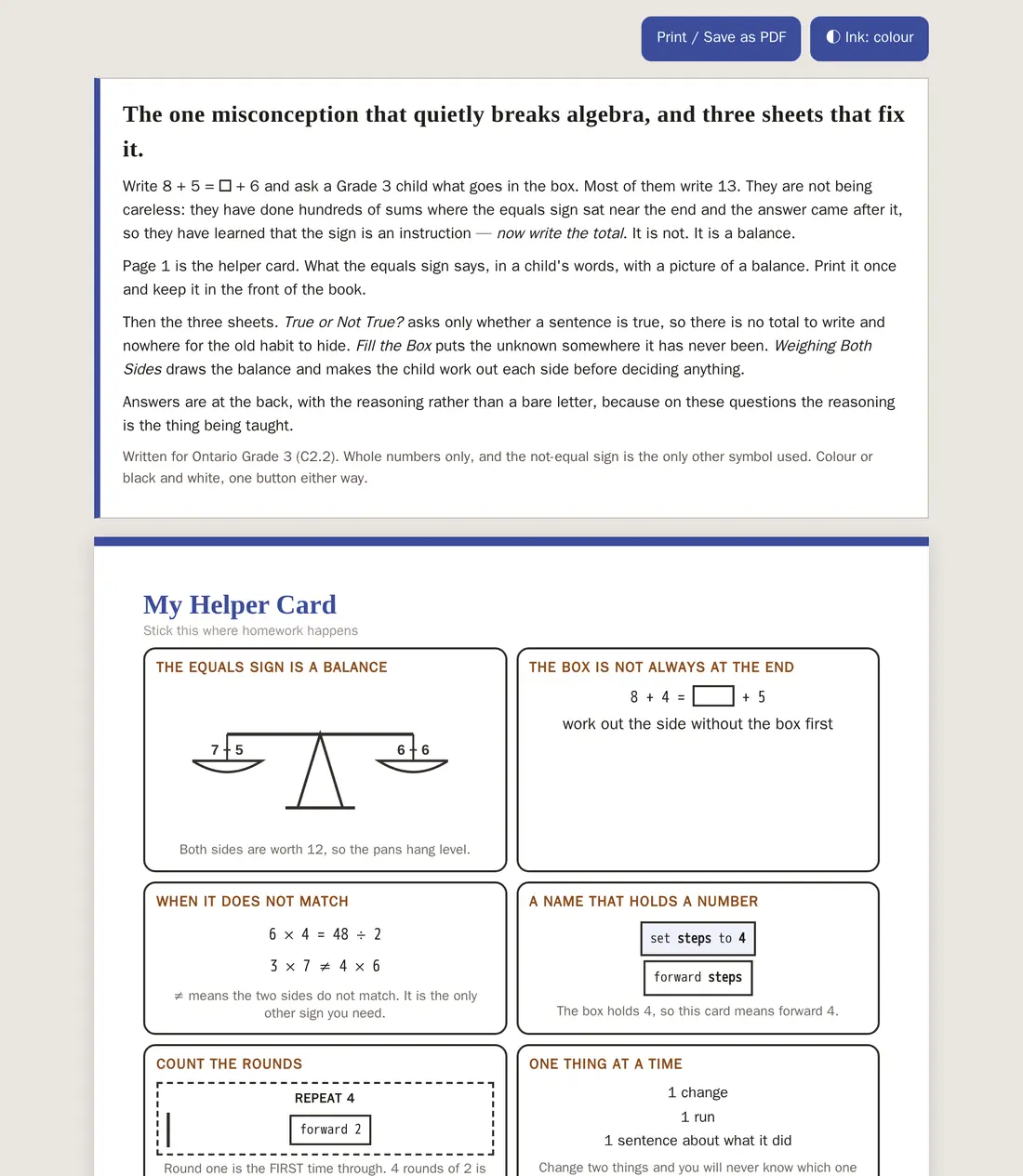
Balance the Equation — Equals Sign Starter Set
For Teachers and parents
The equals sign as balance rather than as "the answer comes next" — the misconception that quietly breaks algebra years later.
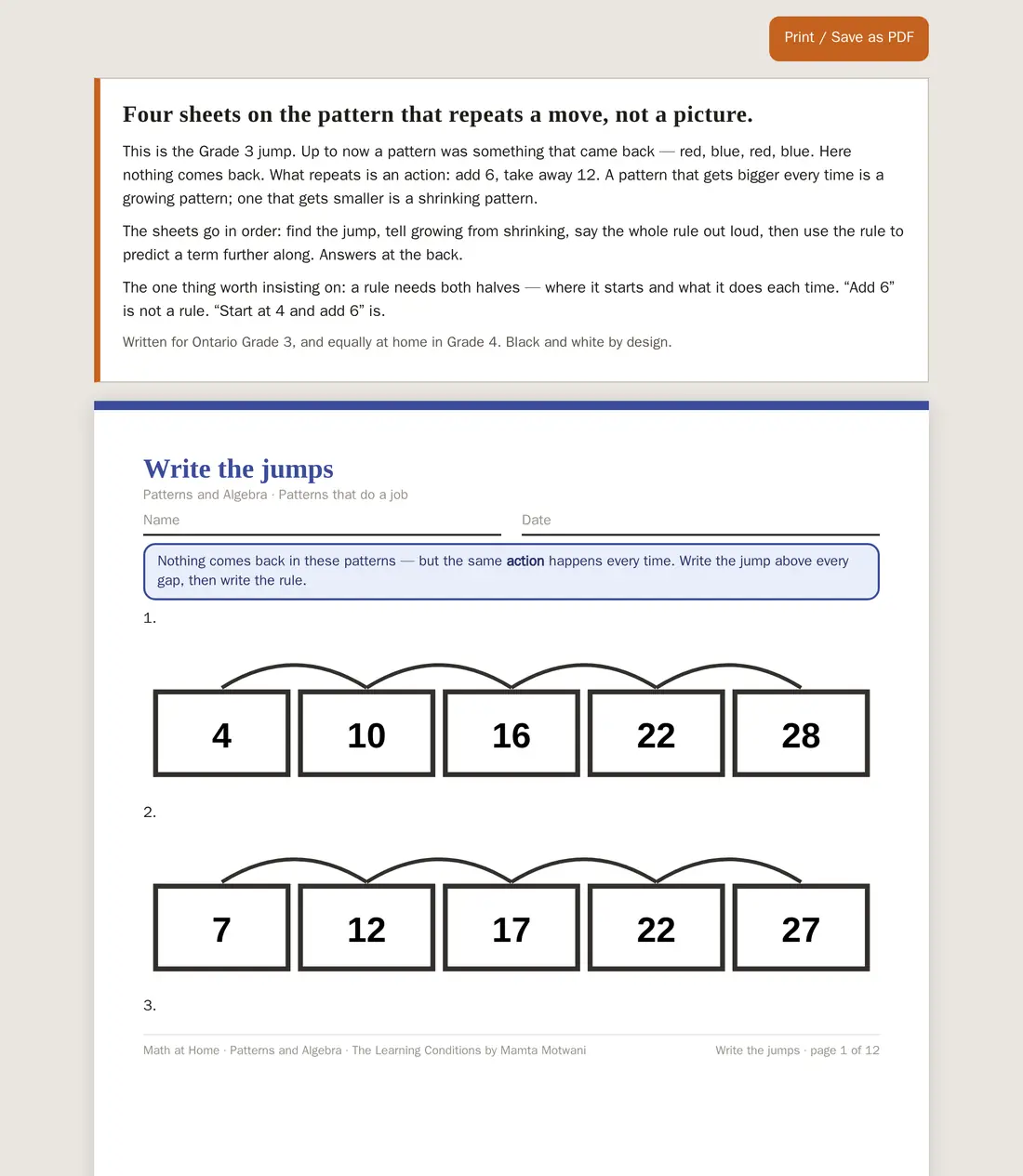
Growing and Shrinking Patterns
For Teachers and parents
Patterns that change by a rule, with the rule made explicit rather than guessed at.
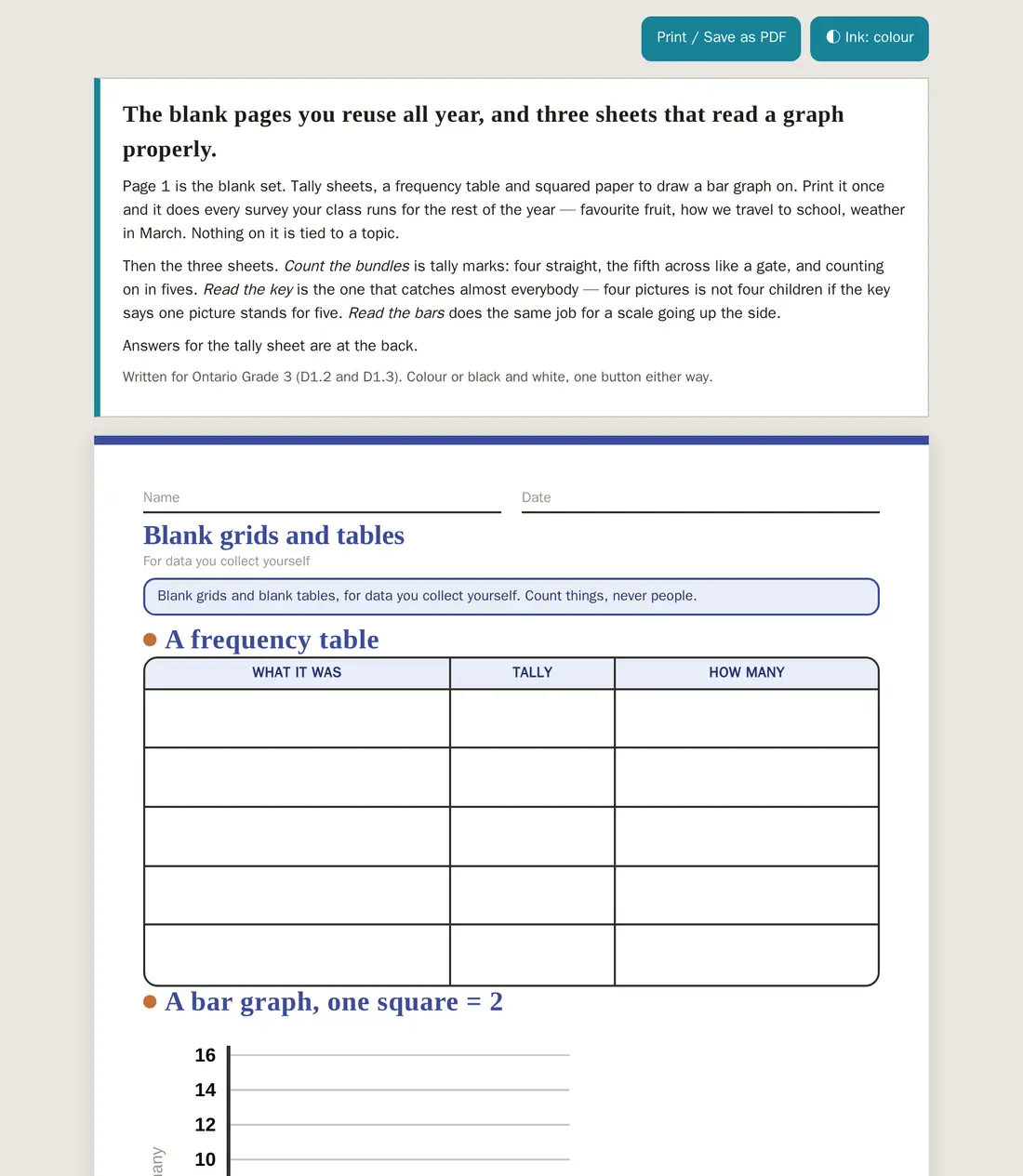
Tally, Pictograph and Bar Graph Starter Set
For Teachers and parents
The three representations side by side, so the same data can be seen moving between them.
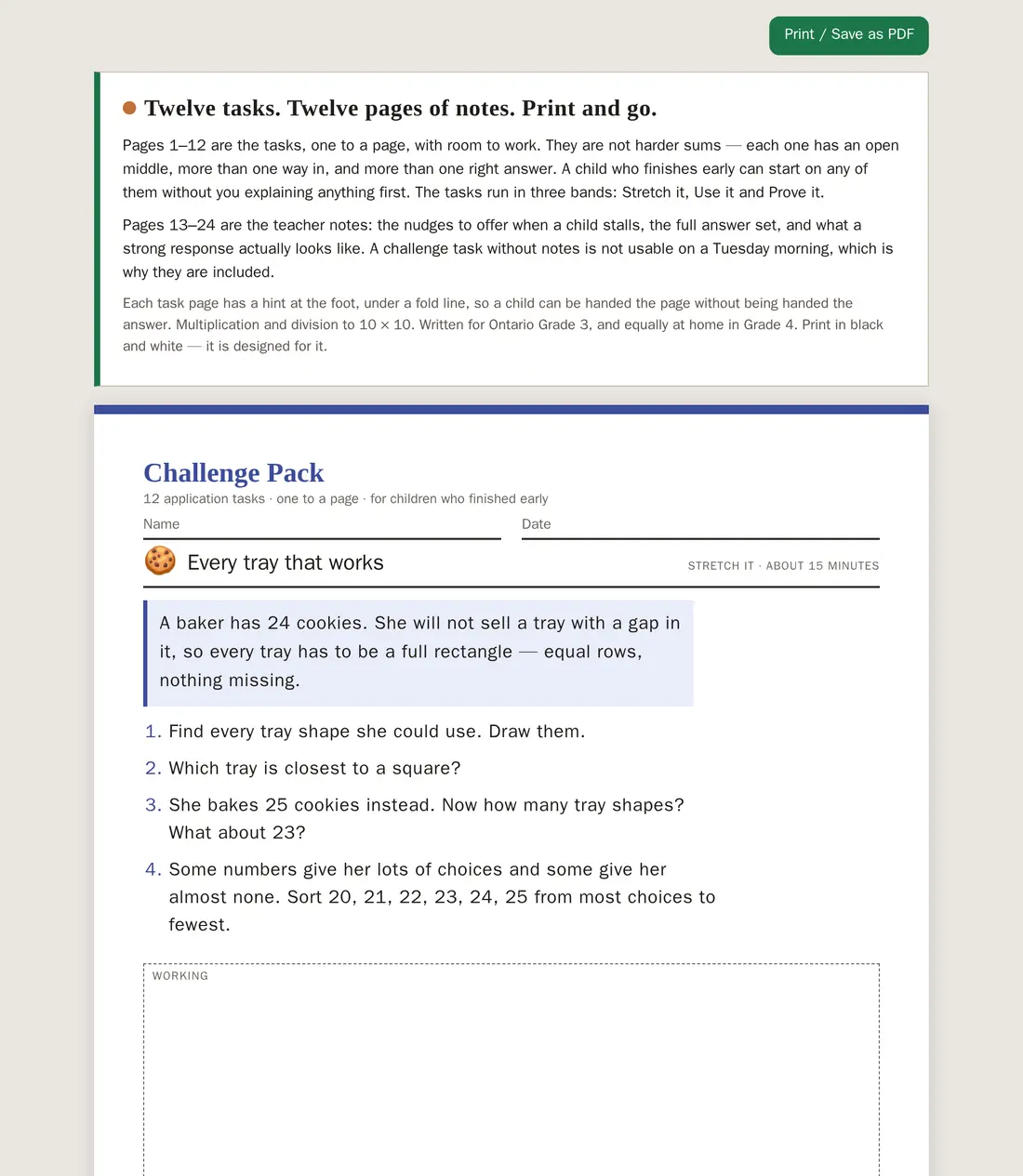
Gifted and Early Finisher Challenge Tasks
For Teachers with a child who finishes first
Tasks that go deeper rather than further — more thinking on the same content, not the next grade’s worksheet.
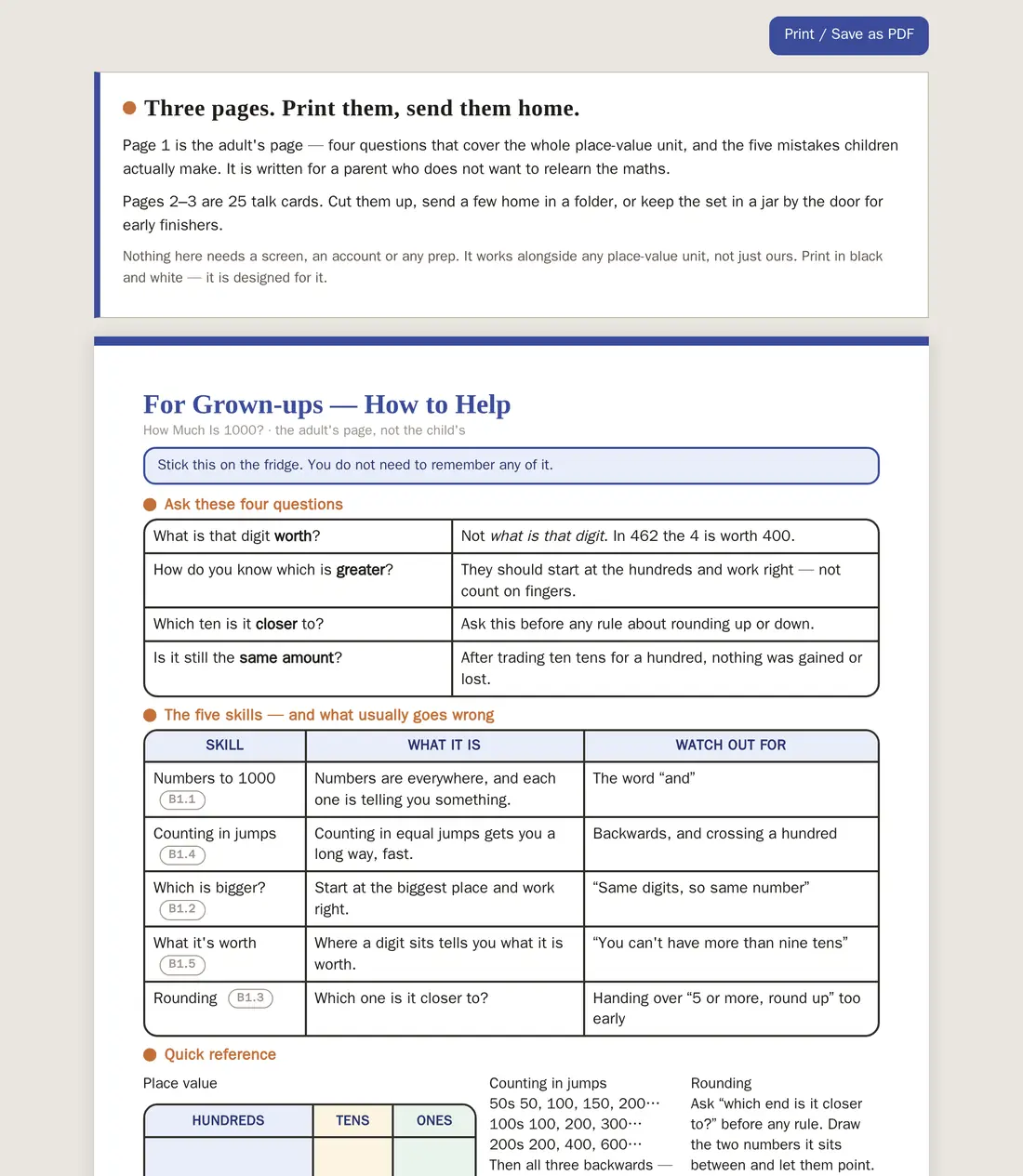
Place Value Talk Cards and Parent Guide
For Parents and carers
Questions to ask out loud, with a guide for the adult on what each one is for and what a good answer sounds like.
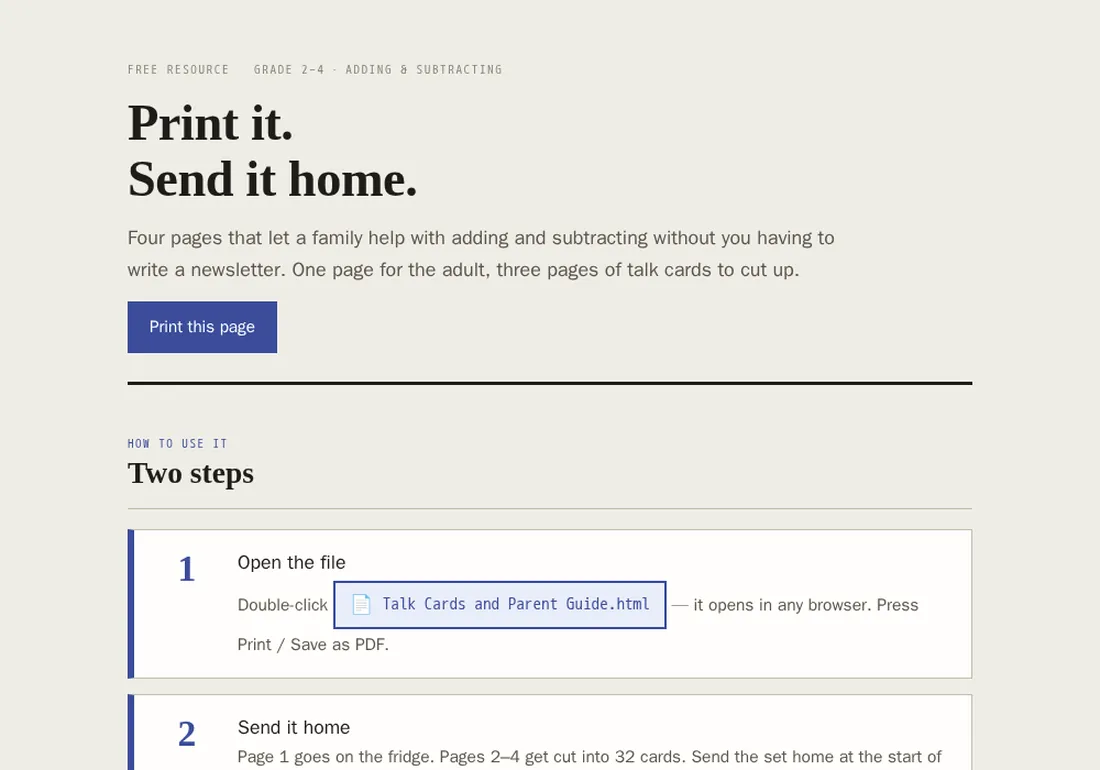
Addition and Subtraction Talk Cards and Parent Guide
For Parents and carers
The same idea for addition and subtraction — the adult gets the reasoning, not just the script.
More of the same standard
Finished products, shown rather than opened. They are here because the point of this page is not only what is given away — it is that the design standard holds across the whole catalogue, including the parts that are not open.
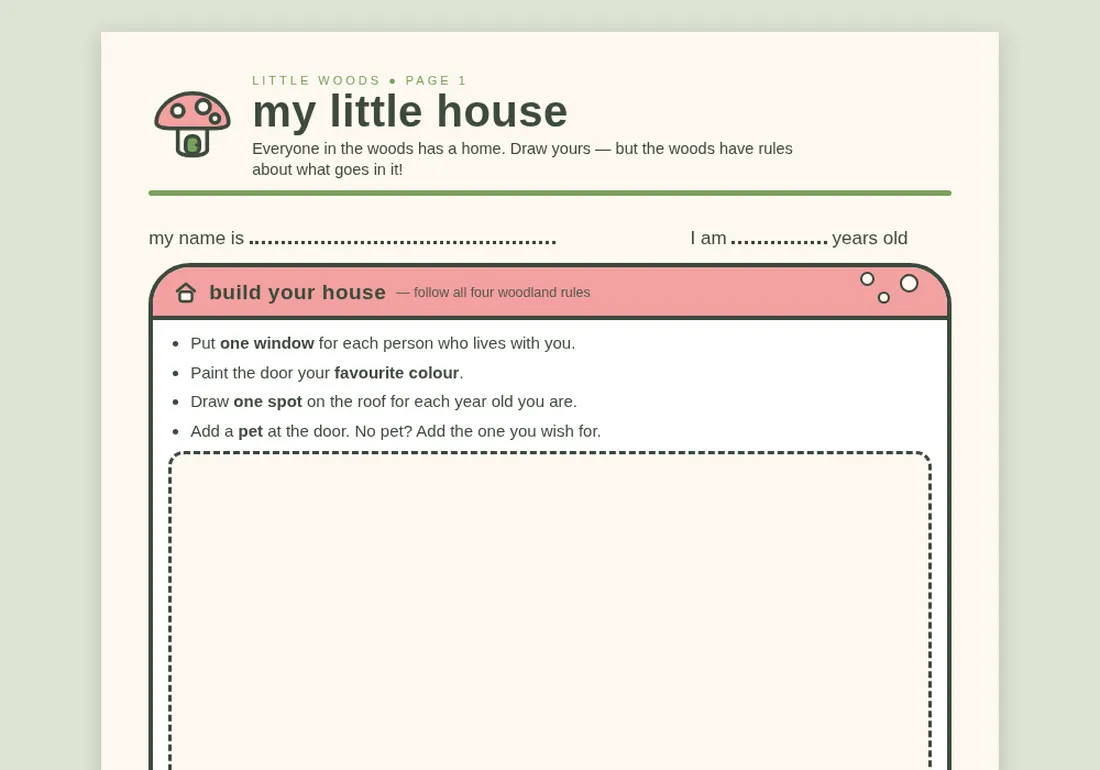
Little Woods
A full Grade 2 first-week packet — a woodland the class builds a house in, one rule at a time.
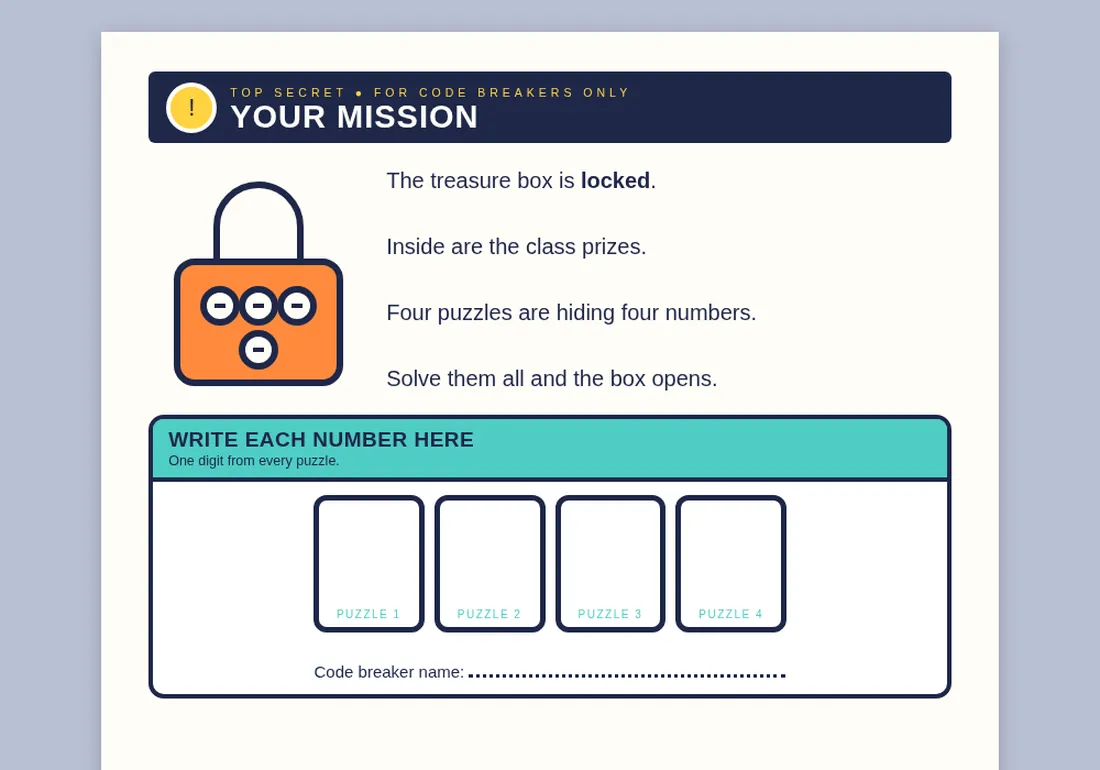
Unlock the Treasure Box
A back-to-school escape room. Four puzzles, four digits, one locked box of class prizes.
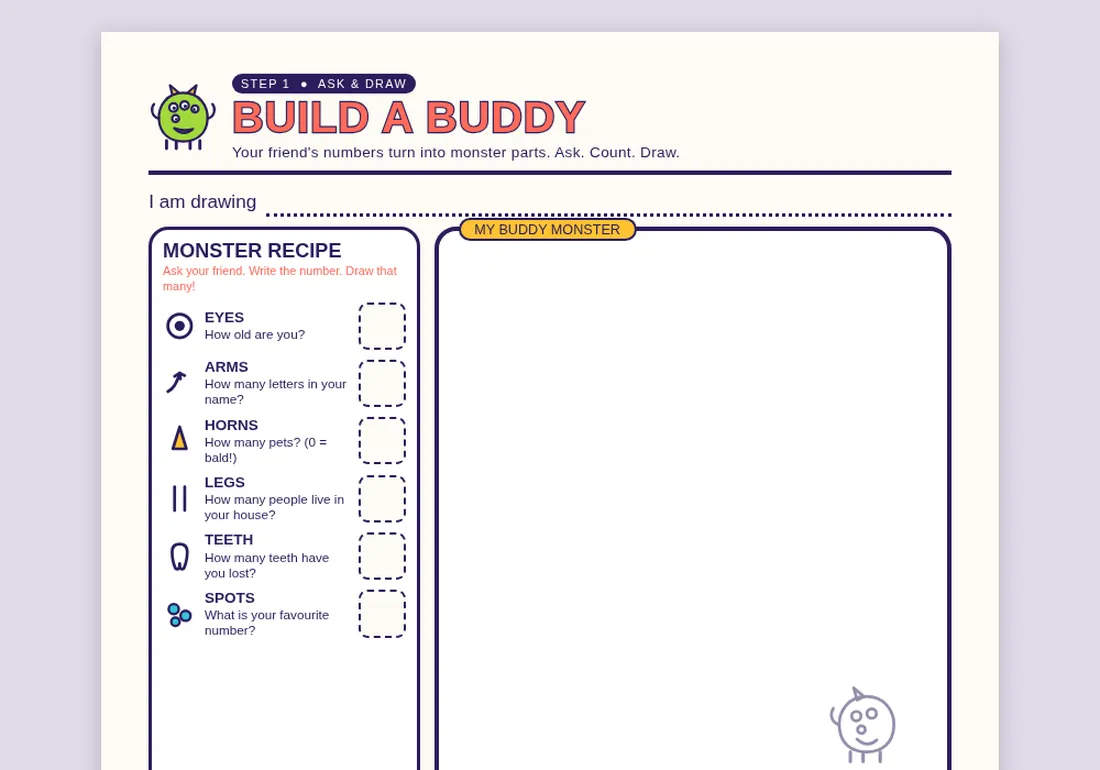
Build a Buddy
A friend’s numbers turn into monster parts. Ask, count, draw — an ice-breaker that is really a number talk.
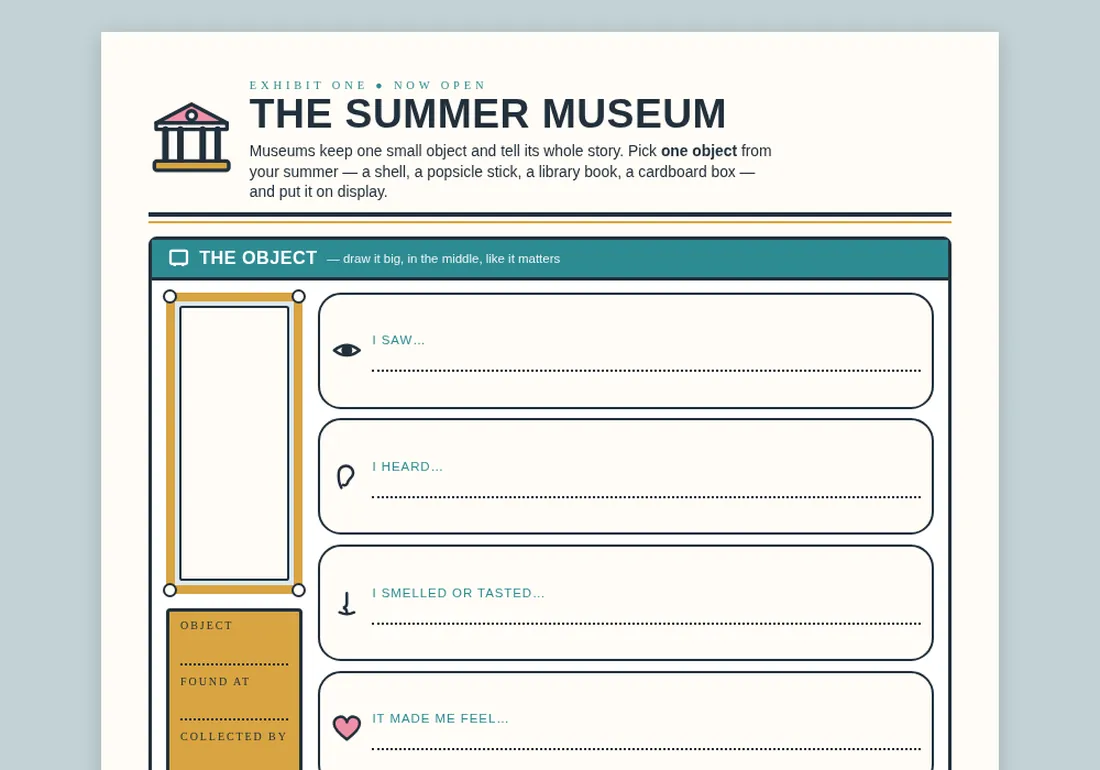
The Summer Museum
Grade 2 writing. One object from the summer, curated as a museum exhibit and described through the senses.
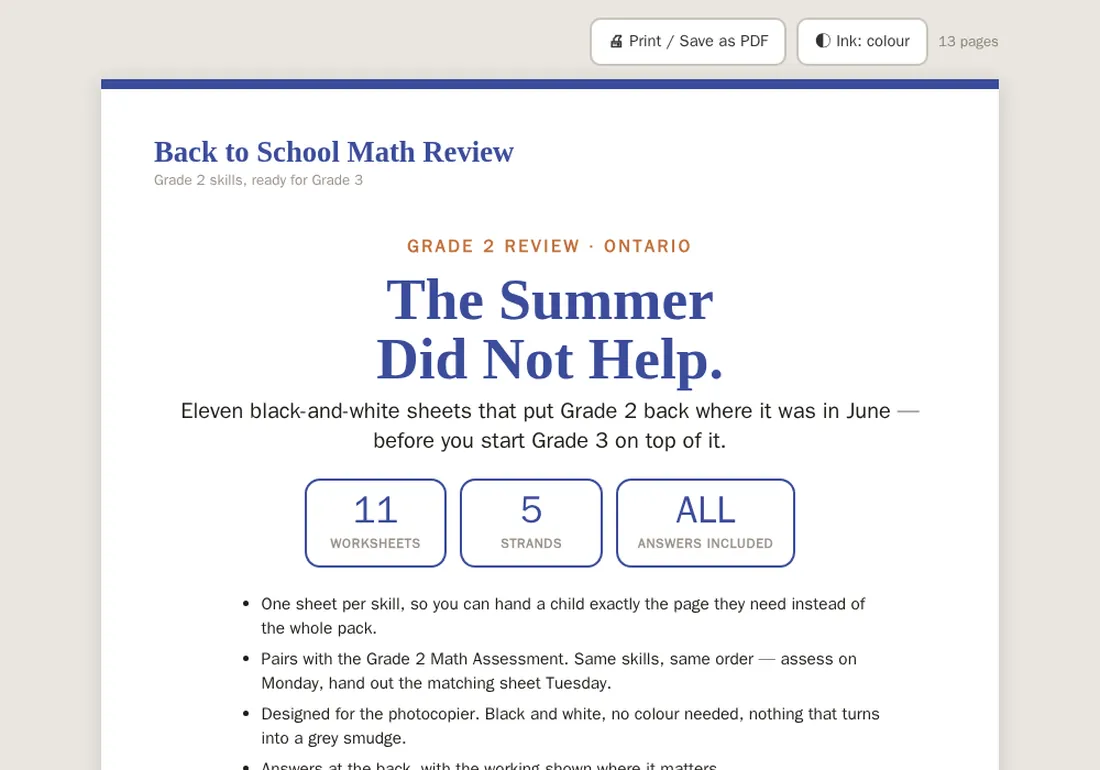
Back to School Math Review
Where a class actually is in September, on paper, before the first unit starts.
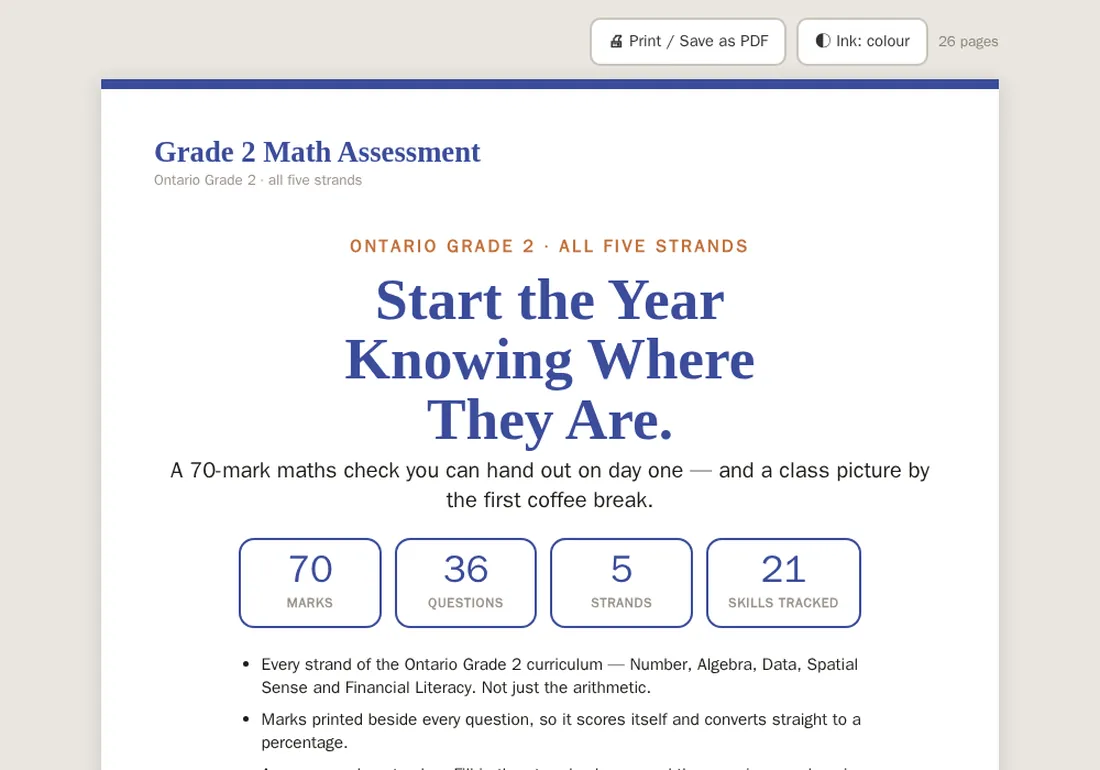
Grade 2 Math Assessment
A diagnostic across the strands, built to be marked quickly and read as a class picture.
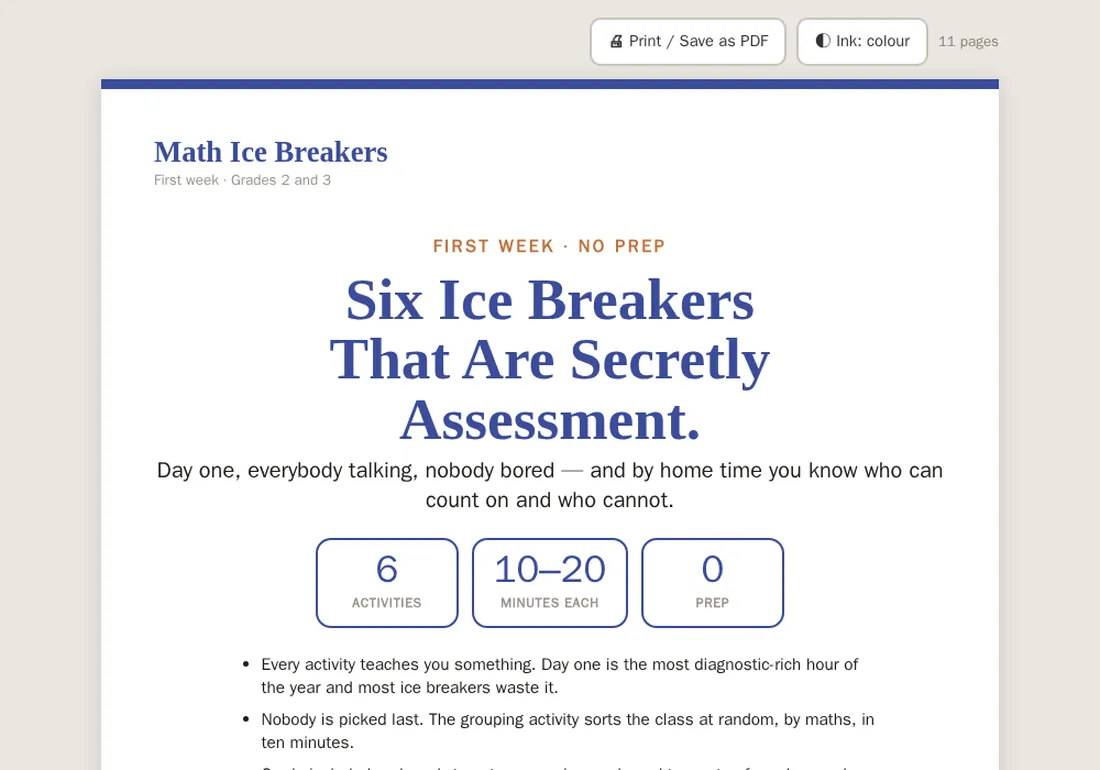
Math Ice Breakers
Number talk as a getting-to-know-you activity for the first week.
These are not open. If one of them is the thing you actually want to see, ask me and I will send it.
This is a small part of it
The twelve above are the openly published corner of a much larger body of work: 93 learning resources across Grades 1 to 10, spanning mathematics, science, social studies and literacy — full multi-unit programmes, individual units, assessment sets, daily routines and single-page tools. More is in build, and finished work is added here as it lands, so the count above is a snapshot rather than a limit.
Some of it is access-controlled rather than open and needs a code; some exists as documents rather than as web products, so there is nothing to link. If one of those is the thing you actually want to see, ask me and I will send it.
How these were made.
Each one began as a learning problem rather than a piece of software. The case studies set out the problem, the decisions taken and why, and — stated plainly — what has and has not been measured.