Math at Home
Nine units of Grade 3 mathematics designed for the adult in the room
- Units
- 9
- Pages
- 629
- Games
- 85
- Curriculum
- Ontario Grade 3
- Unit 1
- Free and open
What this case study claims
Design decisions, intended behaviour and the reasoning behind them, plus counts verified against the built product. It does not claim learner outcomes, adoption or improvement: those have not been measured, and describing an intention as a result would be the easiest thing on this page to get wrong.
Overview
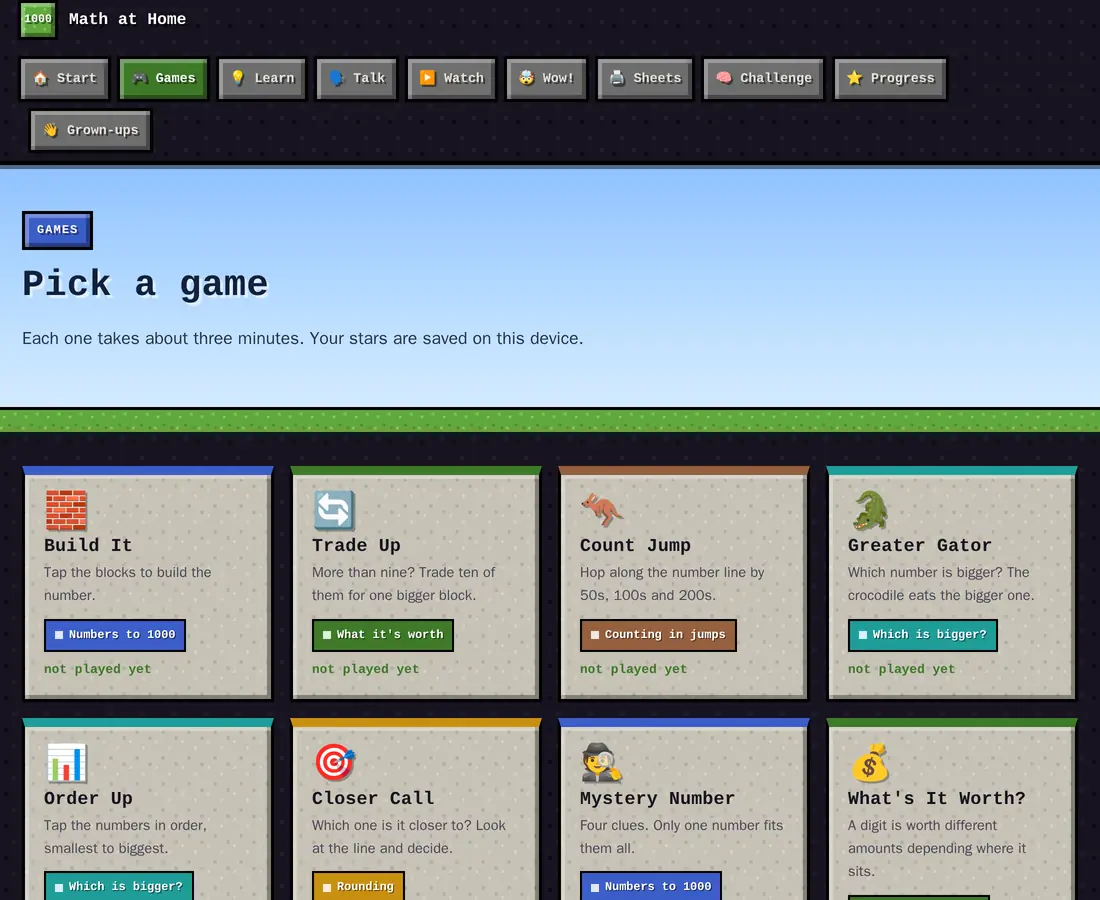
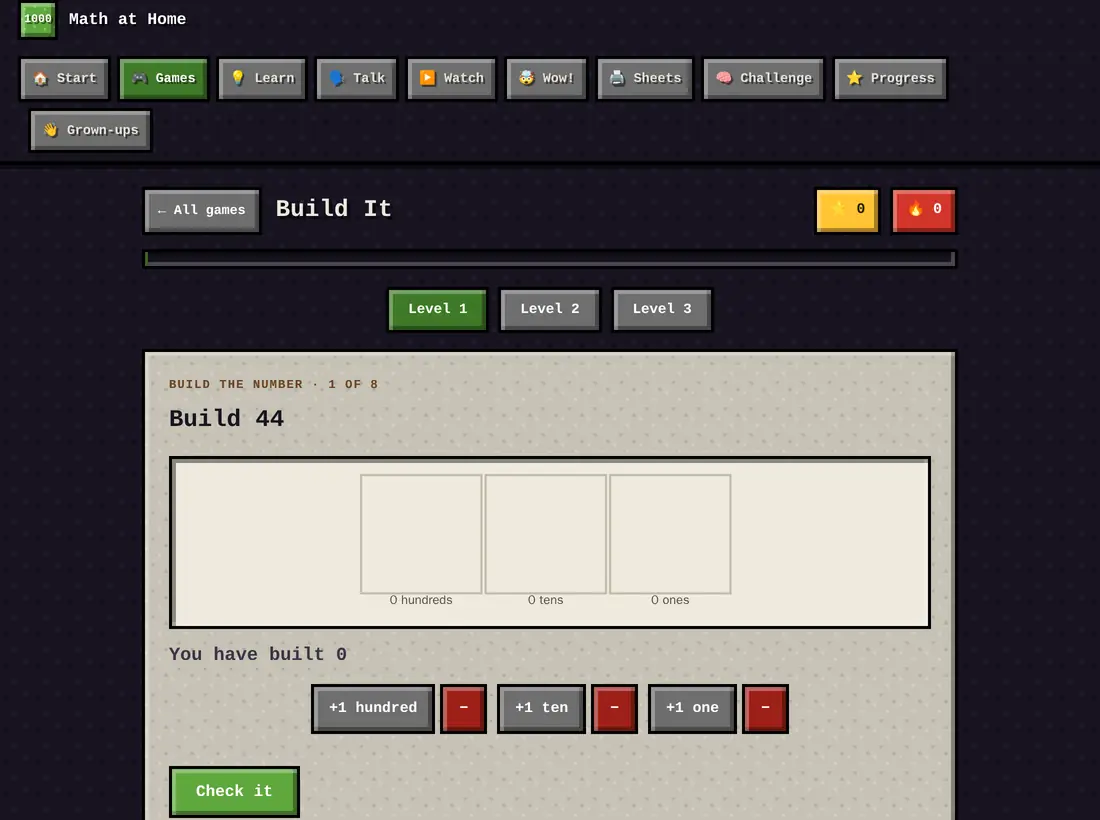
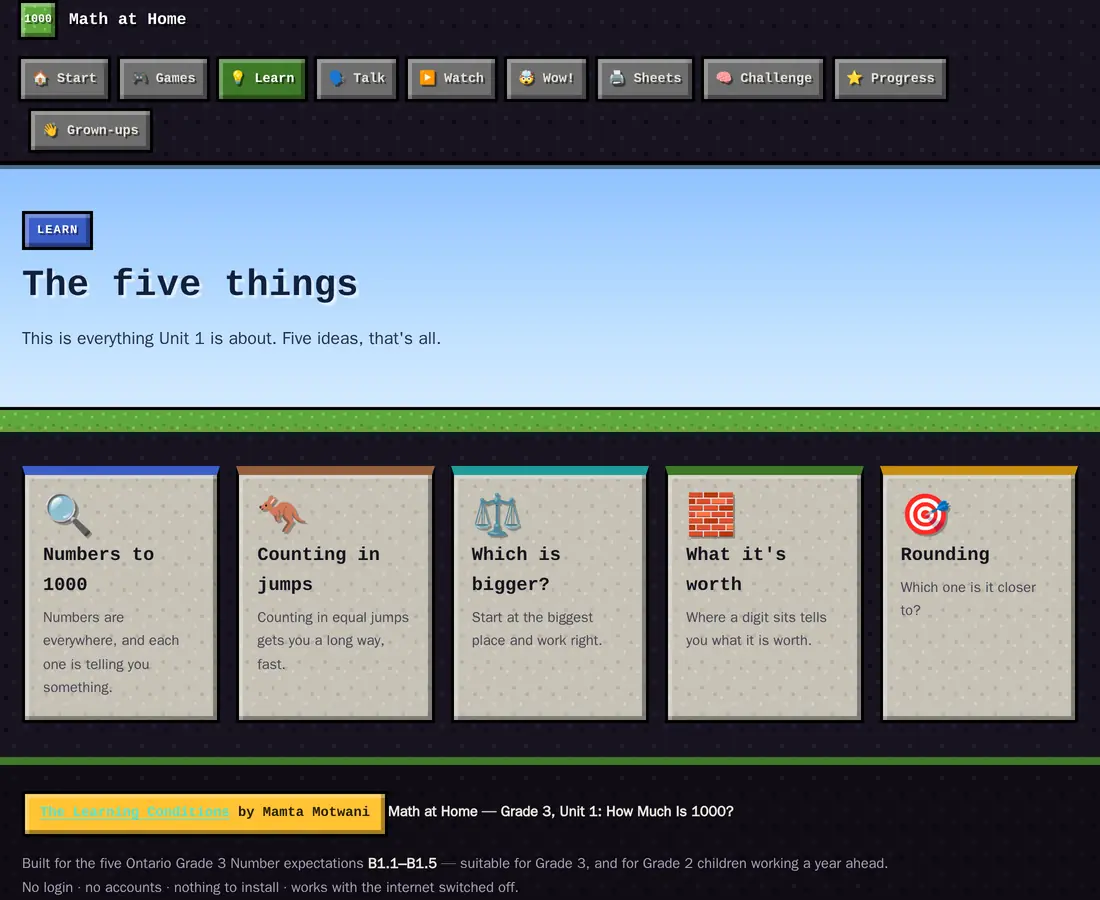
Nine units of Ontario Grade 3 mathematics, 629 pages, built for the adult at the kitchen table rather than for a teacher. Each unit is a self-contained offline app: eight to ten games, six interactive Learn pages, forty-odd printables with answer keys, talk cards, a challenge set, a progress store held on the device, a page written for grown-ups, a scripted first ten minutes — and a Check instrument with no score, one attempt, skill-tagged items and a report addressed to the adult. Unit 1, How Much Is 1000?, is free and open.
Problem
Home mathematics resources are designed for teachers and then handed to parents. The parent receives a pack of worksheets with no statement of what it is for, no way to judge whether the child is on track, and no guidance for the situation that most affects the outcome: the child is stuck and the adult does not know what to say next. Content supply is not the constraint — there is more free Grade 3 mathematics material available than any family can use. The constraint is that the supervising adult has no instructions. The product had to treat that adult as the primary user.
Audience
Parents and carers with no mathematics training and no lesson-planning time, and the children sitting beside them, usually tired, usually after school.
My role
- Learning-experience design for a non-expert adult and a child, together
- Assessment design — the Check instrument and its adult-facing report
- Practice design across nine units — questions made fresh each round rather than drawn from a fixed list
- Specifying the shared game behaviour and the on-device progress record
- Print design, curriculum mapping and all instructional writing
Goals
What the design set out to achieve. These are objectives, not results.
- Let a child start without an adult present
- Let a child be wrong without it costing anything
- Give the adult a next action rather than a ranking
- Make practice non-repeating, so playing a game twice is practice and not recall
- Keep everything on the device — no accounts, no uploads, nothing about a child leaving the home
How it works
Each unit is a self-contained set of 67 to 72 offline pages, and all nine units share the same building blocks: the games, the practice questions, the progress record, the interactive demonstrations and the Check. There is no server and no account. Progress is kept on the device itself, which is a privacy decision as much as a practical one — there is no account to create, no address to collect and nothing to leak, because nothing is ever transmitted.
Design decisions
The Check has no score and exactly one attempt
Every item is tagged to a skill, the child works through it once, and what comes out is a report written for the adult that names what to do next. The reasoning is deliberate on each count. A score invites a retry; a retry turns a diagnostic into a rehearsal and the second result tells you nothing. And a percentage is not actionable — a parent who learns their child scored 60% still does not know what to do on Tuesday. The instrument’s job is to route the next twenty minutes, so that is what it outputs.
Questions are generated, not listed
Seven of ten games draw genuinely new questions every round rather than replaying a fixed bank. The point is replay value in the pedagogical sense: the second play is more practice, not a memory test on the answer key.
Three minutes is the design target
Games are built to about three minutes because the honest unit of home practice is one sitting with a tired child, not a session. A game that needs ten minutes gets abandoned in the middle, and an abandoned game is a small failure the child remembers.
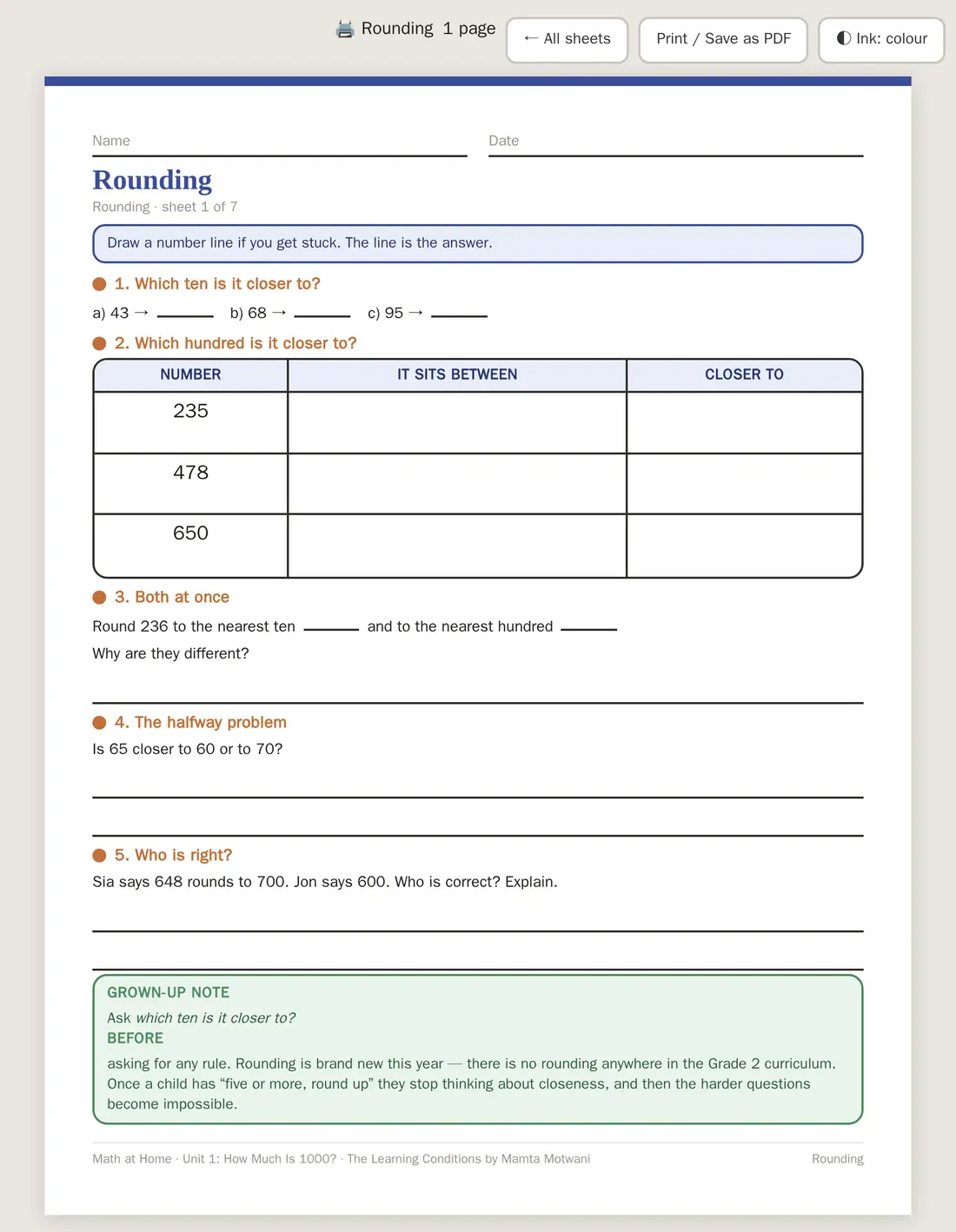
Printables are black and white by design
Home printers run out of colour and families ration it. Nothing in these sheets carries information in colour alone, so a black-and-white print is the full resource rather than a degraded one. This is also the accessibility position: colour never does the work on its own.
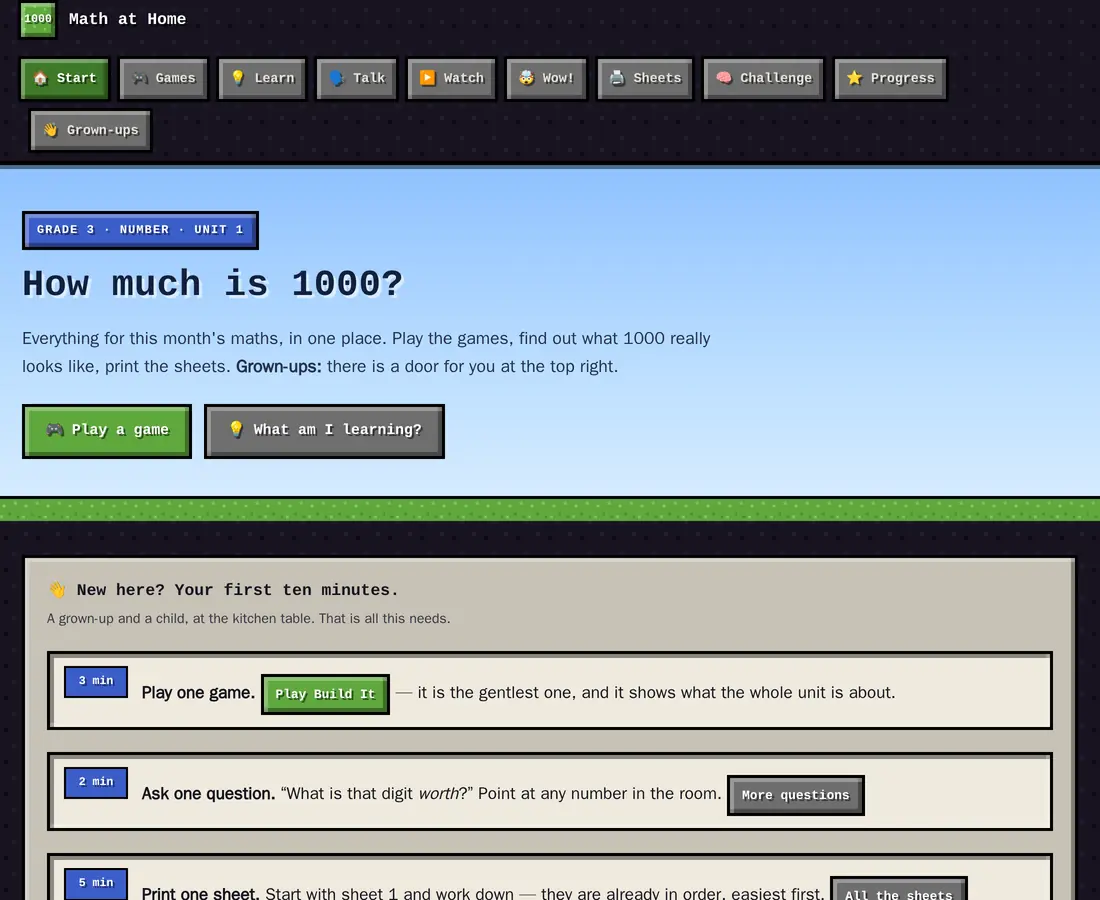
A scripted first ten minutes
One game, one question to ask out loud, one sheet — timed, in order, on the front page. The onboarding is written for the adult, because the adult is the one deciding whether this is going to be worth it.
The grown-ups page explains why, not what
It says what the mathematics is for and what a child usually finds hard about it, rather than instructing the parent on how to run an activity. An adult who understands why the digit’s position matters can improvise the next question; an adult following instructions cannot.
Each of these follows from a published position rather than from taste. The reasoning is set out in The Learning Conditions, a framework of four conditions: a child must be able to be wrong at no cost, hold decisions that are genuinely hers, start without an adult, and have an adult nearby who knows what to say next.
AI’s role
Nothing in these units calls a model, and no child’s work is transmitted anywhere — the whole app runs with the network unplugged. In the build, the most valuable use of AI was adversarial rather than generative: building the practice questions and then running them at volume to find which questions they could produce and, more importantly, which they could not. AI also drafted parent-facing explanations, which were then cut hard, because generated prose over-explains to a reader who is standing up in a kitchen.
Human judgment
The Check is the clearest example in this portfolio of a decision that cannot be delegated. Removing the score, allowing one attempt and addressing the report to the adult are each defensible on formative-assessment grounds, and each of them is commercially the wrong instinct — stars, streaks and a percentage are what sells a learning product. Holding that line is judgement. So is the three-minute target, which came from watching where a child’s attention actually goes rather than from what fits neatly into a lesson.
Experience
Open, and linked in full
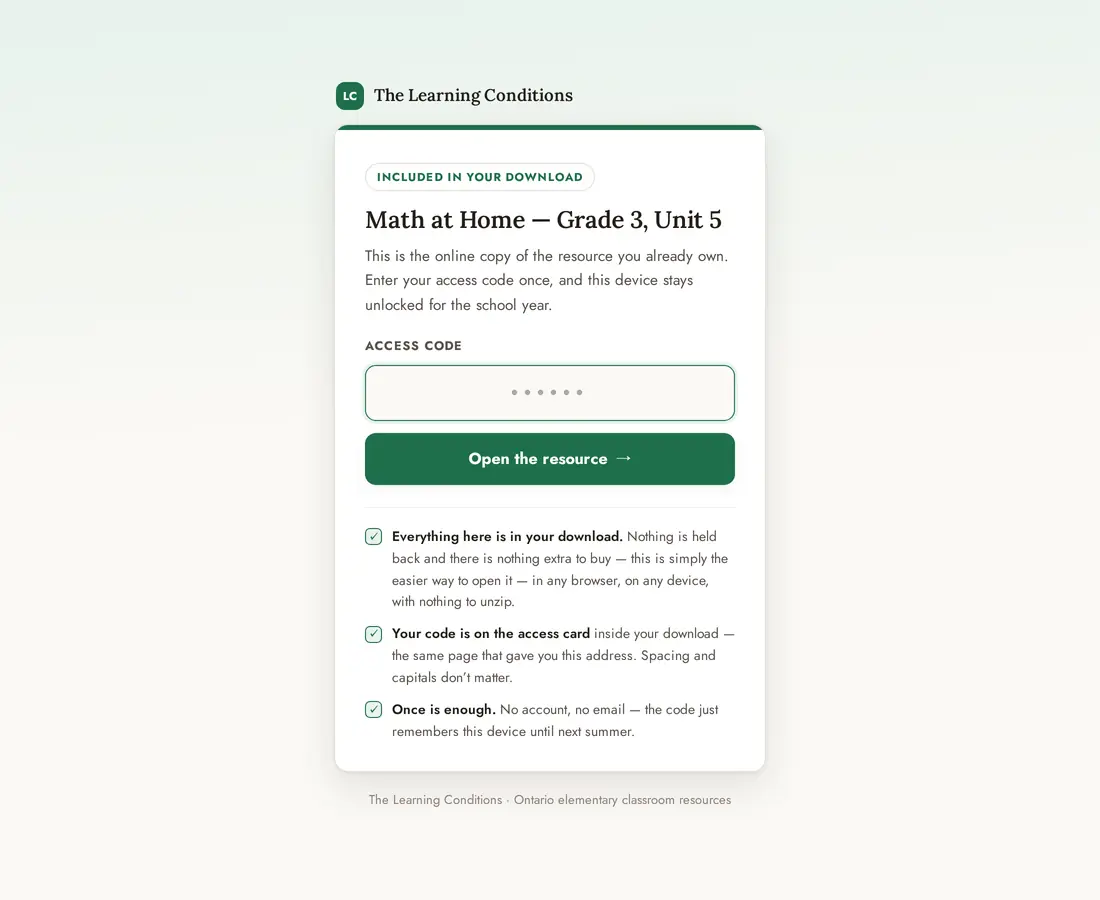
A complete part of this work is published free and open. The link below opens the real thing — not a demo — so the design can be judged rather than taken on description.
https://resources.mamtamotwani.org/free/place-value-unit/
Challenges
Questions made fresh each round can be technically valid and pedagogically wrong, and they arrive that way silently. A subtraction that never happens to require regrouping on a sheet whose whole purpose is regrouping. A comparison question where both numbers come out the same. Measurement in decimal centimetres on a page that promises whole numbers — that one reached the child in 88% of rounds on a page that said it would not, and it was found by machine rather than by reading. That class of defect is what forced the QA suite into existence, and it is why the questions are now checked against the finished pages a child actually sees.
Iteration
The iteration on this series is recorded in the checks that now run on it rather than in a changelog. Each defect found by running the questions at volume became a rule written back into the design and a check added against it, so the same failure could not return quietly in a later unit. The units built later inherit the rules that the earlier ones paid for.
Reflection
The Check is the design decision I would defend hardest and the one with the least evidence behind it. It is reasoned from formative-assessment principles and from what a parent can act on; it is not measured, and I have no data on whether families use it or what happens when they do. Unit 1 being free at least means the reasoning can be checked against the artefact instead of taken on trust. If I were to add measurement, it would have to be measurement that does not turn the Check back into a score, which is a harder design problem than it sounds.
Skills demonstrated
- Formative assessment design
- Learning-experience design for non-expert adults
- Non-repeating practice design
- No-account, on-device data design
- Print and worksheet design
- Ontario mathematics curriculum mapping
- Accessibility
Read next
Adult Learning
The Learning Conditions
A practitioner framework, published as a live site
Systems
Curriculum QA Suite
Pedagogical rules turned into pass-or-fail release checks
Adult Learning
Classroom Tools
Nine single-page tools, given away