Classroom Tools
Nine single-page tools, given away
- Tools
- 9
- Price
- Free
- Format
- One page, print or project
What this case study claims
Design decisions, intended behaviour and the reasoning behind them, plus counts verified against the built product. It does not claim learner outcomes, adoption or improvement: those have not been measured, and describing an intention as a result would be the easiest thing on this page to get wrong.
Overview
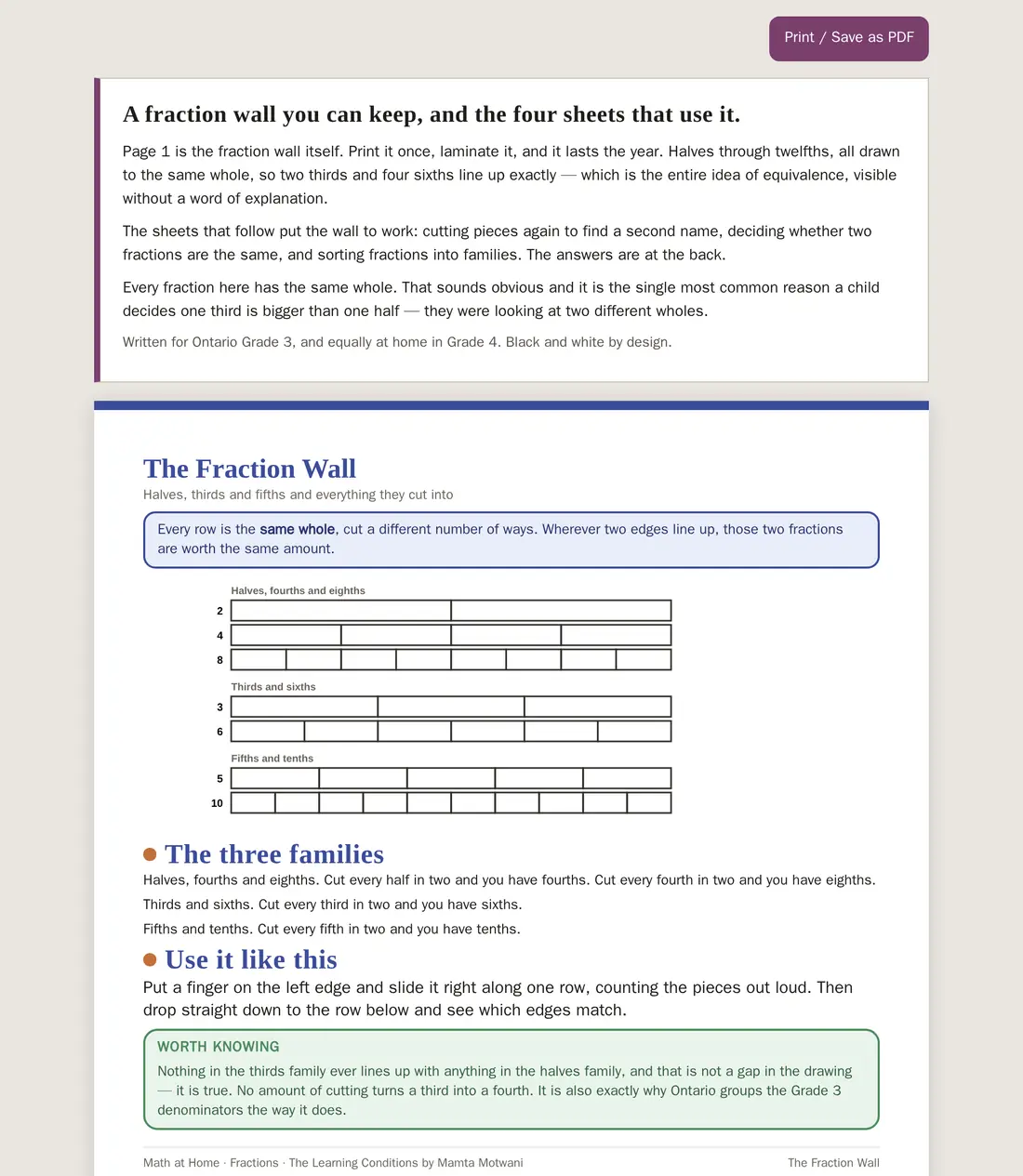
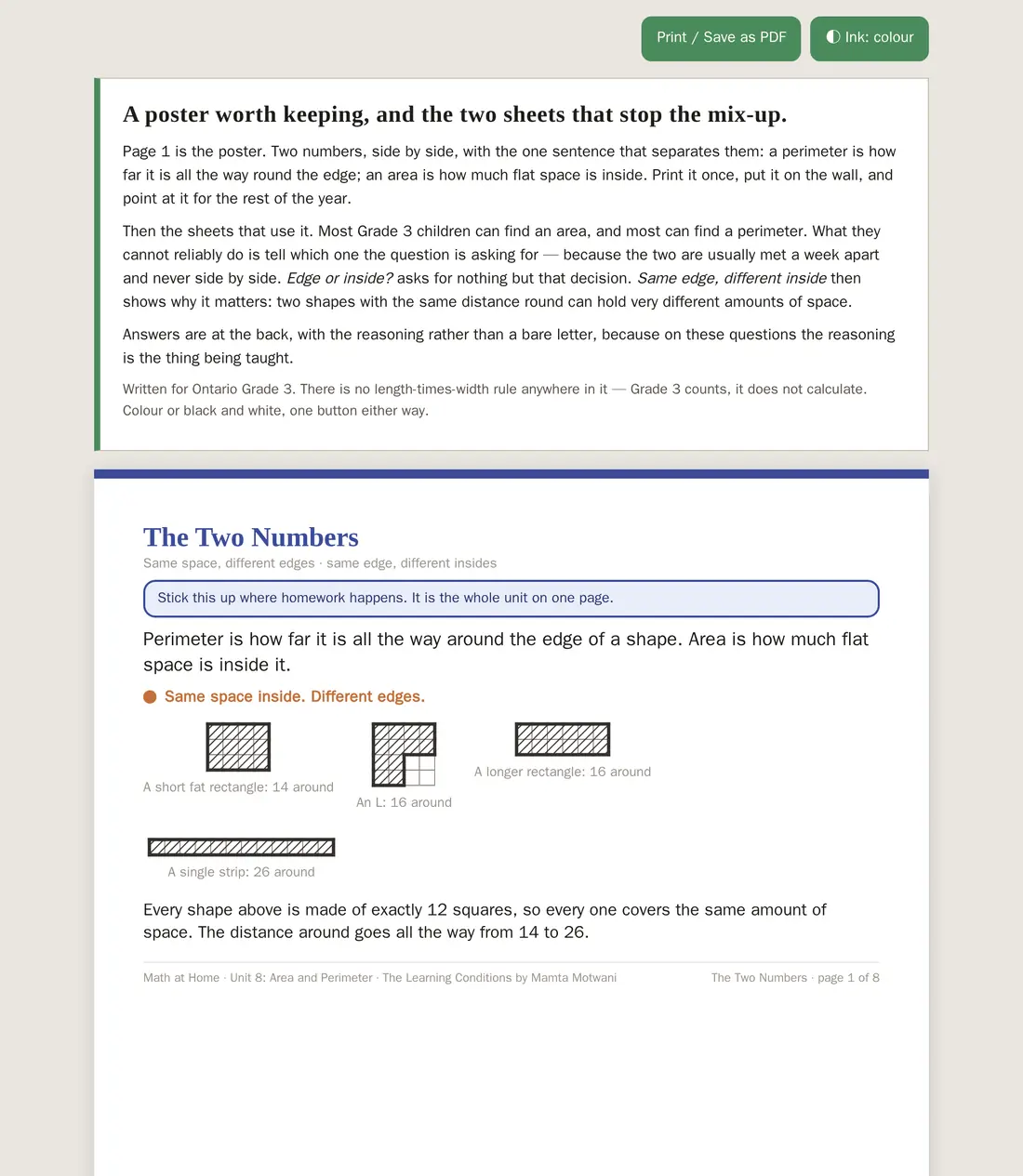
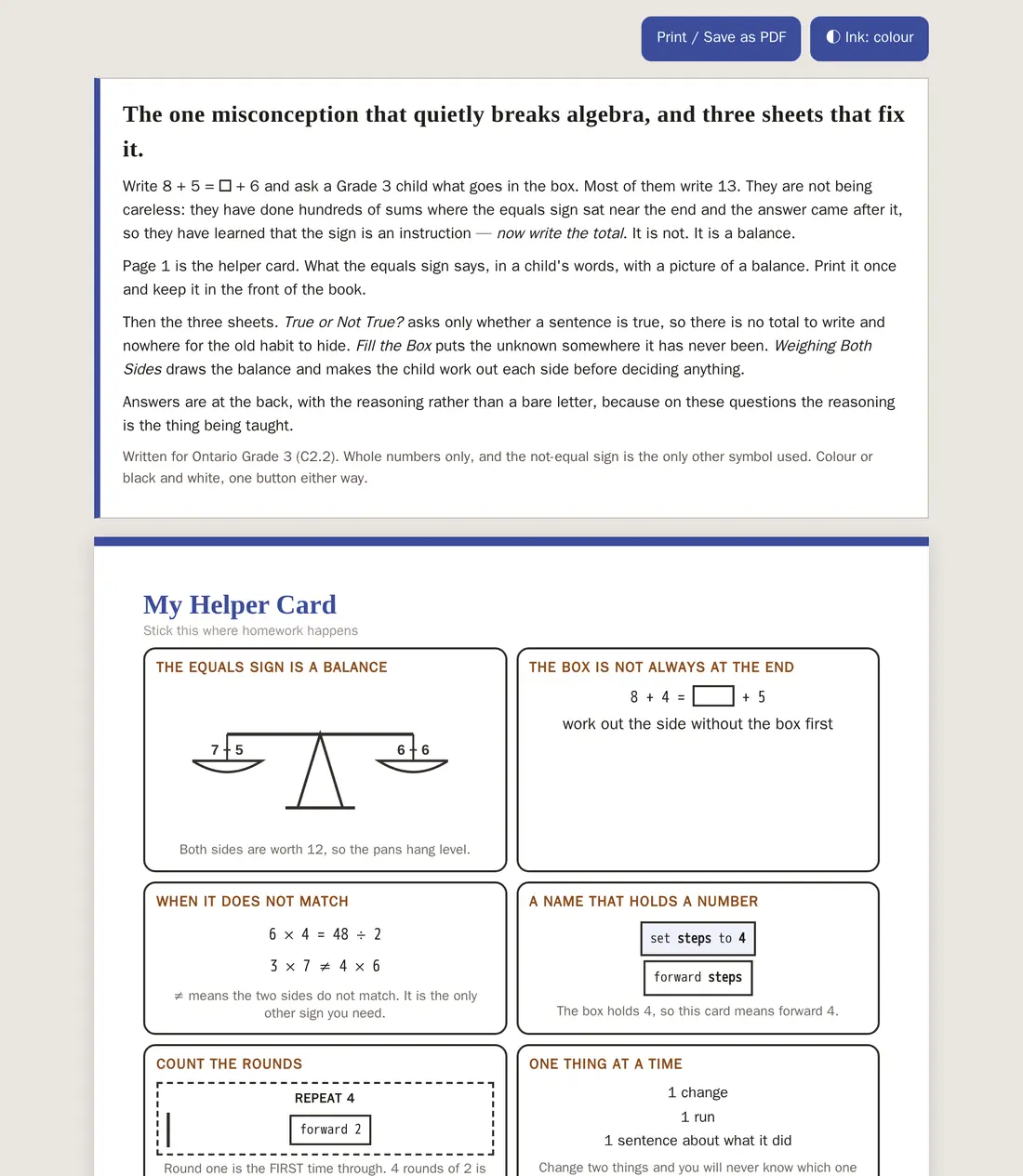
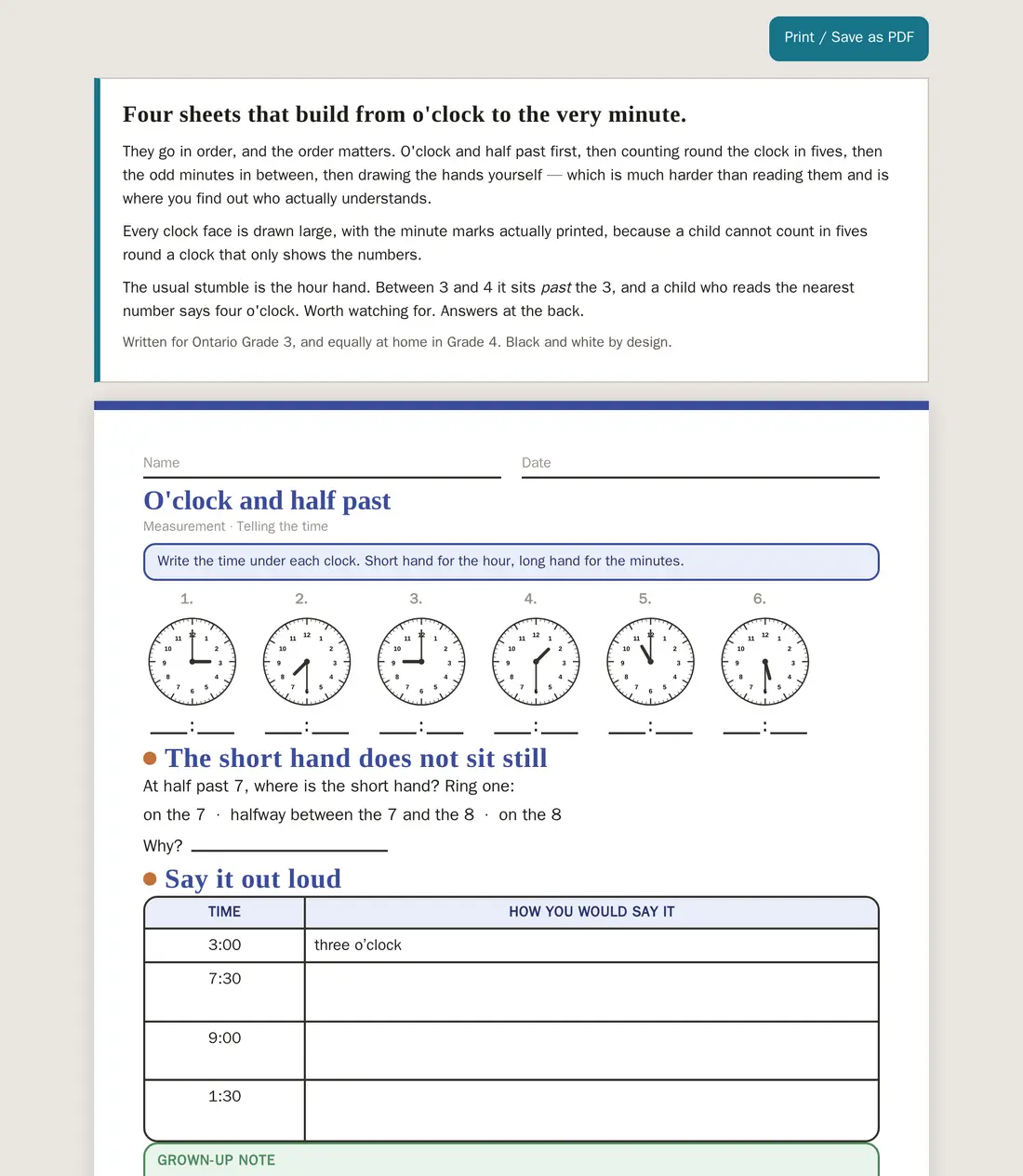
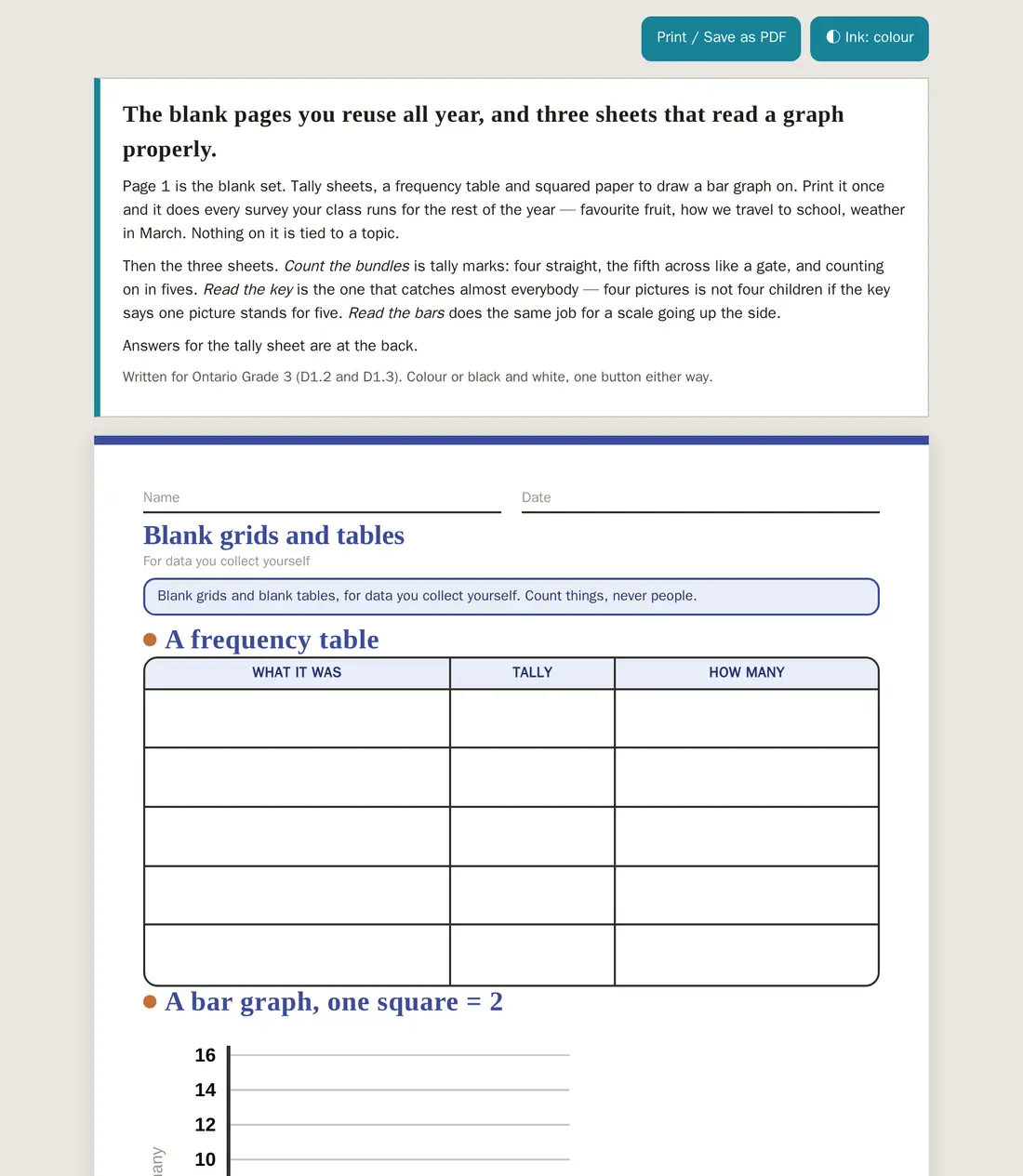
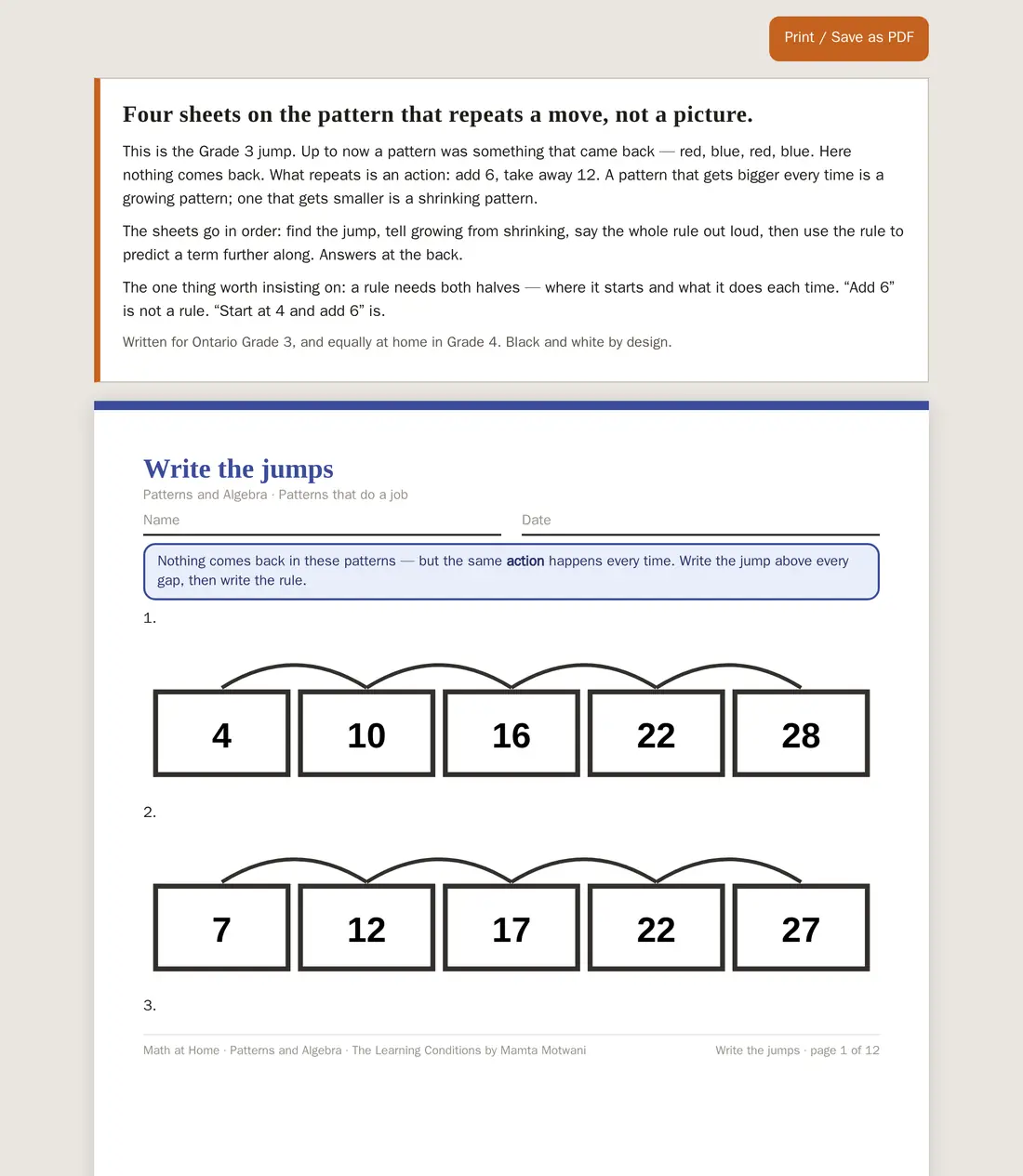
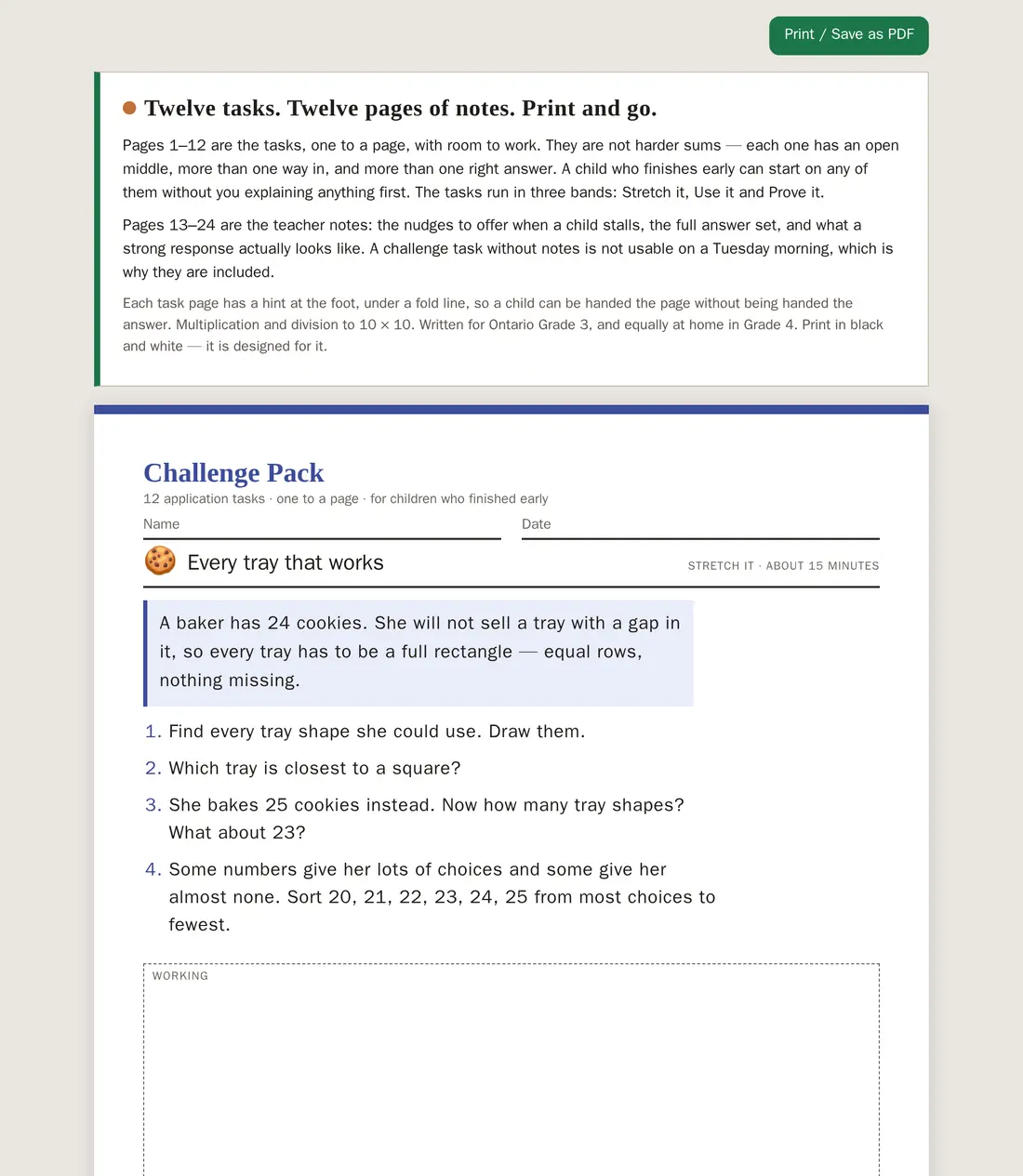
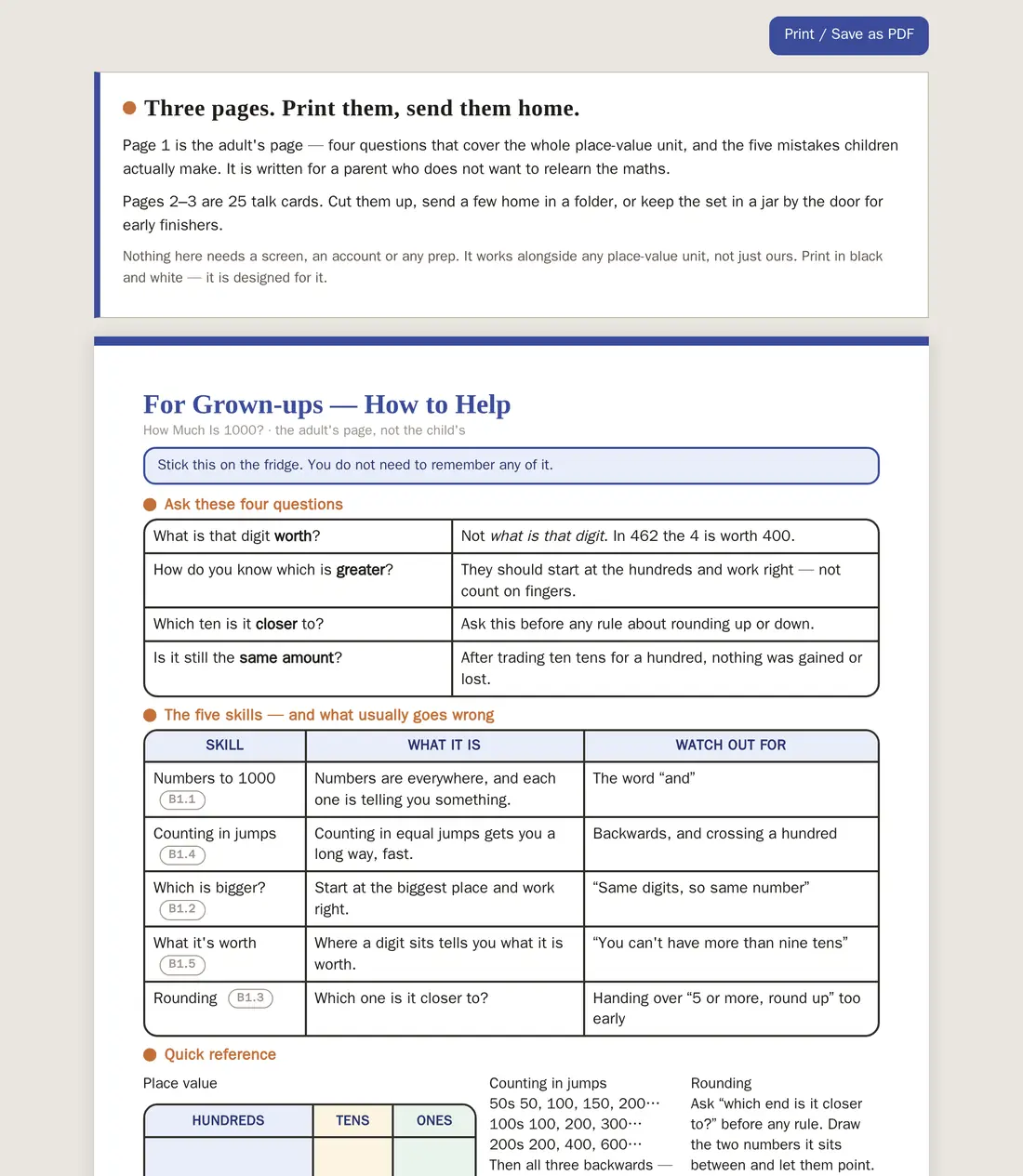
Nine single-page classroom tools, given away and openly linkable. Each is one page that does one thing and explains itself: a fraction wall drawn so every family shares the same whole, area and perimeter, telling time to the minute, the equals sign as balance, tally and pictograph and bar graph, growing and shrinking patterns, challenge tasks for early finishers, and talk cards with a guide for the adult using them.
Problem
A teacher preparing at 8:40 in the morning needs one page that works immediately, prints on a standard black-and-white office printer, and can be used without reading anything first. Most free classroom material fails at least one of those three conditions: it needs assembly, it needs colour, or it needs a page of instructions before it can be handed out. Each failure costs preparation time at the point in the day where there is none to spend.
Audience
Teachers who need something usable within ten minutes, and parents who have been handed a topic and no context for it.
My role
- Design of all nine tools — what each one carries, and what it deliberately leaves out
- Instructional writing, including the adult-facing guidance on each page
- Print and projection design
Goals
What the design set out to achieve. These are objectives, not results.
- One page, one idea, no assembly
- Usable projected on a board and printed in black and white, without redesign
- Explain the idea to the adult on the same page as the tool
- Give the work away openly, so it can be linked and judged directly
How it works
Each tool is a single self-contained page with everything it needs on it — nothing to unzip, no separate files to lose, nothing that breaks when the page is moved or emailed on. Each is published openly at its own address, so it can be linked from anywhere and used without an account.
Design decisions
The fraction wall is drawn to one whole
Halves through twelfths are all drawn against the same whole, so two thirds and four sixths line up on the page. That is the entire idea of equivalence, made visible without a sentence of explanation — and misreading two different wholes as the same is the single most common reason a child concludes that one third is larger than one half.
Black and white is the design, not the fallback
Nothing on these pages carries meaning through colour. A greyscale print is the complete tool, which matters on a school printer and is also the correct accessibility position.
The rationale sits on the page
Each tool includes a short note to the adult saying what the idea is and what children typically get wrong about it. It is the same principle as the parent guidance elsewhere in this portfolio: the person holding the sheet needs to know why, or they cannot answer the next question.
Free and openly linkable, deliberately
These nine are the part of the catalogue that can be handed to anyone with a URL. That makes them the honest evidence in this portfolio: not described, just opened.
Each of these follows from a published position rather than from taste. The reasoning is set out in The Learning Conditions, a framework of four conditions: a child must be able to be wrong at no cost, hold decisions that are genuinely hers, start without an adult, and have an adult nearby who knows what to say next.
AI’s role
These are small, hand-built pages. AI’s role in them was drafting and tightening the explanatory copy, and checking the printed output behaves at page boundaries. Nothing in the tools calls a model; they are static files that work offline.
Human judgment
Deciding what one idea each tool should carry, and refusing the second idea. Every one of these could have been three pages. The value is that it is one, and that judgement is about what a teacher can absorb at 8:40, not about what fits.
Experience
Open, and linked in full
A complete part of this work is published free and open. The link below opens the real thing — not a demo — so the design can be judged rather than taken on description.
https://resources.mamtamotwani.org/free/fraction-wall/
Challenges
The constraint that a tool must be complete on one page, and legible both projected on a whiteboard and printed at A4, pulls in opposite directions: projection wants large type and few elements, print wants density. The fraction wall was the hardest to hold to a single page while keeping every row on the same whole and every label readable at the back of a room.
Iteration
The nine tools were built alongside the larger units and several are extracted from them, which is its own kind of iteration: an idea that needed a whole page of its own inside a unit is a candidate to stand alone. The single-whole constraint on the fraction wall is the clearest case — it is the constraint that makes the tool worth having, and it came from the misconception, not from the layout.
Reflection
These are the least architecturally interesting things in this portfolio and the most immediately useful, which is worth being honest about. They are also the only artefacts here a reader can evaluate in thirty seconds without taking anything on faith. No download or usage figures are claimed; the tools are open, and that is the whole of the claim.
Skills demonstrated
- Instructional design at small scale
- Print and projection design
- Mathematical misconception analysis
- Single-page resource design
- Accessible, colour-independent design
Read next
Interactive Learning
Math at Home
Nine units of Grade 3 mathematics designed for the adult in the room
Adult Learning
The Learning Conditions
A practitioner framework, published as a live site