Grade 10 Math Crash Course
An MPM2D exam review built as a five-day plan, not a pile of practice
- Student workbook
- 42 pages
- Answer key
- 37 pages
- Questions
- 130, all worked
- Mock exam
- 40 questions, 60 minutes
- Topics
- 5, over a 5-day plan
- Course
- Ontario MPM2D
What this case study claims
Design decisions, intended behaviour and the reasoning behind them, plus counts verified against the built product. It does not claim learner outcomes, adoption or improvement: those have not been measured, and describing an intention as a result would be the easiest thing on this page to get wrong.
Overview
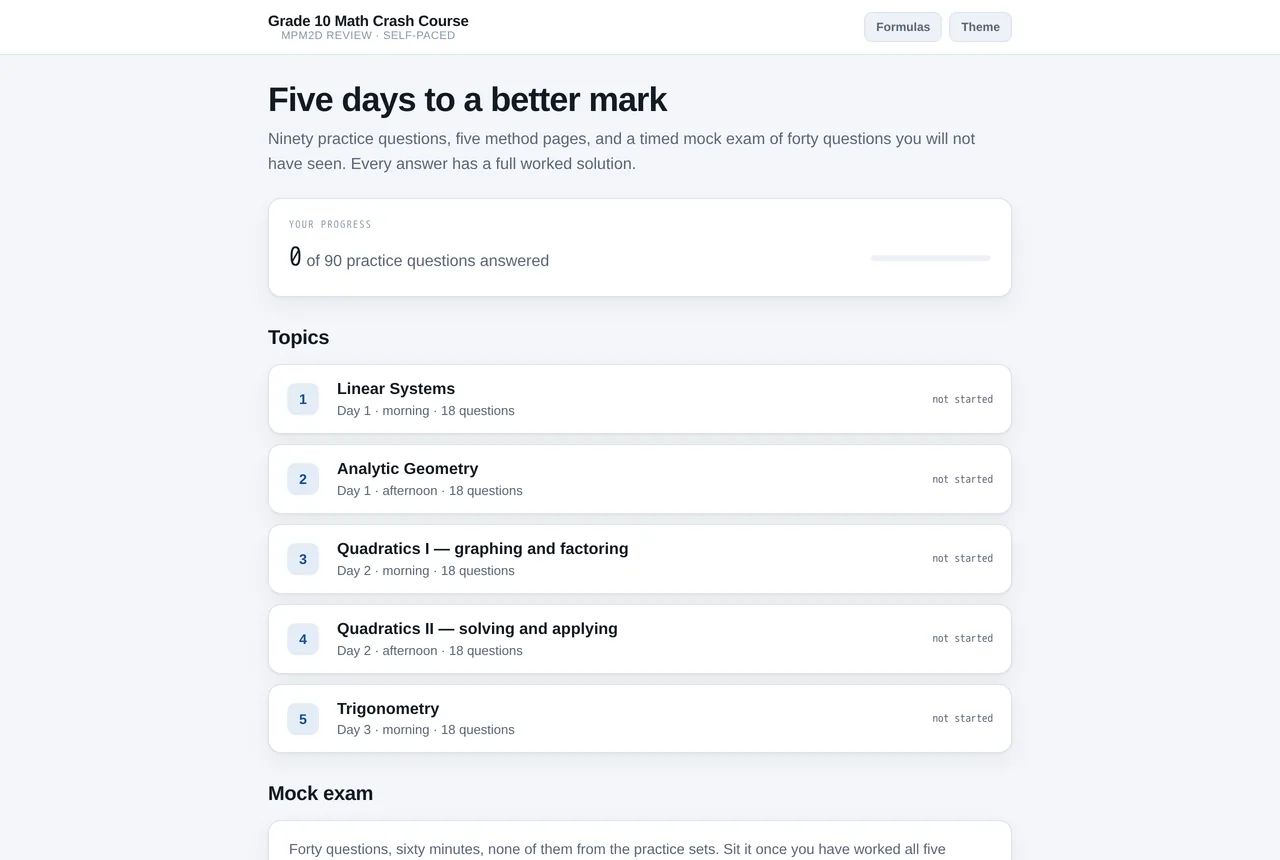
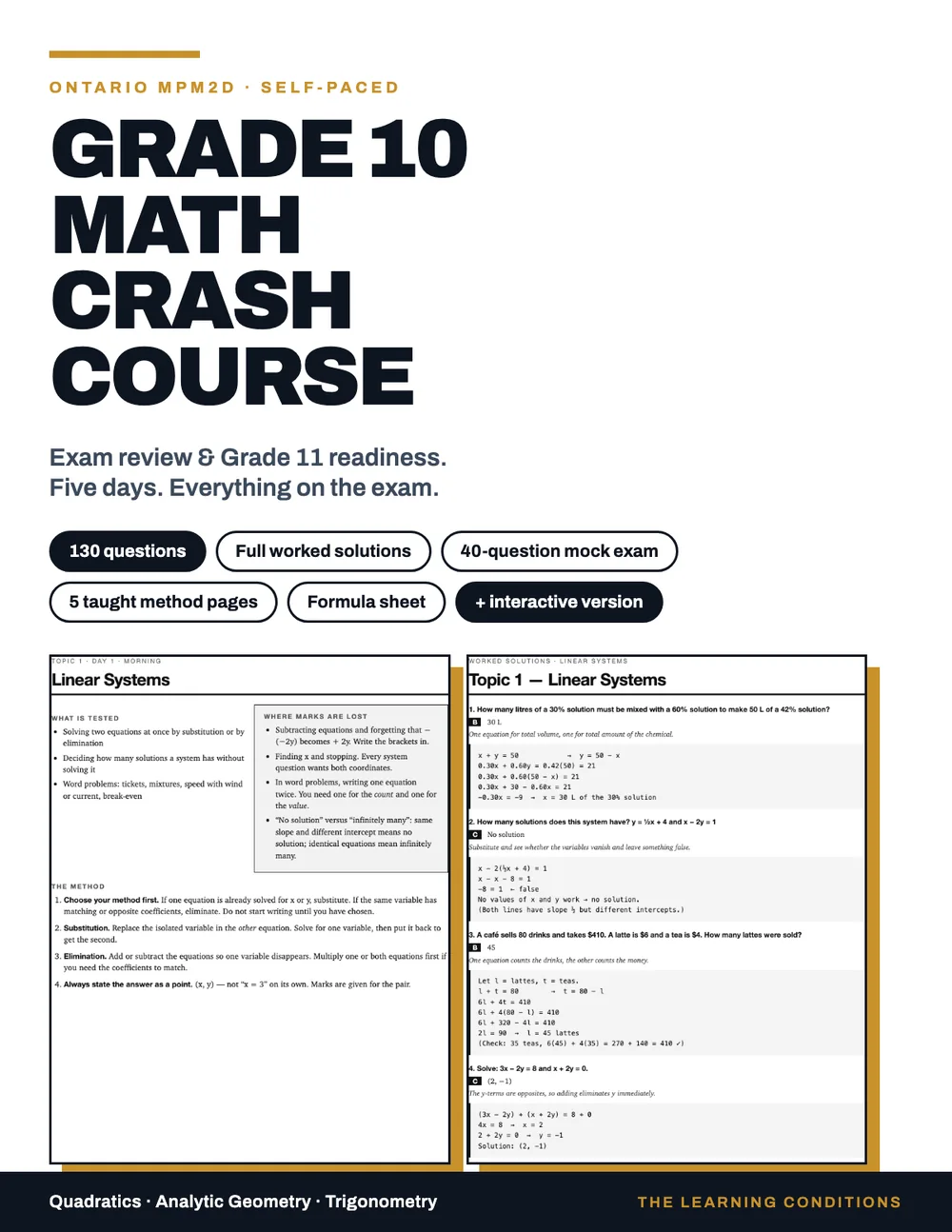
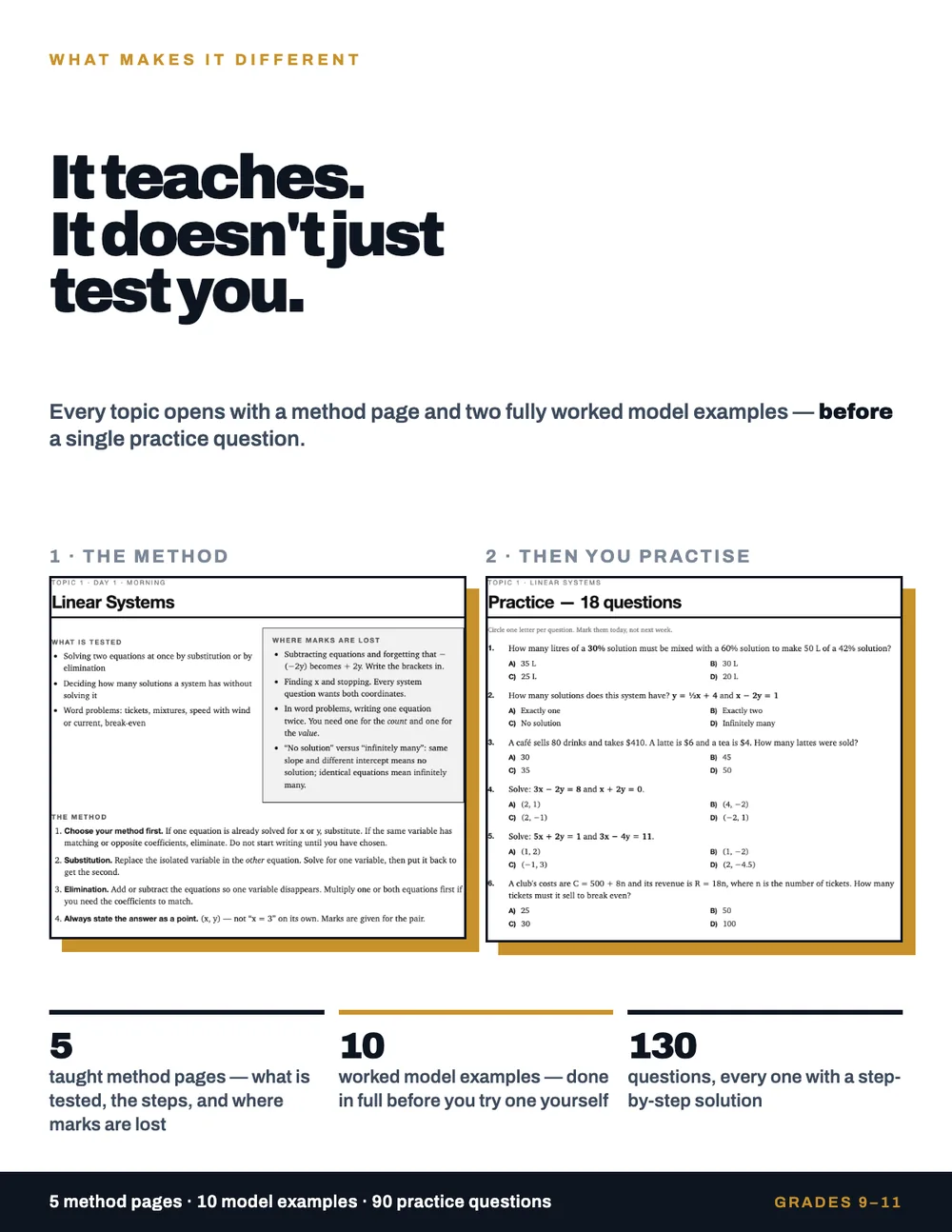
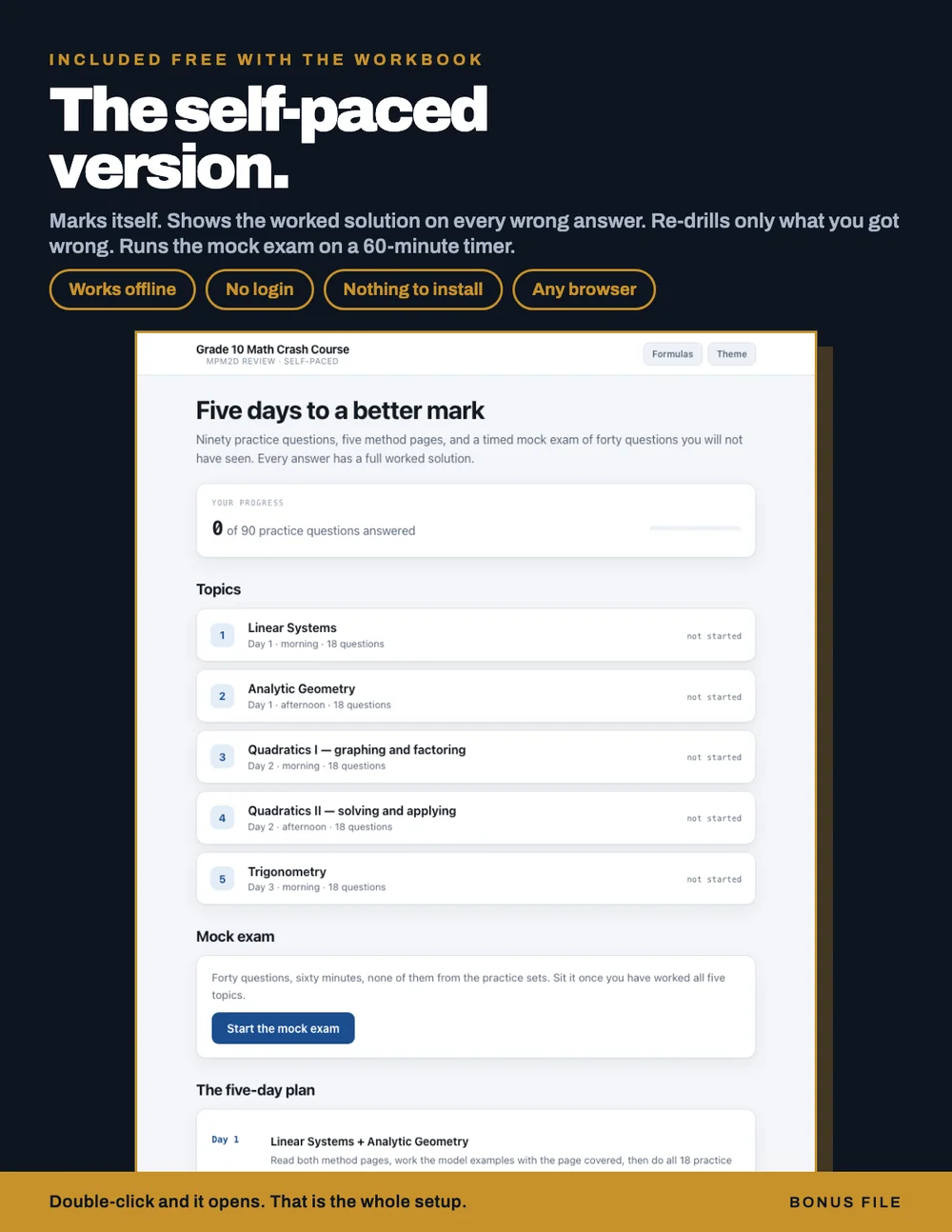
An exam review for Ontario Grade 10 Academic Mathematics, built in two forms from one source. The printed form is a 42-page student workbook and a separate 37-page answer key. The digital form is a self-paced site that runs offline in a browser, marks itself, and keeps a student’s progress on their own device. Both carry the same 130 questions — 90 practice across five topics, and a 40-question timed mock built from questions that appear nowhere in the practice sets — and every one of them is worked in full rather than answered.
Problem
Exam review arrives as a question bank, and a question bank is not a plan. A student two weeks from an exam does not need more questions; they need to know which topic is costing them marks and what to do on Tuesday. The second failure is subtler: most review packages reuse their own practice questions as the final test, so a student scores well on material they have already seen and walks into the exam with a false reading of where they stand.
Audience
Grade 10 Academic students revising alone, often the night before, on a phone. And the teacher or tutor handing it to them, who needs it to work without setup, accounts, or a licence per student.
My role
- Course architecture — the five topics, the five-day plan, and the order they are met in
- Question authoring — 130 questions with full worked solutions and a marking scheme for the long-answer set
- Assessment design — a mock exam disjoint from the practice sets, so the score means something
- Interaction design — the self-paced version, its progress model and its gap reporting
- Production — workbook, answer key, preview and the interactive build generated from one question bank
Goals
What the design set out to achieve. These are objectives, not results.
- Turn a question bank into a schedule a student can actually follow
- Make the mock exam a real measurement by keeping it disjoint from the practice
- Work every question in full, because the method is the thing being taught
- Run with no account, no install and no internet, on whatever device the student has
- Ship printed and interactive forms from one source so they cannot disagree
How it works
One question bank in structured data; four outputs generated from it. Each question carries its options, its correct answer, a one-line hint and a full worked solution, so the workbook, the answer key and the interactive version are three renderings of the same record rather than three documents maintained in parallel. The long-answer set additionally carries an explicit marking scheme — marks against what earns them — so a student can mark their own work the way the real paper is marked. The interactive build is a single self-contained HTML file: no framework, no CDN, no network calls, progress in local storage.
Design decisions
A five-day plan, not a table of contents
The five topics are scheduled — Day 1 morning, Day 1 afternoon, Day 2 morning, and so on. The structure answers "what do I do now", which is the question a student two weeks out is actually asking.
The mock is disjoint from the practice
Forty questions, none of which appear in the ninety. Reusing practice questions as the final test is the single thing that makes a review package feel thorough and measure nothing.
Every question is worked, not answered
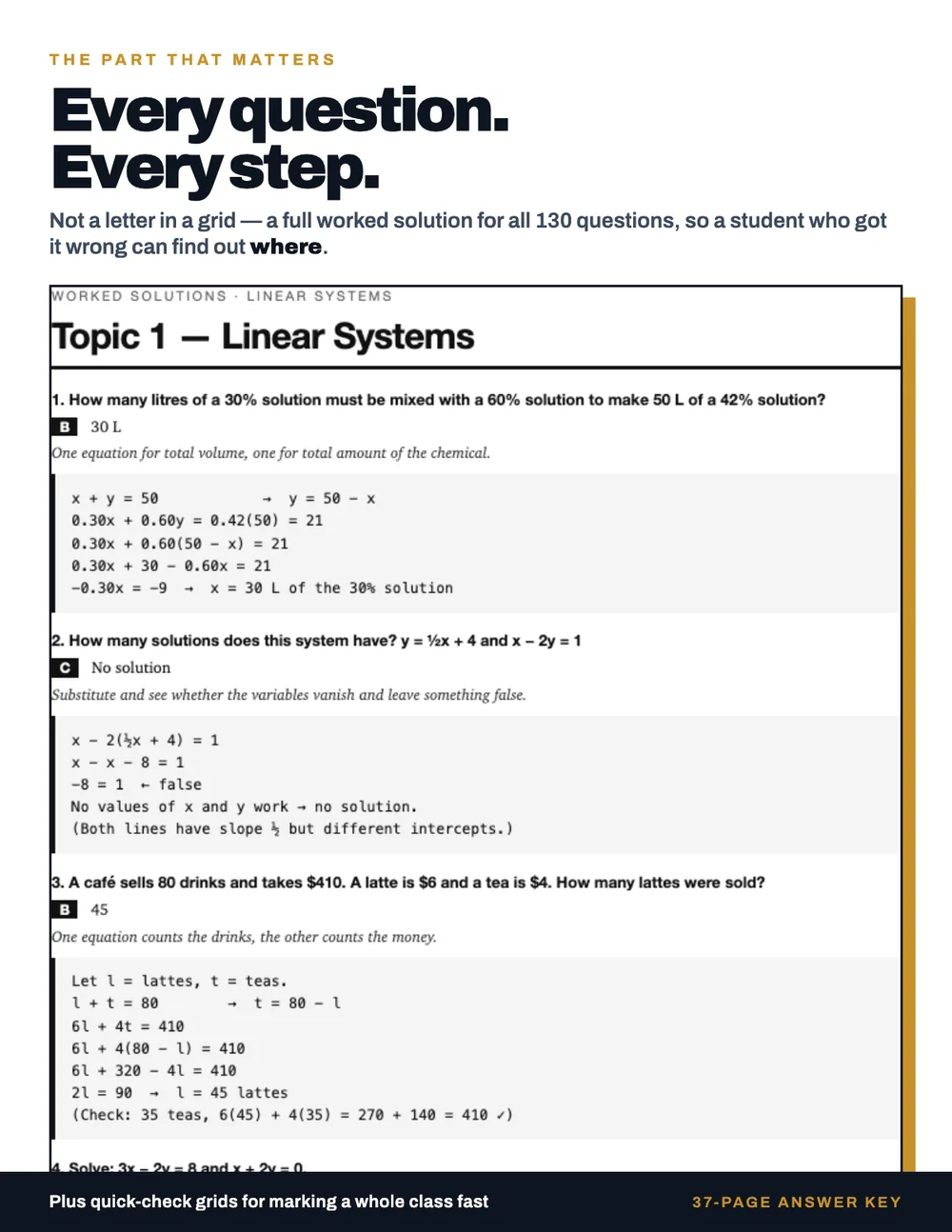
An answer tells a student they were wrong. A worked solution tells them where. The answer key is 37 pages for 130 questions because the working is the product.
The marking scheme is shown, not hidden
Long-answer questions carry their mark allocation line by line, so a student can see that verifying the solution is worth a mark and that the method carries more than the final number.
One file, no account
The interactive version is a single HTML file that opens from a download and works on a phone with no signal. A revision tool that needs a login is a revision tool that gets abandoned at the first friction.
AI’s role
Drafting and rendering: generating candidate questions against each topic specification, and producing the workbook, the key and the interactive build from one bank so the three cannot drift apart.
Human judgment
Whether a question is actually at MPM2D level rather than adjacent to it. Whether a distractor is the mistake a Grade 10 student really makes or a wrong answer nobody would pick. Which five topics carry the exam and what order they should be met in. Whether a worked solution shows the step where students lose the mark, or skips it because it is obvious to someone who already knows.
Experience
Shown from the outside only
This unit is a paid product, and the teaching material is the product. What follows shows its front door and describes its architecture in words. No lesson pages, printables, assessments or games are reproduced, and no screenshot here contains text a reader could re-type and use.
Challenges
Keeping the mock genuinely disjoint. It is easy to write forty new questions; it is harder to keep them the same difficulty and the same style as the practice while sharing none of the same numbers, and to verify that after every regeneration of the bank.
Iteration
The plan came late. The first build was five topic sections and a final — correct, and useless to a student with a week left. Scheduling the topics across days, and putting a progress tracker in front of them, was what turned a set of questions into something a student could act on.
Reflection
This is the only secondary-level project in the collection and the only one that produces a printed book and an interactive tool from the same source. The constraint that shaped it most was the one that shapes everything here — it has to work on a school laptop with no account and no internet, which rules out most of what an exam-prep product would normally be.
Skills demonstrated
- Ontario MPM2D curriculum
- Assessment design and marking schemes
- Question authoring with full worked solutions
- Single-source publishing to print and interactive
- Offline-first interaction design
- Progress modelling and gap reporting