Grade 2 Language Hub
A full year of Reader’s and Writer’s Workshop, September to June
- Units
- 10, September to June
- Pages
- 788
- Slide decks
- 191
- Printables
- 544
- Games
- 32
- Curriculum
- Ontario Grade 3 Language (2023)
- Status
- Complete, not published
What this case study claims
Design decisions, intended behaviour and the reasoning behind them, plus counts verified against the built product. It does not claim learner outcomes, adoption or improvement: those have not been measured, and describing an intention as a result would be the easiest thing on this page to get wrong.
Overview
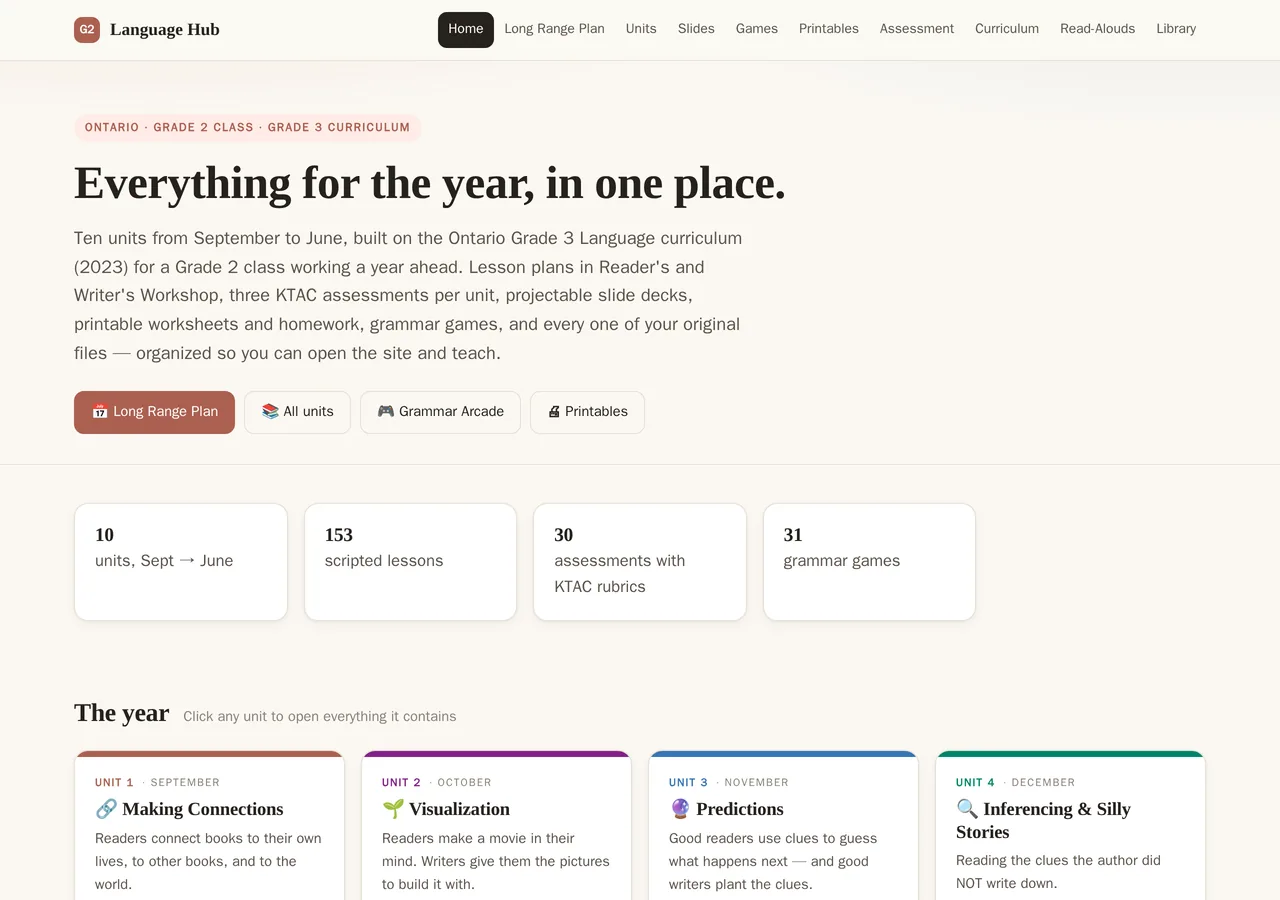
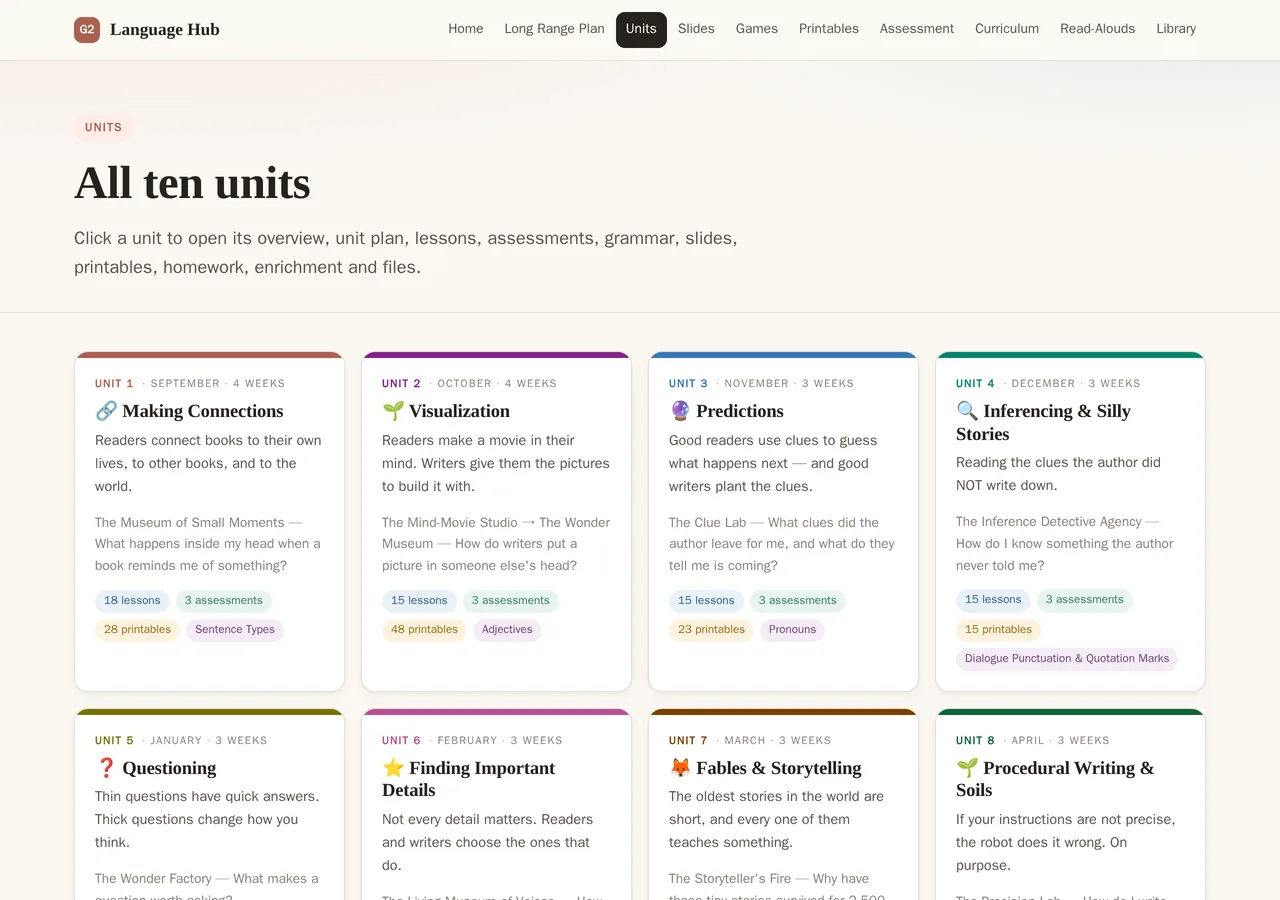
Ten units of Reader’s and Writer’s Workshop for a Grade 2 class working a year ahead, published as an offline website of 788 pages. Each month is a unit, each unit is a classroom frame — The Museum of Small Moments in September, The Clue Lab in November, The Storyteller’s Fire in March, a Freckle Juice book club in June — and each frame gives that month’s writing a real audience. Alongside the units sit 191 slide decks, 544 printables, 32 grammar games, and a curriculum page that quotes every Grade 3 Language expectation verbatim from the Ministry document rather than paraphrasing it. The teacher’s own 242 existing files are absorbed into the site, sorted by unit and searchable, with the originals left untouched.
Problem
A year of literacy usually arrives as ten disconnected units, and grammar arrives as a separate strand taught on Fridays. Neither is how a child experiences writing. The harder problem is that a teacher already has years of accumulated material — documents, decks, PDFs — and any new system that ignores it asks them to abandon their own work to adopt it. The requirement was a year-long structure where every unit has a stated audience, the grammar is taught inside that unit’s writing, and the teacher’s existing files are carried in rather than replaced.
Audience
One Grade 2 class taught the Grade 3 curriculum, and the teacher planning it — someone who needs to open a unit on a Monday in November and teach from it that morning.
My role
- Curriculum architecture — the ten-unit year, its frames, and the grammar sequence running through them
- Unit and lesson writing — all ten units, with the Reader’s and Writer’s Workshop structure scripted
- Assessment design — observation, conversation and product for each unit, on one shared achievement frame
- Interaction and visual design — the site, 191 decks, 544 printables and 32 grammar games
- Migration — absorbing 242 existing teacher files into the structure without altering the originals
Goals
What the design set out to achieve. These are objectives, not results.
- Give every unit a real audience, so the writing has somewhere to go
- Teach grammar inside the writing of the month rather than as a parallel strand
- Quote the curriculum expectations verbatim so coverage can be checked rather than trusted
- Absorb the teacher’s existing material instead of asking them to abandon it
- Run offline, on a school laptop, with no login and nothing to install
How it works
One generated static site. Unit content lives in three Python modules, games in another, page layouts in a fifth; a single build produces the units, the decks, the printables and the library. Because every page is generated from one source of truth, a unit page, its deck and its printables cannot drift apart — the failure mode that makes hand-assembled curriculum unreliable by the third revision. The site is self-contained: it opens from a folder, works with no internet, and the slide decks are keyboard-driven so a teacher can present without a second tool.
Design decisions
The month is a place, not a topic
Each unit is a classroom frame with a real audience — a museum, a clue lab, a company of actors. The frame is what makes the writing worth finishing, and it is chosen before the lessons are written rather than added as decoration afterwards.
Grammar sits inside the unit
Sentence types in September, quotation marks in December, conjunctions in March. Each grammar focus is chosen because that month’s writing needs it, so it is practised in the piece rather than on a worksheet beside it.
Expectations are quoted, not paraphrased
Every code on the site carries the Ministry’s exact wording, extracted from the curriculum PDF. Paraphrase is where coverage claims quietly stop being true.
The teacher’s own files are first-class
All 242 existing documents are sorted by unit and linked from the unit they belong to, with a searchable library page. The originals are copied, never edited — adopting the system costs nothing already made.
Offline first
A school network is the constraint, not the internet connection at home. The whole year runs from a folder with no login and nothing to install.
AI’s role
Generation and consistency work: drafting unit and lesson prose against a fixed structure, producing the printables and decks from one source, and extracting the curriculum expectations from the Ministry PDF so the wording on the page matches the document exactly.
Human judgment
Every pedagogical decision. Which frame a month gets, and whether it gives the writing a real audience or just a theme. Which grammar belongs in which unit. Whether a lesson is teachable in the time a Grade 2 morning actually has. Whether a class working a year ahead is ready for a Grade 3 expectation in November or should meet it in February. None of that is legible from a curriculum document.
Experience
Shown from the outside only
This unit is a paid product, and the teaching material is the product. What follows shows its front door and describes its architecture in words. No lesson pages, printables, assessments or games are reproduced, and no screenshot here contains text a reader could re-type and use.
Challenges
The hardest part was the existing material. Absorbing 242 files without editing them meant the structure had to bend to what was already there rather than the other way round — sorting by unit, linking from the right place, and making it searchable, while leaving every original byte-identical.
Iteration
The frames came before the lessons and were revised most: several months were rewritten because the audience was implied rather than real, and a frame that a class cannot actually perform for someone is only a theme with a better name.
Reflection
This is the largest thing in the collection and the only one with no product descended from it. That is a deliberate position rather than an oversight — it was built for one class, and the question of whether a year of literacy should become a commercial product is different from the question of whether it works in the room it was made for.
Skills demonstrated
- Curriculum design across a full school year
- Reader’s and Writer’s Workshop structure
- Assessment design on a single achievement frame
- Static site generation from a single source of truth
- Content migration without altering source material
- Ontario Language curriculum (2023)