Master Growing Success
A self-paced e-learning course for teachers on Ontario’s assessment policy
Who it’s for: Ontario teachers, Grades 1–8
The work
- 5
- 38
- 90 to 110 minutes, in five sittings
- One printable page per module
- Ontario teachers, Grades 1–8
- Independent professional learning; not an AQ, not Ministry-endorsed
Shown here, not opened. Not published openly: structure, a few screens and the design decisions are shown; walkthrough on request.
In short
- Learners
- Ontario teachers, Grades 1–8
- Problem
- Teachers can define assessment for, as and of learning, and still cannot apply the distinction to their own planning.
- My decision
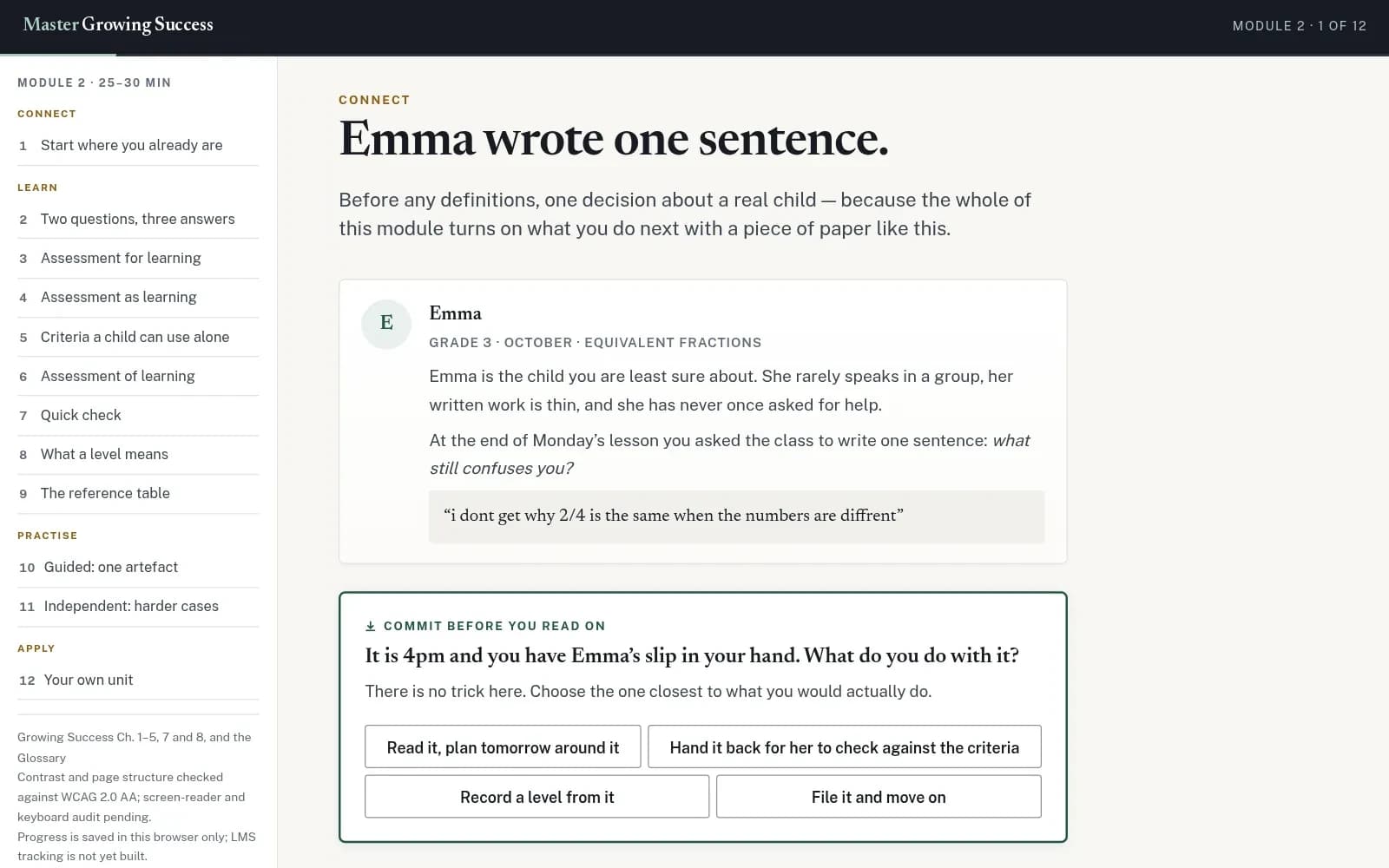
- Commit before the definitions. Module 2 opens on one Grade 3 child’s exit slip and asks the teacher what they would do with it, before any definition appears.
- AI’s part
- AI sped up drafting and building. What each module teaches, the evidence it rests on and every claim it makes were my calls.
- Measured
- Design, structure and counts are checked against the built work. Learner outcomes have not been measured yet.
My key teaching decision
Commit before the definitions
Module 2 opens on one Grade 3 child’s exit slip and asks the teacher what they would do with it, before any definition appears. The teacher meets the idea as an answer to a decision they have already made, not as a term to memorise.
How I used AI: AI sped up drafting and building. What each module teaches, the evidence it rests on and every claim it makes were my calls.
The thinking behind it
The whole case study: the learners, the problem, every design decision, what AI did and what it could not decide, and what has and has not been measured.
Read the thinking
Overview
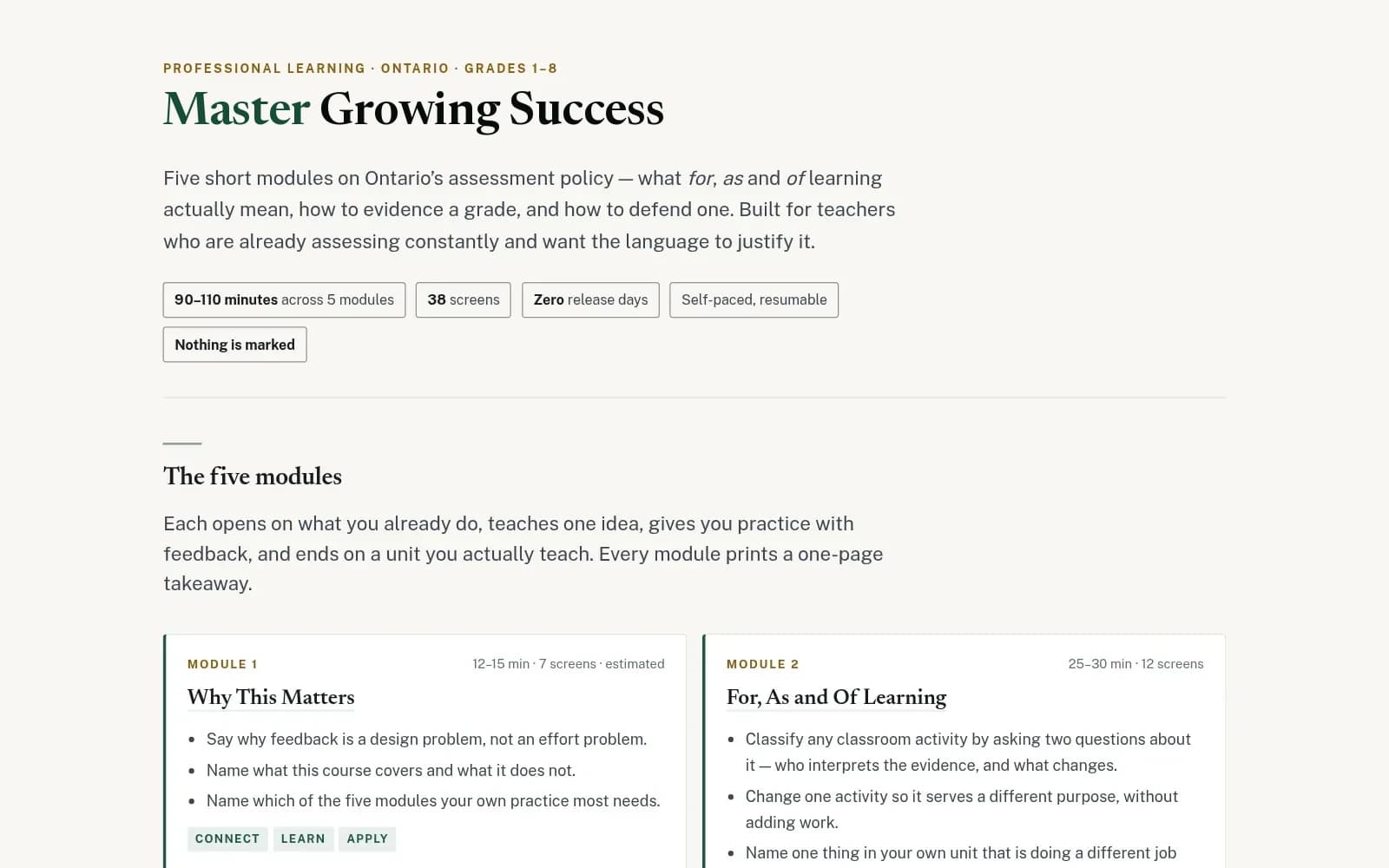
Five self-paced modules on Ontario’s assessment policy, Growing Success (2010), for teachers in Grades 1 to 8: Why This Matters; For, As and Of Learning; Triangulation; From Evidence to a Grade; and Your Own Unit, Audited. There are 38 screens, about 90 to 110 minutes in all, taken in five sittings. Each module opens on what the teacher already does, teaches one idea, gives practice with feedback, and ends on a unit the teacher actually teaches. Every module prints a one-page takeaway. Nothing is marked, and progress stays in the teacher’s own browser.
The problem
Teachers can define assessment for, as and of learning, and still cannot apply the distinction to their own planning. They also undervalue observation and conversation as evidence, even though the policy makes all three sources count toward a grade. The course exists to fix that one gap, and anything that did not serve it was cut.
Who it is for
Ontario Certified Teachers in Grades 1 to 8, often with many years in the classroom, who can recite the definitions but find them hard to apply. They are adults with a lot of experience, so the course starts from their practice, not from the definitions.
My role
- Course design: what the course is for, what it leaves out, and the five-module sequence
- Instructional writing for experienced teachers
- Assessment design: quick checks, guided and independent practice with feedback, and the unit audit
- Source discipline: every quotation from the policy carries its chapter
- Accessibility and print design: the one-page takeaway for every module
What it had to do
Objectives the design set out to meet. They are aims, and none is reported here as a result.
- Classify any classroom activity by asking two questions: who interprets the evidence, and what changes
- Tell observations, conversations and products apart, and read the shape of one student’s evidence
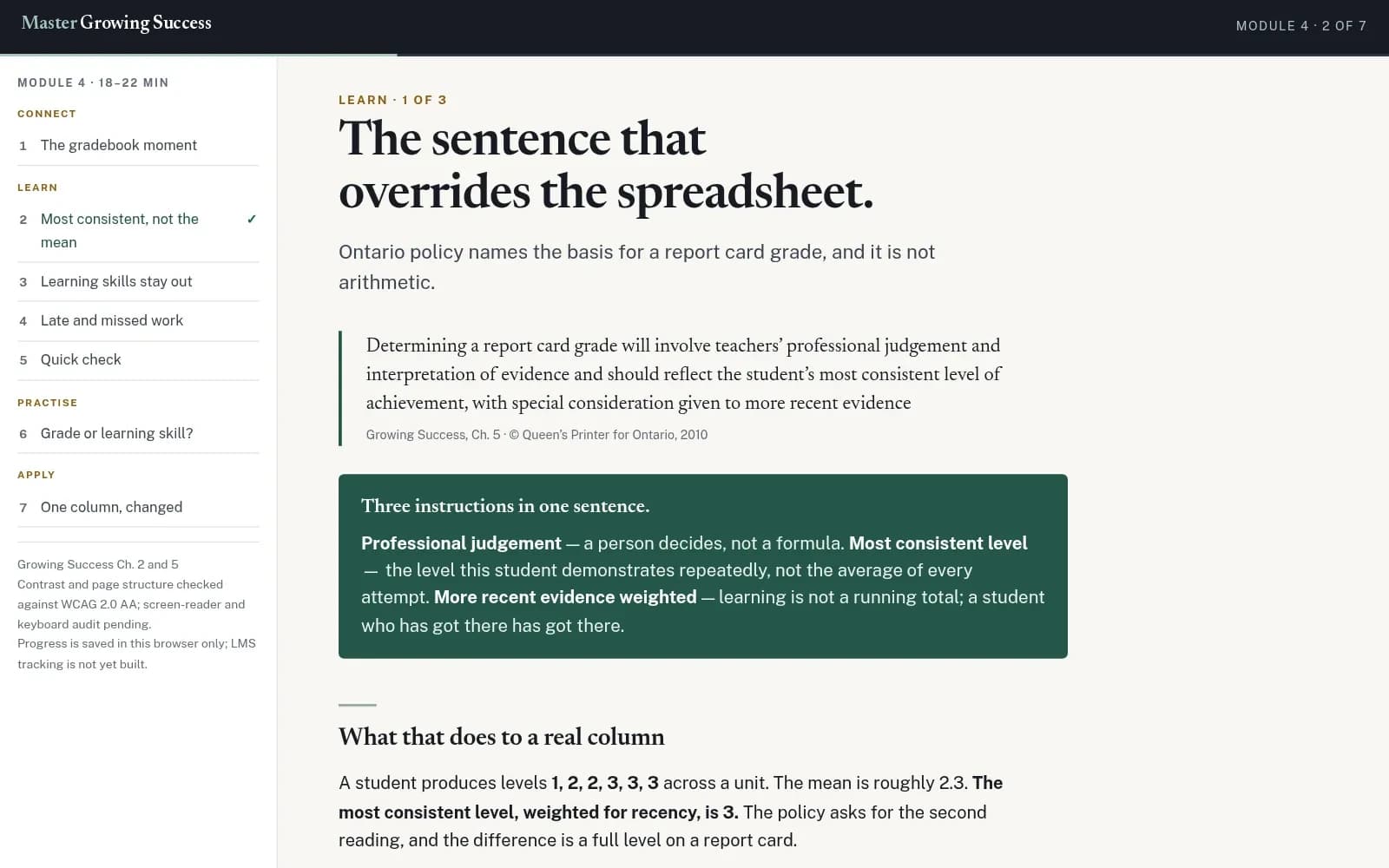
- Determine a grade from most consistent achievement, using calculation to inform and judgement to decide
- Keep learning skills out of the grade, and know what the policy actually permits on late and missed work
- Leave with a printed audit of a unit the teacher actually teaches, and one change to make
How it works
Each module is a single self-paced page with a running list of its screens, grouped as connect, learn, practise and apply. Screens, practice items and tables are kept as structured content and built into the pages, so a change is made once. Progress is saved in the browser, so a teacher can stop and come back. Every module prints a one-page takeaway. The course is independent professional learning: it is not an Additional Qualification and is not endorsed by the Ontario Ministry of Education, and it says so on every takeaway.
Design decisions
Commit before the definitions
Module 2 opens on one Grade 3 child’s exit slip and asks the teacher what they would do with it, before any definition appears. The teacher meets the idea as an answer to a decision they have already made, not as a term to memorise.
Two questions, not three definitions
For, as and of learning are taught through two questions a teacher can ask about any activity: who is going to interpret this evidence, and what will change because of it. The same activity can serve any of the three purposes, and the questions show which one it is serving.
The balance audit
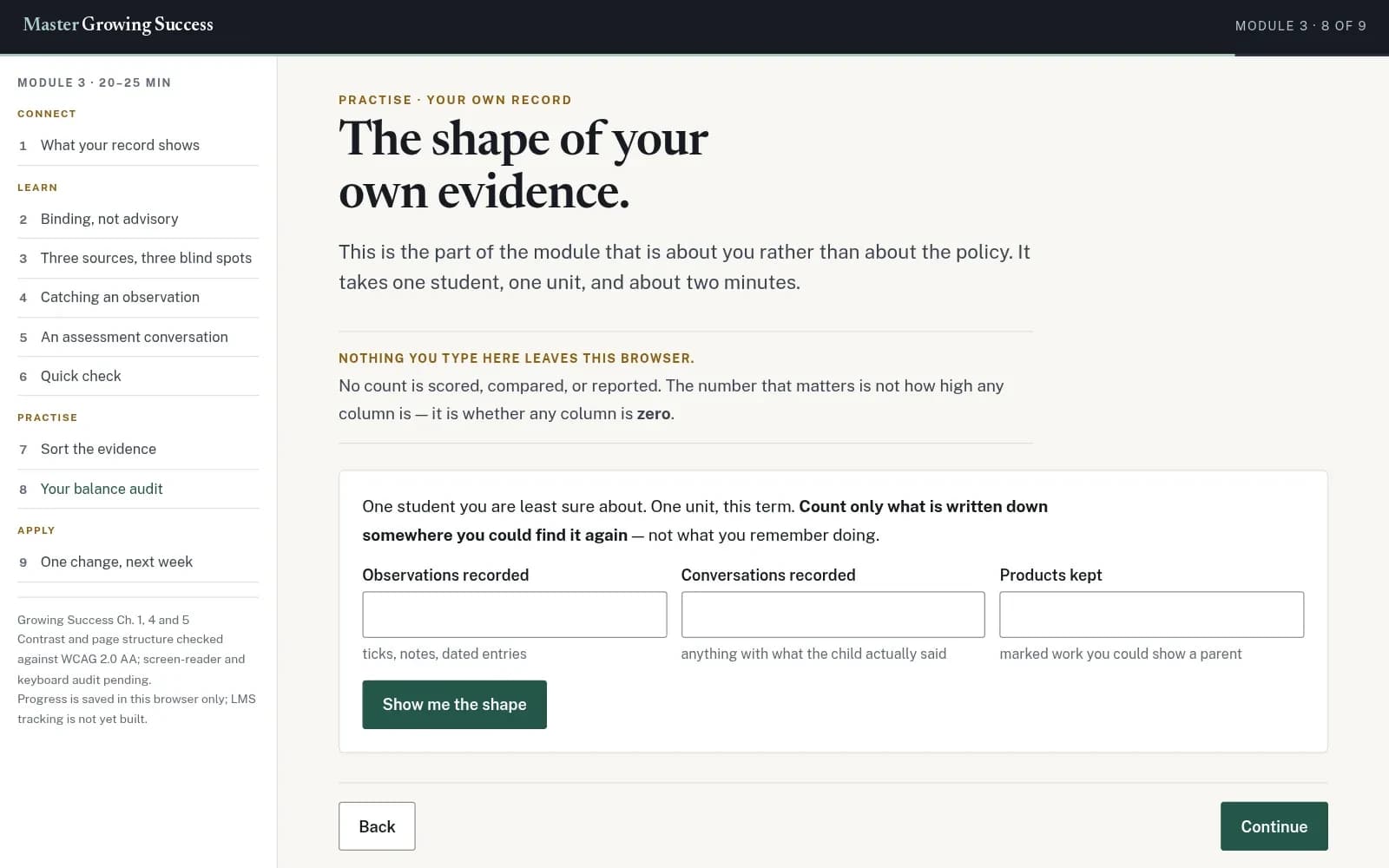
Module 3 asks the teacher to count only what is written down for one student in one unit: observations, conversations and products. Nothing is scored or reported. What matters is not how high any column is but whether any column is zero.
Quote the policy, never paraphrase it into a rule
Every quotation from Growing Success carries its chapter, so a teacher can find it and defend a decision with it. The policy is quoted, not reproduced.
End on the teacher’s own unit
Module 5 is an audit of one unit the teacher actually teaches, against the four modules before it. The course is a success if the teacher leaves holding that printed audit with one change named on it.
What I knew from teaching
Most of the judgement was about what to leave out. The achievement chart in depth, report card comments and secondary-only material (the 70/30 split, credit recovery, e-learning) were moved out of scope for this course. Research claims got the same discipline. A well-known feedback finding is shown with its caveat on the screen: it comes largely from lab and workplace studies, not classrooms. Figures that came only from a secondary summary were removed until they could be checked in the original papers.
AI’s role
AI sped up drafting, building and checking. What the course is for, what each module teaches and leaves out, which evidence it rests on, and every claim it makes were my calls.
What was hard
Writing for experienced teachers without lecturing them. They already assess all day and can recite the terms, so every module had to start from something they do and give them practice on cases that are genuinely hard, not a restatement of the definitions.
What changed along the way
The plan went through several drafts, revised after design and content audits. Designed to WCAG 2.0 AA; contrast on control borders was then raised to meet WCAG 2.1’s 3:1 for controls. Only Module 2 has been timed against a real read, at 25 to 30 minutes. The other times are estimates, which is why the length is given as a range.
Looking back
This is the same design method as my classroom work, applied to adult learners: start from what the learner already does, ask for a commitment before the explanation, and end on something they keep and use. Here the thing they keep is an audit of their own unit.
Skills
Let’s build better learning.
Hiring for a teaching, curriculum or learning-design role, or need curriculum writing, e-learning, a teacher workshop or tutoring? Tell me what you are trying to make possible.