The 15-Minute Morning
A character framework put inside the fifteen minutes a school already has
- Activities
- 111 — 37 greetings, 34 games, 40 questions
- Under a pillar
- 74, with 37 kept deliberately general
- Grade bands
- Two — 1–3 and 4–6, filtered throughout
- Output formats
- Screen, projected slides, print
- Accessibility
- WCAG 2.0 AA verified, both themes
- Status
- Complete, in use
What this case study claims
Design decisions, intended behaviour and the reasoning behind them, plus counts verified against the built product. It does not claim learner outcomes, adoption or improvement: those have not been measured, and describing an intention as a result would be the easiest thing on this page to get wrong.
Overview
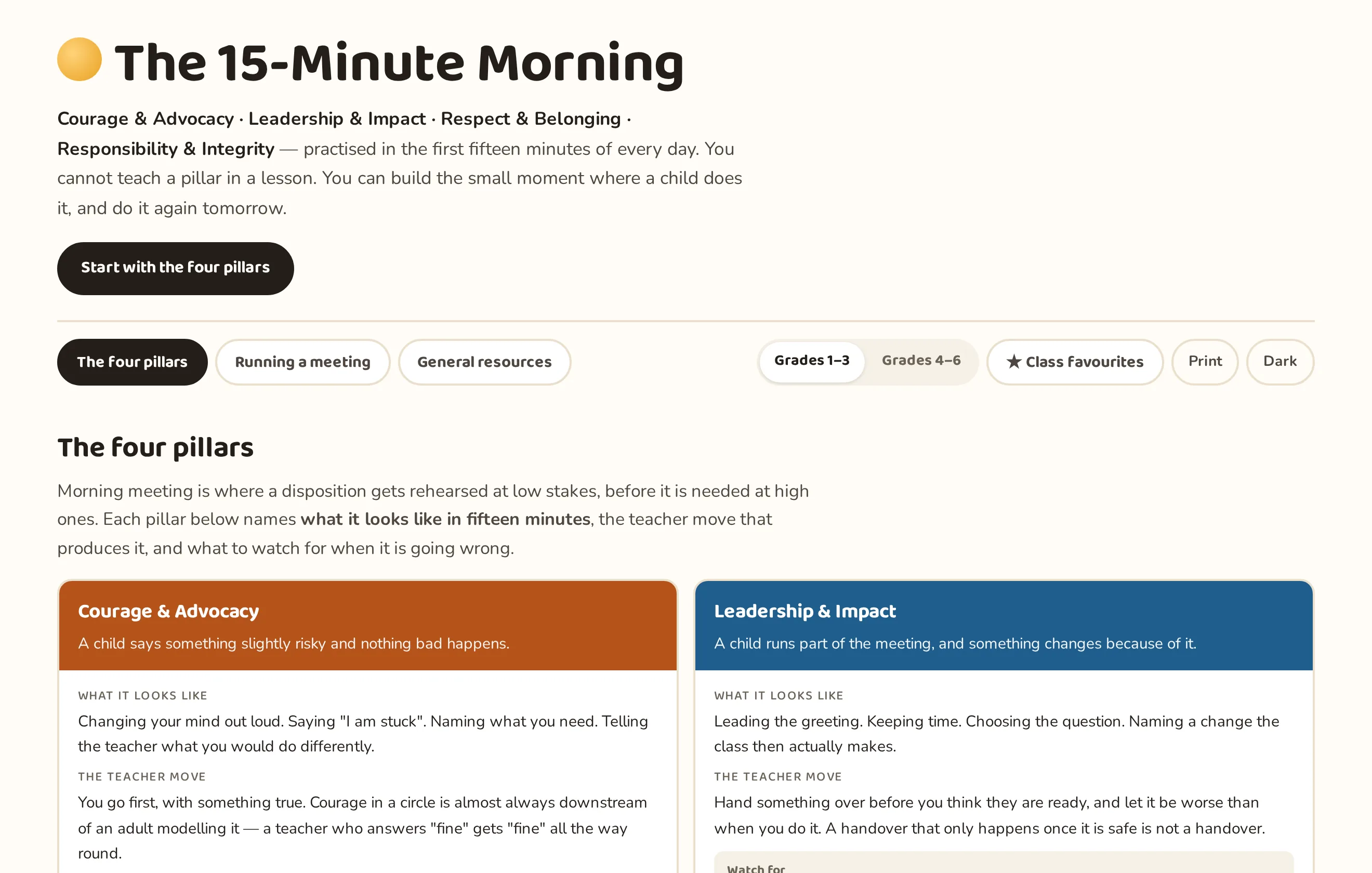
A morning meeting resource for elementary teachers, built around the four character pillars a school had adopted for the year — Courage and Advocacy, Leadership and Impact, Respect and Belonging, Responsibility and Integrity. 111 activities across greetings, games and questions, 74 of them tagged to a pillar and 37 kept deliberately general, every one banded for Grades 1–3 or 4–6. Navigation is pillar-first: a teacher opens a pillar and sees only what practises it. Every view also projects as a slide deck and prints as a handout, so the same material works on a screen, on a wall and on paper.
Problem
A character framework normally arrives as posters, an assembly and a line in the newsletter, and then competes for time against a curriculum that has none to give. Teachers are asked to build courage and belonging without being told which fifteen minutes of the day it happens in. The result is a set of values that everyone can name and nobody can point at. The second problem is specific to resource banks: a teacher deciding at 8:48 what to run at 8:50 will not read a rationale. If choosing takes longer than doing, the routine is dropped by October — which is what happens to most morning meeting schemes.
Audience
Classroom teachers Grades 1 to 6, choosing under time pressure at the start of a day, on whatever device is nearest — often a phone. Also school leaders introducing the framework to staff, who need the structure to be legible without a walkthrough.
My role
- Instructional design — the pillar-first structure and the grade banding
- Writing — all 111 activities, including the rule that makes each game work and what to do when it does not
- Front-end build — the library, the projected decks, the print stylesheets
- Accessibility engineering — colour system, contrast, keyboard and screen-reader behaviour
- Verification — automated audits of data integrity, contrast and link health
Goals
What the design set out to achieve. These are objectives, not results.
- Make each pillar visible in a real fifteen minutes rather than in an assembly
- Get a teacher from opening the page to running something in under a minute
- Keep general activities separate, so the framework never becomes the only reason to use the site
- Work on a phone, a projector and a printer without a second version
How it works
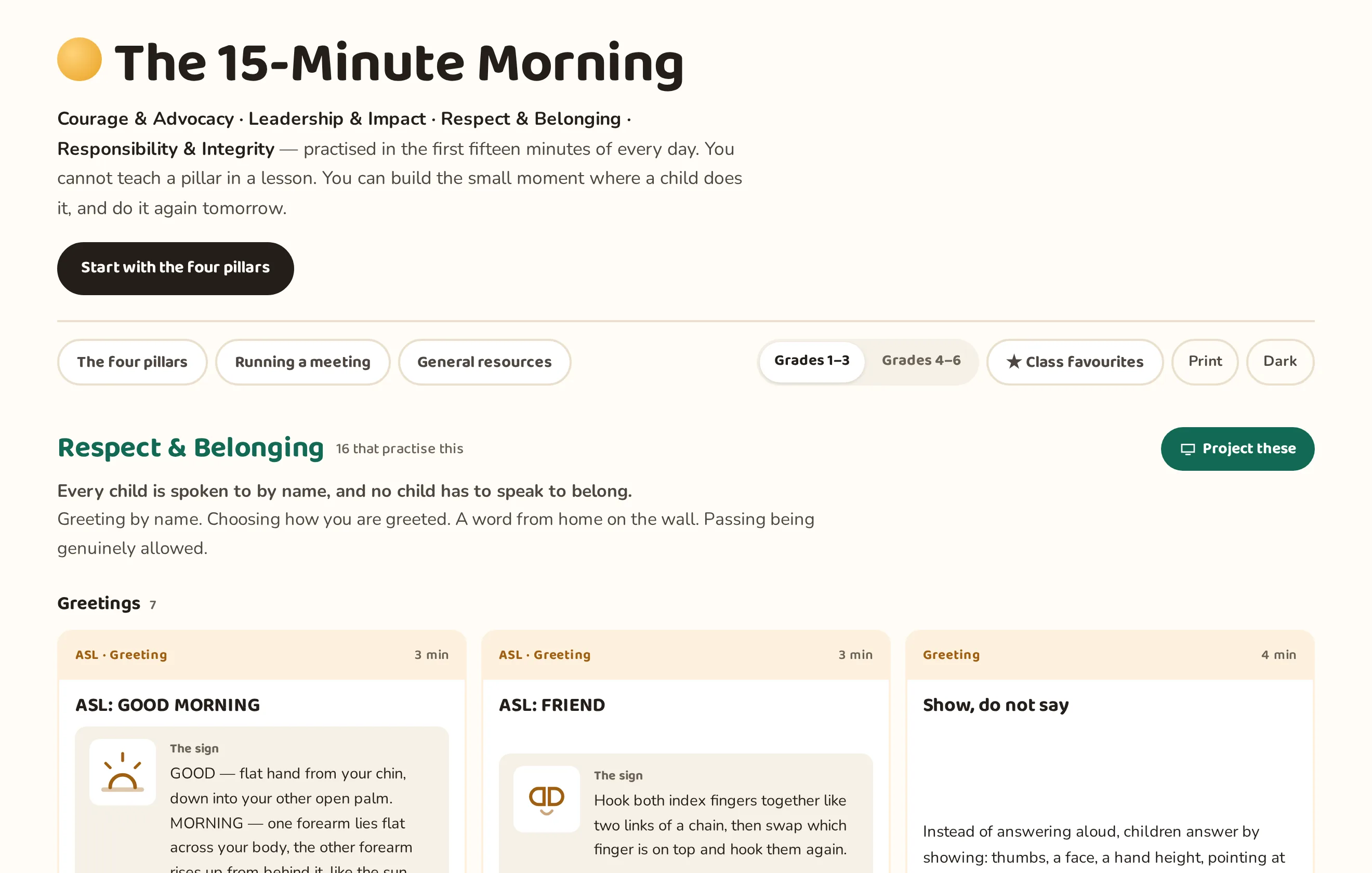
One page, one data file, no build step and no backend. Every activity is a record carrying a duration, a grade band, an optional pillar, the moment it is meant to create, why it works, and a one-line prompt used when the activity is projected. Games carry four more fields: the setup, the play, the one rule that makes it work, and what to do when it goes wrong. That single record drives three outputs. On screen it is a card. Projected, the prompt becomes a full-bleed slide in the pillar’s colour. Printed, the collapsed detail is forced open, because the instructions are the only reason to print a game. Nothing is duplicated between the three, so a correction lands everywhere at once. Favourites persist in the browser alone. There are no accounts, nothing is transmitted, and the site has no record of any class.
Design decisions
The framework is the navigation, not a filter
Tagging activities by pillar and offering a filter would have been less work and would have buried the framework behind a control nobody presses. Making each pillar a destination means a teacher asked to work on belonging opens Respect and Belonging and sees sixteen things that practise it. The cost is that every pillar must be genuinely stocked — no pillar may open on a thin page, which set a floor of four greetings, four games and four questions in each grade band.
A general tab, so the framework does not eat the site
Thirty-seven activities are deliberately left untagged. A resource where everything maps to a pillar reads as compliance, and teachers discount it accordingly. Keeping a third of the library outside the framework is what keeps the tagged two-thirds credible.
The sample names the agreement each step practises
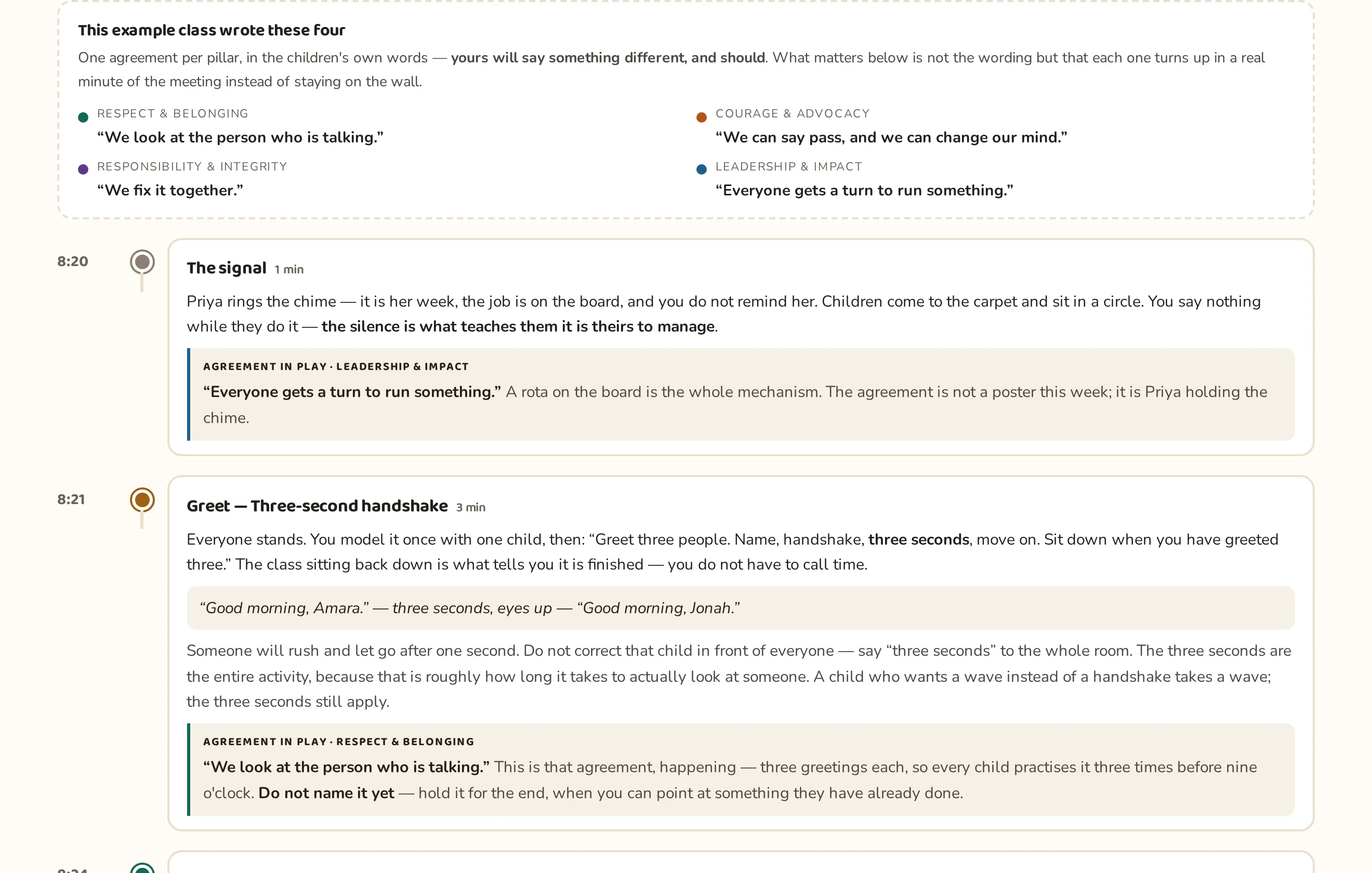
The worked fifteen minutes is timed from a real start time and annotated: the chime is Leadership and Impact, the handshake is Respect and Belonging, the restart on the counting game is Responsibility and Integrity. It also says when not to name it — naming the agreement mid-activity turns it into a lesson about respect, so it is held until the hand-over.
Two grade bands, because a greeting ages
What works for seven-year-olds reads as babyish to nine-year-olds, and the same greeting list used across a school is the most common reason morning meeting dies in the junior grades. Every activity declares a band, and the band filter applies to every view, every deck and every printout.
Every game carries its own failure mode
Each game states the one rule that makes it work and what to do when it collapses — the untangle that cannot be solved, the counting game where nobody speaks, the guesser who finds the leader instantly because the class is staring. A resource that only describes the successful version leaves a teacher stranded the first time it goes wrong, which is also the last time they try it.
Colour was computed, not chosen
The three activity colours were validated for colour-vision deficiency by simulating deuteranopia, protanopia and tritanopia and measuring separation in OKLab. Two earlier palettes failed — a teal and navy pairing collapsed under tritanopia — and were rejected before anything was built on them.
AI’s role
Drafting at volume and checking at volume. The activity records were drafted conversationally and then revised heavily against what actually happens in a room of twenty-six. The larger contribution was verification: scripted audits that re-ran on every change — data integrity across all 111 records, WCAG 2 AA scans across both themes, both grade bands, every view and every deck, contrast maths computed rather than eyeballed, and every external link fetched to confirm it still resolved.
Human judgment
What each activity is for. An AI will write a greeting; it will not tell you that fingerspelling your name is useless to children who do not yet know the alphabet, or that a teacher who answers "fine" gets "fine" all the way round the circle, or that the fifteen uncomfortable seconds after the teacher stops starting the meeting are the entire point and rescuing them teaches the opposite lesson. Every judgement about what a six-year-old can actually do came from the classroom, not the model. The same applies to the framework. Deciding which activities honestly practise a pillar — and refusing to tag the ones that do not — is a professional judgement, and the thirty-seven untagged activities are the evidence it was made rather than avoided.
Experience
Built for one school, and closed
This was commissioned by a school for its own staff, and it stays with them. There is no link from this page. What follows shows the structure and the reasoning in words and screenshots; the activities themselves are not reproduced here.
Challenges
The first build pointed teachers at the pillars as an abstract idea and expected them to make the connection. It did not survive contact: a pillar is not actionable until it is attached to a specific minute of a specific activity. Rebuilding the navigation so each pillar owned its own page forced a content audit that exposed the real problem — the tagged activities had drifted towards Grades 4–6, and Courage and Advocacy offered a Grade 2 teacher two things. Filling that took twenty new activities written specifically to the gaps. An accessibility audit late on found the muted text colour failing AA by a fraction across roughly a hundred elements, and two controls that were invisible in dark mode because their colour tokens inverted underneath them. Both were the kind of defect that no amount of looking at the page reveals.
Iteration
It went through four structural rewrites: a scheme of work, then a flat library, then a library with a pillar filter, then a pillar-first structure with a separate general tab. Each change came from a specific failure rather than a preference — the scheme of work prescribed days nobody would follow, the flat library made the framework invisible, and the filter made it optional. The staff-session deck was built and then deliberately withdrawn. Its presenter notes rendered on the projected slide, one step promised a feature that had been removed, and no step carried a duration — defects that are survivable when the author presents and are not when someone else does. It stays out until those are fixed.
Reflection
The useful finding is that a values framework becomes real at the point where it is attached to a repeated minute. Not a lesson about courage, but a game where changing your mind means walking across the room while the class applauds the crossing — run again next week, and the week after. The design consequence is that the framework had to be load-bearing in the navigation and absent from a third of the content at the same time. Teachers can tell the difference between a resource built around an initiative and a resource that has had an initiative applied to it, and the untagged third is what signals which one this is.
Skills demonstrated
- Instructional design for adult professional practice
- Curriculum-to-routine translation
- Information architecture under time pressure
- Accessible front-end engineering (WCAG 2.0 AA)
- Colour-vision-deficiency validated palette design
- Automated content and accessibility verification
- Multi-output design — screen, projection and print from one source