Second-Year University Physiology — Week 1 Cases
A university case session, rebuilt so students reason rather than recall
- Stages
- 15, across five parts
- Length
- ~95 minutes
- Commit points
- 12 — answer before the explanation opens
- Modes
- Student, presentation, facilitator
- Level
- Second-year undergraduate
- Status
- Complete, live
What this case study claims
Design decisions, intended behaviour and the reasoning behind them, plus counts verified against the built product. It does not claim learner outcomes, adoption or improvement: those have not been measured, and describing an intention as a result would be the easiest thing on this page to get wrong.
Overview
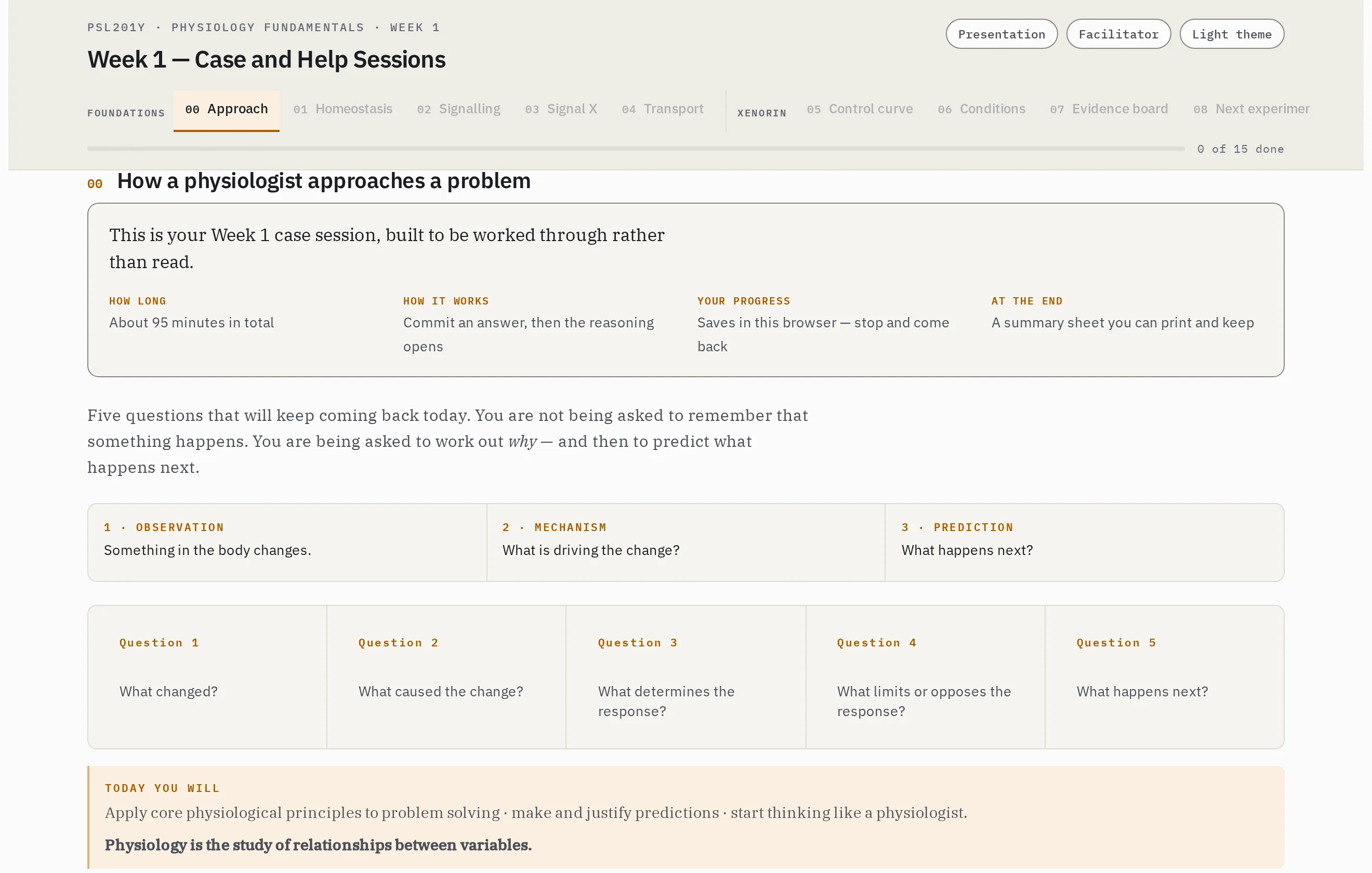
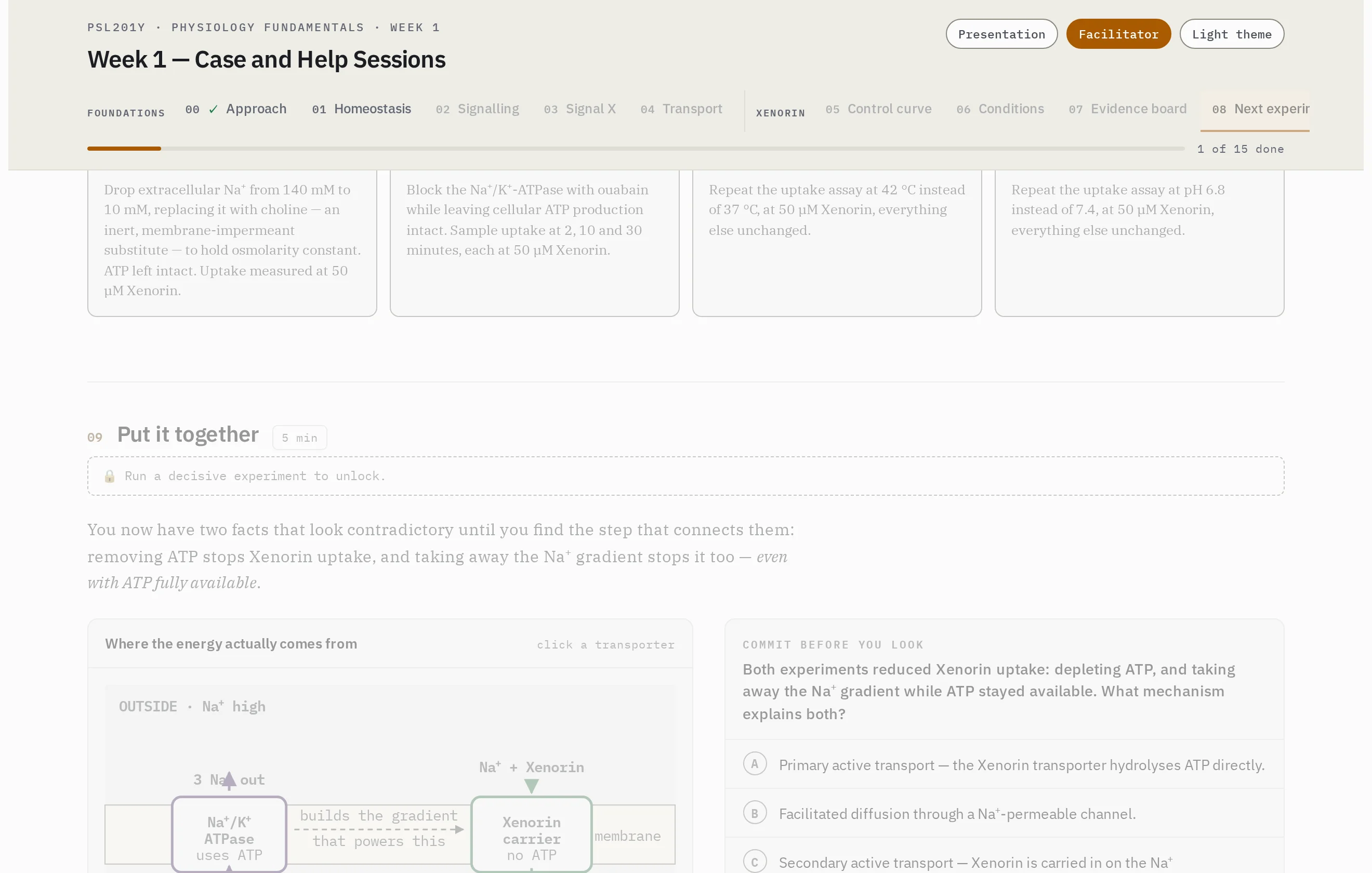
A Week 1 case and help session for a second-year university physiology course, rebuilt from the course director’s existing lecture deck into a session students work through rather than watch. Fifteen stages run across five parts and take about ninety-five minutes. Twelve of them ask the student to commit to an answer before any explanation opens. The session ends in a summary sheet the student can print and keep, and the same page carries a facilitator view with teaching notes and a presentation view for the lecture theatre.
Problem
The material already existed and was strong, but it was a slide deck. In that form a case is narrated: the lecturer poses a question, waits a moment, and supplies the answer, and the room follows along agreeing. Students leave believing they could have reached the same conclusion, and then cannot do it on an exam. The requirement was to convert a session that was delivered *to* students into one that cannot proceed until each student has committed to a position of their own.
Audience
Second-year undergraduates meeting physiological reasoning for the first time, working either in a help session or alone afterwards — and the instructor running it, who needs the same artefact to work on a projector and to carry notes only they can see.
My role
- Instructional design — converting a lecture deck into a staged session with a defined reasoning method
- Learning design — the commit-then-reveal structure, the stage gating, and what each stage is allowed to assume
- Content design — rewriting the cases so each one turns on a decision rather than a recall
- Interaction and visual design — the interface, the data displays and the three viewing modes
- Accessibility — every chart readable as a table, every state carrying a word as well as a colour
Goals
What the design set out to achieve. These are objectives, not results.
- Make the student state a position before the explanation is available to them
- Keep the subject expert’s content and sequence intact — this was a change of form, not of substance
- Give the instructor one artefact for the projector, the help session and the student working alone
- Let a student stop partway through and come back without losing their reasoning
- End on something the student keeps, rather than on a completion message
How it works
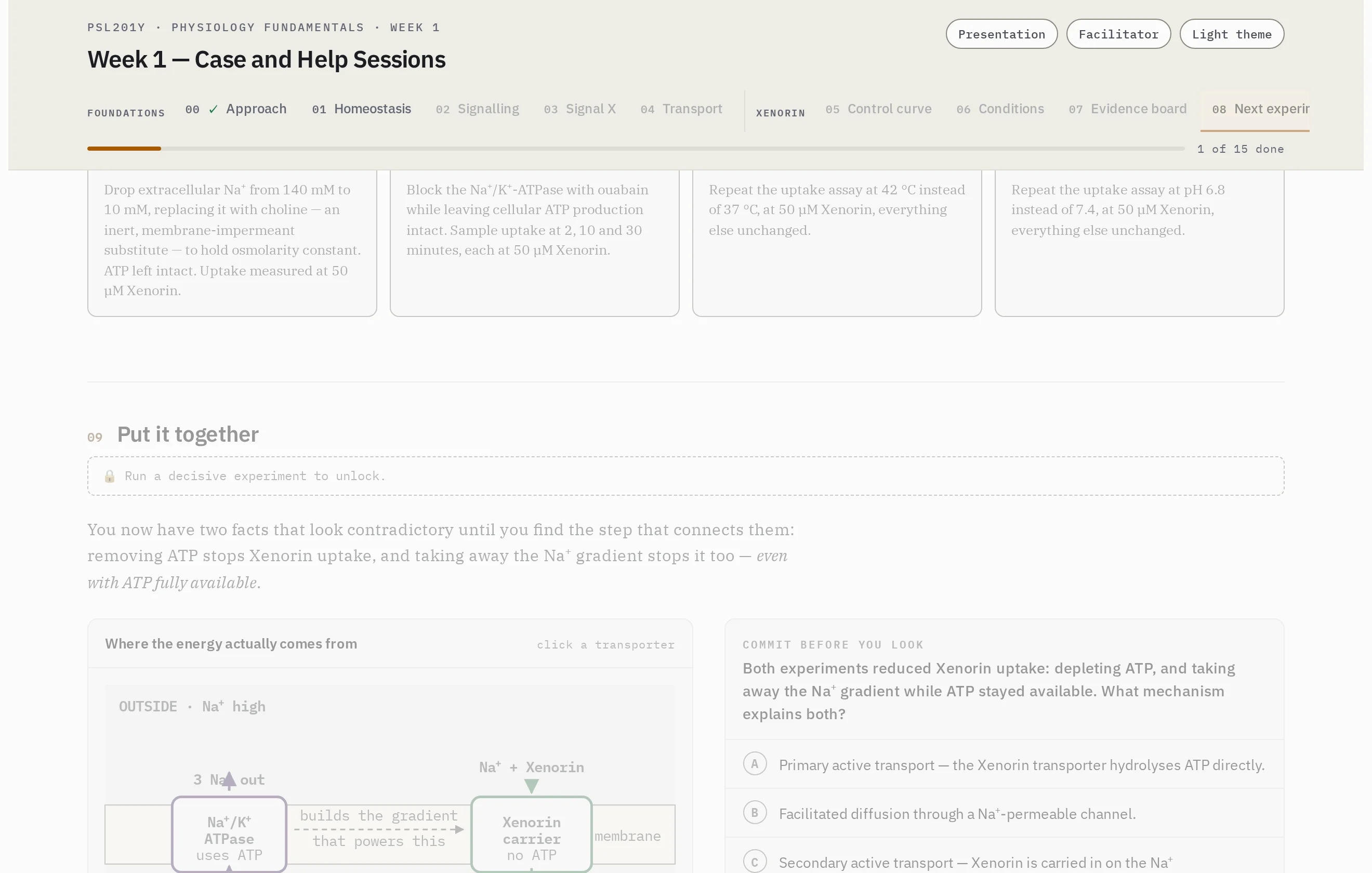
One page holds the whole session. Stages unlock in order, so a student cannot read ahead to the explanation before committing — the gating is the pedagogy, not a restriction. Progress is held in the student’s own browser: nothing is submitted, nothing is scored, and nothing is reported to the course. The same page switches between a student view, a presentation view sized for a lecture theatre, and a facilitator view that adds teaching notes without a second document to keep in step.
Design decisions
Commit before the reasoning opens
Twelve of the fifteen stages hold the explanation closed until the student has chosen an answer. This is the whole design. A student who has publicly committed to "Cell B is producing Signal X itself" reads the correction differently from one who was told the answer first — and remembers it differently.
Five questions that keep returning
The session opens by naming the method rather than the content: what changed, what caused it, what determines the response, what limits it, what happens next. Every case afterwards is worked with those same five questions, so students leave with a procedure they can apply to a case they have never seen.
Real data, not illustrations
The cases use dose-response curves and uptake assays the student reads and interprets. Each chart is also available as a table, because a student who cannot read the chart is not a student who cannot read the physiology.
One artefact, three readings
Rather than a student handout, a lecturer deck and a facilitator guide that drift apart after the first revision, there is one page with three views. A change to a case is made once and is correct in all three.
AI’s role
Drafting and iteration speed. The reasoning structure, the decision about what each stage may assume, and every judgement about what a second-year student can be expected to work out unaided were mine, made against the course director’s material.
Human judgment
The subject expertise was the client’s and the content was already correct — my judgement was about form. Which moments are genuinely decision points and which only look like them; where a student will guess rather than reason and how to close that off; how long ninety-five minutes actually is when every stage asks for a commitment. The hardest call was restraint: a case that has been made interactive everywhere stops being a case and becomes a quiz.
Experience
Open, and linked in full
A complete part of this work is published free and open. The link below opens the real thing — not a demo — so the design can be judged rather than taken on description.
https://resources.mamtamotwani.org/work/physiology-week1/
Challenges
Converting a narrated case without losing the narration. A lecturer builds tension across a case — here is a result, here is a second result that contradicts it, now what? That tension is easy to destroy by fragmenting the material into exercises. The structure had to preserve the arc while making the student the one who resolves it.
Iteration
Two earlier builds treated the case and the underlying principle as separate pages. Both failed the same way: students met the principle with no reason to care about it, then met the case with the principle already forgotten. The published version interleaves them — the principle arrives at the moment the case requires it.
Reflection
This is the clearest evidence I have that the design method transfers. The subject is undergraduate physiology, not primary curriculum; the content came from someone else’s expertise; and the same structure held — commit first, open the reasoning second, end on something the learner keeps. It also settled a question for me about working with subject experts: the most useful thing I contributed was not content, it was the decision about where a learner is made to think.
Skills demonstrated
- Instructional design for post-secondary
- Case-based and problem-based learning
- Working from a subject expert’s material
- Interaction design
- Data display and interpretation
- Accessible interface design